

Discover how a booking and travel chatbot simplifies reservations, automates travel support, personalizes itineraries, and improves customer engagement with AI-powered automation.
Introduction
The travel industry has changed significantly as customers increasingly expect convenient booking experiences, instant answers, flexible reservations, and personalized recommendations. Travelers want to compare options, check availability, understand cancellation policies, receive booking confirmations, and manage itinerary changes without waiting for a customer service representative. Travel agencies, hotels, airlines, tour operators, and online booking platforms must meet these expectations while managing high inquiry volumes, seasonal demand, and increasingly complex customer journeys.
A Booking & Travel Chatbot helps businesses meet these expectations by providing automated assistance throughout the travel planning and reservation process. Depending on its integrations and capabilities, a chatbot can answer common questions, collect booking preferences, recommend suitable options, connect customers with reservation systems, send confirmations, and provide post-booking support. More advanced solutions use artificial intelligence (AI), natural language processing (NLP), and structured workflows to understand customer requests and guide travelers toward appropriate next steps.
For businesses seeking to modernize their digital customer experience, a chatbot can become an important part of their booking infrastructure. It can reduce repetitive support work, make information easier to access, and help customers move from initial research to completed reservations with fewer unnecessary steps. However, success depends on more than installing a conversational interface. Businesses must connect accurate information sources, protect personal data, define clear booking workflows, and provide human assistance when a request requires judgment or special handling.
With a practical implementation strategy, Engagerbot can help businesses explore how conversational automation supports booking and travel operations. This guide explains the technology, business applications, essential features, implementation process, security considerations, performance measurement, and best practices needed to build a useful and trustworthy travel chatbot.
What Is a Booking & Travel Chatbot?
A booking and travel chatbot is a digital assistant that communicates with travelers through a website, messaging platform, mobile application, or another supported digital channel. Its primary purpose is to help customers find information, explore travel options, complete reservation-related tasks, and receive assistance before, during, and after a trip. Unlike a conventional contact form, which requires customers to submit information and wait for a response, a chatbot can guide users through a conversation and adapt its next question to the information already provided.
For example, a traveler visiting a tour operator’s website might ask, “Can you recommend a three-day trip for two adults?” The chatbot could ask about the destination, preferred travel dates, approximate budget, accommodation requirements, and desired activities. If connected to reliable inventory and pricing systems, it could retrieve suitable packages and present available options. If those integrations are unavailable, it should clearly explain that it can collect the traveler’s preferences and direct them to the appropriate booking page rather than pretending to confirm availability. This distinction is essential because customers must be able to trust the information presented during the reservation process.
Modern travel chatbots range from simple rule-based assistants to AI-powered conversational systems. Rule-based chatbots follow predefined decision paths, making them suitable for frequently asked questions, booking instructions, and straightforward customer service workflows. AI-powered assistants can interpret a broader range of natural-language requests, identify user intent, and handle more varied conversations. Hybrid systems combine the predictability of structured workflows with the flexibility of AI. Businesses should select an approach based on their booking complexity, available technology, customer expectations, and operational resources rather than assuming that the most sophisticated AI system is always the best choice.
A well-designed chatbot is not simply a replacement for a travel agent or customer support employee. It is a tool that helps travelers complete routine tasks efficiently while allowing human staff to concentrate on complex itineraries, unusual requests, complaints, and high-value customer relationships. When designed around real customer needs, it can make travel information more accessible and create a more consistent digital experience.
Why the Travel Industry Needs Conversational Booking Automation
Travel decisions often involve multiple stages, including destination research, price comparison, date selection, accommodation planning, transportation arrangements, and final reservation confirmation. Customers may move between several websites before making a decision, and even a small amount of missing information can cause confusion or abandonment. A traveler might need clarification about baggage allowances, hotel check-in times, visa requirements, airport transfers, or cancellation conditions before feeling comfortable completing a purchase. Conversational automation gives businesses a way to address these questions within the customer journey instead of forcing visitors to search through disconnected pages.
Travel companies also experience unpredictable fluctuations in demand. Holiday periods, major events, seasonal destinations, flight disruptions, and promotional campaigns can produce sudden increases in customer inquiries. A small team may struggle to respond promptly when dozens or hundreds of travelers ask similar questions at the same time. A chatbot can handle multiple routine conversations simultaneously, provide consistent answers from approved information sources, and collect the details required for follow-up. This does not eliminate the need for staff, but it can help businesses manage customer communication more efficiently and prioritize requests that genuinely require human intervention.
Another reason conversational automation matters is that modern travelers expect convenient digital interactions across devices and time zones. Someone researching a holiday late at night may want immediate information even when the travel agency’s office is closed. A chatbot can make approved travel information and basic booking guidance available outside normal business hours. However, 24-hour conversation availability does not automatically mean 24-hour reservation availability. Live inventory checks, payment processing, ticket issuance, and changes to existing reservations depend on the connected systems and the business’s operational arrangements.
The strongest business case emerges when automation solves a specific, measurable problem. A company receiving large numbers of repetitive questions may benefit from an FAQ-focused assistant. A tour operator losing potential customers because its inquiry form is difficult to complete may benefit from guided lead qualification. An established booking platform may need deeper integrations that support live availability and reservation management. Identifying the actual bottleneck before choosing technology prevents businesses from investing in features that look impressive but do not improve customer outcomes.
How a Travel Chatbot Works: From Customer Question to Booking
A travel chatbot typically begins by receiving a customer’s message through a website chat window, messaging application, or integrated customer support channel. It then interprets the request using predefined rules, natural-language processing, or an AI model. The system attempts to identify the customer’s intent, such as searching for accommodation, finding a tour, checking a booking policy, or changing an existing reservation. It may also extract relevant details, including dates, destination, number of travelers, budget, and preferred amenities. If the request is incomplete, the chatbot asks a follow-up question rather than making unsupported assumptions.
After identifying the request, the chatbot determines what information or action is needed. For a general question, it may retrieve an answer from an approved knowledge base containing current policies, destination information, and booking instructions. For a live reservation search, it may query an integrated inventory or booking application programming interface (API). For a customer requesting a reservation change, it may need to authenticate the user, retrieve the existing booking, verify the applicable rules, and submit the requested change to the relevant system. Each action requires appropriate permissions and reliable data access; a conversational AI model alone cannot guarantee that a reservation has been created or updated.
The final stage involves communicating the result and guiding the customer toward the next step. The chatbot might present suitable options, summarize the selected itinerary, display the applicable price, and direct the traveler to a secure checkout process. Once the booking system confirms a successful transaction, the assistant can share the confirmation details and explain how to access the itinerary. If the inventory service fails, the price changes, or the requested action cannot be completed, the chatbot should disclose the limitation and offer an alternative, such as refreshing availability or transferring the conversation to a staff member.
A reliable architecture separates conversational understanding from business-critical operations. The AI component can interpret requests and formulate explanations, while validated application workflows handle availability, prices, payment status, and reservation records. Businesses should also record important actions, monitor failed requests, and test unusual scenarios before launch. This approach reduces the risk of fabricated booking confirmations, incorrect travel details, and misleading promises. The objective is not merely to produce natural-sounding responses; it is to ensure that the entire conversation leads to accurate, verifiable outcomes.
Essential Features of an Effective Booking & Travel Chatbot

An effective booking chatbot begins with a clear set of practical features. Frequently asked question handling is a useful starting point because travelers commonly need information about reservation procedures, payment methods, cancellation conditions, luggage restrictions, accommodation policies, check-in requirements, and available customer support. The assistant should retrieve these answers from maintained, approved sources and provide links to the relevant policy or booking page when further details are necessary. Information should be reviewed regularly because a policy that was accurate several months ago may no longer apply.
The next essential feature is guided travel discovery. Instead of displaying a long list of generic packages, the chatbot can ask travelers about their destination, travel dates, group size, budget, interests, accommodation preferences, and accessibility requirements. It can then narrow the available choices based on those preferences. If connected to suitable inventory, the system may show real-time availability and current prices. If it is not connected to live inventory, it should label recommendations appropriately and direct users to a reliable source for confirmation. Filters, comparison summaries, and clear next steps make the experience more useful than an assistant that simply generates broad travel suggestions.
Booking support is another important capability. Depending on the integration, a chatbot may help users begin a reservation, collect the information needed for a quote, explain payment options, retrieve a booking reference, or guide customers through changes and cancellations. It should distinguish between actions it can perform directly and tasks that require a separate booking engine or a human employee. Customers should receive clear confirmation only after the underlying system verifies that the action succeeded. For transactions involving money, the chatbot should use secure payment workflows rather than asking customers to disclose full payment credentials in an ordinary chat conversation.
Additional features can improve the overall customer experience. Multilingual support can help international travelers, while itinerary summaries can make complex travel arrangements easier to review. Automated notifications can communicate booking confirmations, reminders, schedule changes, and relevant travel instructions when the business has permission to send them. Human handoff allows customers to reach an employee when their needs exceed the chatbot’s capabilities. Analytics can reveal common questions, abandoned booking journeys, and recurring problems. Businesses should introduce these features according to customer demand and operational readiness, ensuring that reliability, accessibility, and data protection remain more important than the total number of features offered.
Benefits of Booking Chatbots for Travel Agencies, Hotels, Airlines, and Tour Operators
For travel agencies, a chatbot can improve the process of converting website visitors into qualified inquiries. Rather than asking every potential customer to complete a lengthy form, the assistant can collect travel preferences conversationally and identify the most suitable next step. An agent might receive a summary containing the destination, preferred dates, approximate budget, traveler count, and special requests. This can reduce repetitive information gathering and help staff prepare more relevant recommendations. Agencies can also use the chatbot to answer routine questions about package inclusions, travel documentation, booking procedures, and consultation appointments, provided the information is accurate and appropriately maintained.
Hotels can use conversational assistants to answer questions about room types, amenities, check-in procedures, parking, dining options, pet policies, and local attractions. When connected to the hotel’s reservation system, a chatbot may help guests explore room availability, compare options, and begin or complete a booking. Before arrival, it can communicate practical information and explain how to request services. During a stay, it may route housekeeping requests or provide information about facilities. After departure, it can share feedback opportunities or direct guests to the relevant customer support team. The exact capabilities depend on the hotel’s property management system, service workflows, and integration permissions.
Airlines and transportation providers face different challenges, including complex itineraries, schedule changes, baggage rules, ticket conditions, and disruptions. A chatbot can help travelers find approved information about check-in, luggage allowances, fare rules, and airport procedures. With suitable integrations and identity verification, it may also retrieve itinerary information or guide customers through eligible changes. However, disruption handling requires particular care. When a flight is canceled or a major delay occurs, customers need current information and practical options, not a generic response. The assistant should rely on official operational data and provide clear escalation routes when rebooking, refunds, or exceptional circumstances require specialist assistance.
Tour operators and activity providers can benefit from automated qualification and reservation support. A chatbot can ask about activity dates, group size, fitness requirements, preferred experiences, equipment needs, and accessibility considerations. It can explain what is included in a tour, identify relevant restrictions, and direct customers to appropriate packages. For businesses selling time-sensitive activities, live capacity and scheduling integrations can help prevent customers from relying on outdated availability information. Across all these business types, the principal benefits are reduced repetitive workload, more accessible customer support, better-structured inquiries, and a smoother booking journey. Actual improvements should be measured using business data rather than assumed from chatbot installation alone.
Personalization, AI, and Better Travel Recommendations
Travelers rarely make decisions based on a destination name alone. Their choices may depend on budget, trip length, preferred activities, travel companions, mobility needs, accommodation standards, weather expectations, and previous experiences. A personalized booking chatbot can gather these preferences through a sequence of relevant questions and use them to narrow the available choices. For example, a family planning a short holiday may value family-friendly accommodation, convenient transportation, and activities suitable for children. A business traveler may prioritize proximity to a meeting venue, flexible check-in arrangements, and reliable transportation. Personalization helps the assistant focus on what matters to the traveler instead of presenting the same options to everyone.
AI can improve this process by interpreting flexible natural-language requests. A customer might say, “I want a quiet beach holiday in November, but I do not want to spend too much on transportation.” An AI-powered assistant can identify the destination type, approximate timing, and cost sensitivity, then ask clarifying questions before retrieving relevant options. It can summarize differences between packages, explain what is included, and help customers compare trade-offs. Nevertheless, recommendations should be grounded in verified inventory, approved destination information, and transparent selection criteria. The chatbot should not invent hotel amenities, guarantee weather conditions, or claim that a destination meets a traveler’s requirements without sufficient evidence.
Personalization also raises privacy and fairness considerations. Businesses should collect only the information needed for the requested service and explain how it will be used. Sensitive details should not be requested merely because they could make a conversation more personalized. When accessibility requirements are relevant, the chatbot should communicate verified information and encourage confirmation with the provider when details are uncertain. Similarly, recommendation logic should avoid presenting sponsored or commercially preferred options as objectively best without appropriate disclosure. Travelers should be able to correct their preferences, revise their search, and choose from alternatives rather than being pushed toward a single recommendation.
A practical personalization strategy starts with a small number of meaningful preferences and improves over time using consented, appropriately managed data. Businesses can test whether tailored recommendations improve booking completion, reduce the number of follow-up questions, or increase customer satisfaction. They should also review whether the recommendations remain accurate across different traveler groups and booking scenarios. AI becomes valuable when it helps customers make informed decisions, not when it adds complexity or creates the appearance of personalization without improving relevance.
Integrating a Travel Chatbot With Booking Systems and Business Tools
A chatbot becomes significantly more useful when it can exchange information with the systems that manage the travel business. Depending on the organization, these may include a booking engine, property management system, customer relationship management (CRM) platform, global distribution system, payment gateway, inventory database, email service, or customer support application. Integrations allow the assistant to retrieve information from the appropriate source instead of relying exclusively on static answers. They can also support workflows such as creating a customer inquiry, checking availability, retrieving an eligible reservation, or sending a verified confirmation.
The integration process should begin by mapping the customer journey and identifying the system responsible for each important piece of information. Room availability, for example, should come from the relevant reservation or inventory platform rather than a manually maintained chatbot response. Payment status should be verified through the payment or booking system. Customer identity should be established using an appropriate authentication method before protected booking information is disclosed. Businesses can use documented APIs, approved connectors, or middleware to connect these services. Technical teams should review authentication requirements, rate limits, error responses, data formats, and service availability before making an integration available to customers.
Reliability is particularly important when a conversation triggers a transaction. Suppose a traveler submits a reservation request but the booking system takes several seconds to respond. The chatbot must not assume that the request failed and automatically submit a duplicate. The workflow should check transaction status, handle retries safely, and use idempotency controls where supported. Similarly, if an inventory response becomes outdated before checkout, the customer should be shown the updated price or availability and asked to confirm any material change. These controls protect customers and reduce avoidable disputes, duplicate reservations, and operational confusion.
Businesses should also plan for failures and future maintenance. Integrations need monitoring, documented ownership, controlled access, and a process for updating API credentials or adapting to changes in connected systems. Test environments can help teams validate booking flows before exposing them to real customers. Where a direct integration is not feasible, the chatbot can still provide value by answering questions, collecting inquiries, and linking to the official booking interface. A staged implementation often works better than attempting to automate every process at once: start with reliable information and straightforward workflows, validate the results, and add transactional capabilities when the supporting systems are ready.
Travel Chatbots for Customer Support Before, During, and After a Trip
Customer support in the travel industry extends far beyond the initial reservation. Travelers may have questions while comparing packages, need assistance after payment, require updated information before departure, or encounter unexpected problems during a trip. A booking and travel chatbot can support these different stages by making relevant information easier to access and directing customers toward appropriate solutions. A well-planned support journey should account for the entire customer lifecycle instead of focusing exclusively on the moment a reservation is completed.
Before a trip, the chatbot can explain booking requirements, summarize package inclusions, provide preparation checklists, and answer common questions about check-in, baggage, accommodation policies, and transportation. Following a confirmed reservation, it can help customers locate their itinerary, understand the next steps, and review important travel instructions. Where the business has permission to send notifications, automated reminders can help travelers remember departure dates, check-in deadlines, or scheduled activities. Information about visas, entry requirements, health regulations, and other official travel requirements should come from appropriate authoritative sources, such as government travel advisories, and should be presented with clear guidance to verify the latest requirements.
During a trip, customers may need help finding their transfer arrangements, understanding a tour schedule, locating an accommodation contact, or reporting a service problem. A chatbot can provide approved information and route requests to the relevant team. If a traveler reports a missed connection, canceled service, safety concern, or urgent accommodation issue, the assistant should recognize that a routine automated response may be insufficient. It should provide an appropriate escalation route, communicate known facts accurately, and avoid promising compensation, alternative transportation, or other remedies unless the responsible system or authorized employee confirms them.
After a trip, the chatbot can collect feedback, answer questions about receipts, explain the process for submitting a complaint, and direct eligible customers toward the correct refund or support workflow. Businesses can analyze recurring feedback to identify problems involving unclear package descriptions, booking errors, delayed communication, or service quality. This information can inform operational improvements and future chatbot updates. The important principle is that automation should improve continuity across the customer journey while preserving human assistance for situations involving uncertainty, emotional distress, significant financial consequences, or complex exceptions.
Booking Chatbot Security, Privacy, and Customer Trust
Travel reservations can involve personal information such as names, contact details, travel dates, booking references, passport information, and payment-related records. This makes privacy and security essential components of chatbot implementation. Businesses should determine which information is genuinely necessary for each workflow, limit collection to that purpose, and establish appropriate retention rules. A chatbot that answers general questions does not need to collect a passport number or payment details simply to recommend a destination. Reducing unnecessary data collection lowers exposure and makes the experience more straightforward for customers.
Technical safeguards should be designed around the systems and information the chatbot can access. These may include encrypted communications, controlled permissions, secure authentication, access logging, rate limiting, and appropriate protection for stored records. Employees and automated components should receive only the access needed to perform their assigned tasks. Sensitive booking details should not be displayed to an unauthenticated visitor merely because that person provides a reservation reference. Businesses should also review their providers’ data-handling practices, subprocessors, retention arrangements, and contractual responsibilities before connecting a chatbot to customer systems.
Official guidance can help technical teams establish a more reliable security foundation. The NIST Cybersecurity Framework provides a structured approach to managing cybersecurity risks, while the OWASP Top 10 identifies important web application security risks. Organizations should also consult the Google Search Essentials when maintaining the discoverability and technical quality of their websites. These resources serve different purposes: security frameworks support risk management, application security guidance helps developers identify vulnerabilities, and Google’s search documentation explains website-related search requirements. None should be treated as a substitute for a business-specific security assessment.
AI introduces additional risks that require attention. A chatbot may misunderstand a request, produce an inaccurate answer, or be influenced by malicious instructions supplied within a conversation or retrieved content. Businesses should restrict which actions the AI can initiate, validate transaction inputs, and keep payment processing and reservation changes within controlled workflows. They should also test whether the assistant reveals confidential information, follows unauthorized instructions, or misrepresents its capabilities. A clear privacy notice, transparent AI disclosure where appropriate, and a dependable human support option help establish trust. Customers should understand what the chatbot can do, what information it collects, and how to request assistance when automated support is not enough.
How to Implement a Booking & Travel Chatbot Step by Step
Successful implementation begins with a clearly defined business objective. Before selecting a platform, a travel company should identify the problem it wants to solve. Examples include reducing repetitive booking inquiries, improving the quality of sales leads, helping customers navigate an existing reservation system, or making approved travel information available outside business hours. The team should review actual customer questions, support records, website analytics, and booking abandonment patterns to determine which tasks would benefit most from automation. This initial research helps prevent unnecessary complexity and provides a baseline against which the project can be evaluated.
The second step is designing the conversation and selecting the appropriate technology. The business should map common customer journeys, including the information needed, decisions customers must make, and situations that require escalation. It can then decide whether a rule-based chatbot, an AI-powered assistant, or a hybrid model is most suitable. A website-focused assistant may begin with a maintained knowledge base and links to existing reservation pages. A business requiring live inventory, personalized availability, and reservation changes will need more extensive integrations. The implementation team should document the required systems, data permissions, error-handling behavior, and customer verification procedures before development begins.
The third step is building, integrating, and testing the solution. The chatbot should be configured with approved answers, clear conversational prompts, and a defined scope of responsibility. If live booking capabilities are required, developers should connect the appropriate APIs and validate that availability, prices, booking status, and customer records are retrieved correctly. Testing should include ordinary requests, incomplete information, ambiguous dates, invalid booking references, expired sessions, unavailable inventory, integration outages, and repeated transaction attempts. Human handoff should be tested as carefully as automated responses. Staff must know how to receive escalated conversations and continue helping the customer without asking them to repeat information unnecessarily.
The final step is launching gradually and improving the experience using measurable results. A pilot can begin with frequently asked questions or a limited set of booking workflows before the company expands into more complex tasks. The team should monitor response accuracy, successful task completion, customer feedback, escalation rates, and booking conversion. Problems should be categorized by their cause, such as missing knowledge, confusing wording, outdated inventory, or technical integration failures. Regular reviews help the business improve the system without making uncontrolled changes. For further guidance on website quality, consult Google’s Search Central documentation. Although a chatbot can support the website experience, it does not automatically improve search rankings; the wider site must still provide useful content, accessible navigation, sound technical foundations, and a trustworthy user experience.
Measuring Chatbot Performance, Booking Conversions, and Return on Investment
A travel chatbot should be evaluated according to the outcomes it produces rather than the number of conversations it handles. High conversation volume may indicate strong customer interest, but it does not prove that travelers are receiving accurate answers or completing their reservations successfully. Businesses should establish measurable objectives before launch and compare results against an appropriate baseline. For a travel agency, the main goal might be generating qualified inquiries. For a hotel, it could be increasing direct booking completion. For a tour operator, it may involve reducing the time required to answer availability questions or helping customers find suitable experiences.
Useful metrics include task completion rate, booking conversion rate, lead qualification rate, customer satisfaction, average response time, escalation rate, and the percentage of answers that require correction. Each metric needs a clear definition. For example, booking conversion should distinguish between customers who start a booking and those whose reservations are confirmed by the underlying booking system. Similarly, an escalation is not necessarily a failure: transferring a complicated request to a trained employee may be the correct outcome. Metrics should therefore be interpreted in context rather than optimized in isolation.
Financial analysis should consider both the benefits and the ongoing costs of automation. Potential benefits include reduced time spent answering repetitive questions, fewer avoidable support interactions, improved lead qualification, and additional completed bookings attributable to the chatbot. Costs may include platform subscriptions, integration development, AI usage, maintenance, security reviews, staff training, and ongoing content management. A basic return-on-investment calculation is:
\[ \text{ROI}=\frac{\text{Financial Benefits}-\text{Total Costs}}{\text{Total Costs}}\times100\% \]
The calculation is only as reliable as its assumptions. Businesses should avoid counting every chatbot-assisted booking as an incremental sale, because some customers might have completed the reservation without the assistant. Where possible, controlled experiments or suitable comparison periods can help estimate the chatbot’s actual contribution. Teams should also distinguish measurable financial benefits from less direct improvements, such as customer convenience or better access to information.
Continuous optimization should focus on specific patterns revealed by the data. If customers repeatedly abandon a booking workflow after viewing the price, the business may need to clarify taxes, fees, package inclusions, or payment terms. If the chatbot frequently transfers questions about cancellation policies, its approved knowledge base may be incomplete. If users receive outdated availability information, the problem may lie in the inventory integration rather than the conversation design. Reviewing transcripts under appropriate privacy controls, testing revised workflows, and tracking outcomes over time creates a practical improvement cycle. The objective is to make the booking experience more accurate, efficient, and useful while maintaining responsible operational and financial oversight.
Common Mistakes to Avoid When Building a Booking & Travel Chatbot
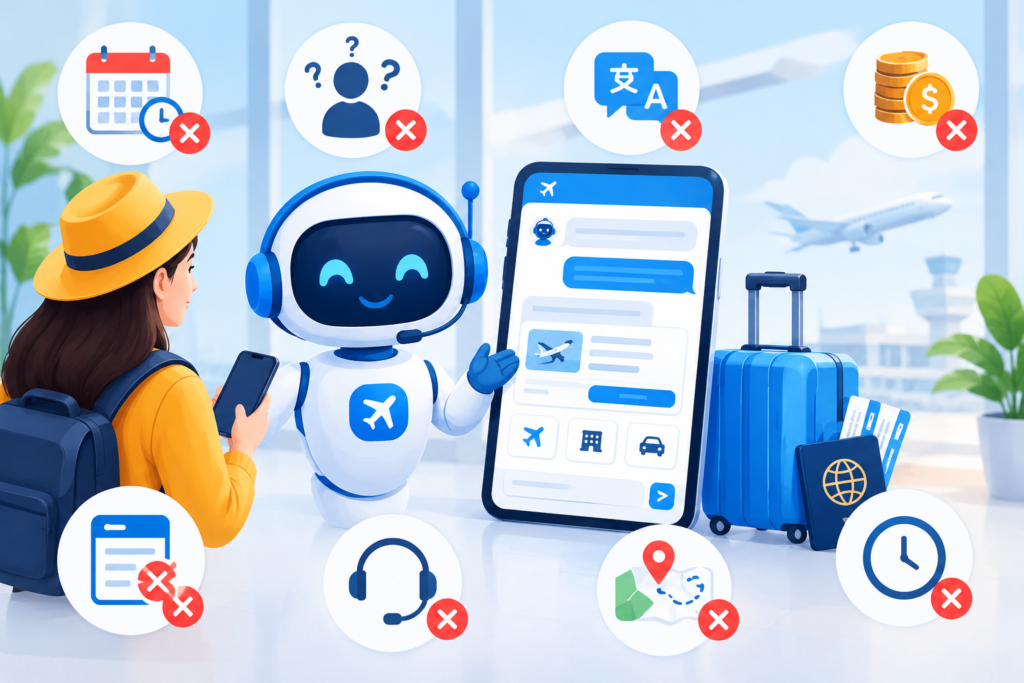
One common mistake is launching a chatbot without defining its responsibilities. Businesses sometimes expect a general AI assistant to manage every stage of travel planning, reservations, payments, cancellations, and complaints immediately. Without clear boundaries, the assistant may give vague answers, make unsupported claims, or direct customers through workflows that do not exist. A better approach is to identify a limited set of high-value use cases, document what the chatbot can and cannot do, and expand its responsibilities only after the supporting processes have been tested.
Another serious mistake is relying on outdated or unverified information. Travel prices, availability, cancellation conditions, schedules, and entry requirements can change. If the chatbot relies on old website content or static documents for time-sensitive facts, customers may receive misleading guidance. Businesses should assign ownership of the knowledge base, review high-impact information regularly, and connect live data sources where necessary. The assistant should distinguish between general information and information verified for a particular reservation. When a fact cannot be confirmed, it should say so rather than generate a confident but unsupported answer.
Poor conversation design is another frequent problem. Long opening messages, excessive questions, confusing options, and repetitive prompts can make customers abandon the interaction. A chatbot should collect information progressively, ask only relevant follow-up questions, preserve context where appropriate, and allow customers to correct earlier answers. It should also recognize when the customer is asking a different question and avoid forcing every conversation into a predetermined booking path. A useful assistant feels like a clear guide rather than an obstacle between the customer and the reservation.
Finally, some businesses neglect integration reliability, privacy, and ongoing maintenance. A chatbot that appears to complete a reservation without receiving confirmation from the booking system can create serious customer disputes. Inadequate access controls may expose confidential information, while missing escalation procedures can leave travelers without help during disruptions. Businesses should test failure scenarios, monitor system performance, provide a visible route to human assistance, and regularly review security and content accuracy. They should also avoid judging success solely by conversation counts or assuming that AI-generated recommendations are automatically personalized or correct. A disciplined implementation process helps prevent these mistakes and creates a foundation for sustainable improvements.
Best Practices Summary for a Successful Booking & Travel Chatbot
The most effective travel chatbot strategies begin with customer needs and measurable business objectives. Companies should identify the questions travelers ask most frequently, the stages where reservations become difficult, and the information customers need before making a decision. They should prioritize improvements that reduce friction without adding unnecessary steps. A chatbot designed around a real customer problem is more likely to deliver value than one built primarily to showcase advanced AI features.
Information quality should remain a central priority. Maintain a reliable knowledge base, assign responsibility for updates, and ensure that prices, availability, and reservation status come from the appropriate systems. Use conversational AI to understand questions and explain verified information, while keeping important transactions within controlled business workflows. Where the chatbot cannot verify a detail, it should communicate the uncertainty clearly and guide the customer toward an authoritative source or an appropriate employee.
Security, privacy, and accessibility should be incorporated from the beginning. Collect only the information necessary for the requested task, restrict access to protected booking records, and review the security of third-party integrations. Provide readable responses, straightforward navigation, and alternatives for customers who cannot or do not wish to use conversational support. Make the option to reach a human employee clear, particularly for complaints, exceptional circumstances, and requests with significant financial or personal consequences.
Continuous evaluation is equally important. Monitor task completion, confirmed booking outcomes, customer satisfaction, escalation quality, operational costs, and recurring failure patterns. Test meaningful changes before applying them widely, and train staff to work effectively with the chatbot rather than treating automation as a separate, unmanaged channel. Businesses should also keep the website itself useful, technically sound, and transparent. Following these practices helps create a travel assistant that supports customer decisions, improves operational efficiency, and develops trust through reliable performance rather than unrealistic promises.
Frequently Asked Questions
1. What is a booking and travel chatbot used for?
A booking and travel chatbot helps customers find travel information, compare suitable options, understand booking policies, and navigate reservation-related tasks. Depending on its capabilities and integrations, it may also retrieve live availability, collect booking details, send confirmed itinerary information, or support eligible changes to an existing reservation. Businesses use these assistants to handle routine inquiries, improve digital accessibility, and help travelers reach the appropriate service more efficiently. The exact functionality depends on the technology and connected systems.
2. Can a travel chatbot make real-time reservations?
Yes, provided the chatbot is connected to a booking platform that supports the required operations and the business has configured the appropriate permissions. The system must retrieve current availability, validate the selected option, communicate the correct price, and submit the reservation through a reliable transaction workflow. A chatbot that only answers questions or links to a booking page cannot independently guarantee a reservation. Customers should receive a confirmation only after the underlying booking system verifies that the transaction has succeeded.
3. How does AI improve a travel chatbot?
AI can help a chatbot interpret natural-language requests, identify customer preferences, ask relevant follow-up questions, summarize options, and respond to a broader range of questions than a simple rule-based system. It can make travel discovery more conversational and reduce the need for customers to navigate rigid menus. However, AI does not automatically provide accurate inventory, current prices, or verified travel rules. These facts must come from appropriate data sources, and important transactions require controlled workflows and validation.
4. Can a travel chatbot handle cancellations and booking changes?
A chatbot can assist with cancellations and changes when the connected reservation system supports those operations and the customer meets the relevant requirements. It should verify the booking, retrieve the applicable conditions, explain any fees or restrictions, and obtain confirmation before executing a consequential action. Some requests may require staff approval or specialist handling. If a change cannot be completed automatically, the chatbot should explain the limitation and provide a clear escalation route rather than suggesting that the reservation has already been modified.
5. Is a booking chatbot suitable for small travel agencies?
Yes. Small agencies can begin with a relatively simple chatbot that answers frequently asked questions, collects customer preferences, qualifies inquiries, and directs visitors to the appropriate booking or consultation page. This can reduce repetitive administrative work without requiring a complete replacement of existing business systems. More advanced capabilities, such as live availability or automated reservation management, can be added when the agency has suitable integrations and a clear business need. Starting small also makes it easier to measure results and control implementation costs.
6. How can businesses protect customer data in a travel chatbot?
Businesses should minimize data collection, use appropriate encryption and access controls, verify customers before displaying protected booking information, and establish clear retention policies. They should review third-party providers, document how data is processed, and avoid collecting payment credentials or sensitive travel documents through unsuitable chat workflows. Regular security testing and monitoring are also important. The exact controls should reflect the information being handled, applicable legal requirements, and the risks associated with the connected booking systems.
7. How do you measure whether a travel chatbot is successful?
Success can be measured through confirmed booking conversions, completed customer tasks, qualified leads, response accuracy, customer satisfaction, escalation outcomes, and the cost of supporting customers. The most useful metrics depend on the business objective. For example, a chatbot designed for lead generation should be evaluated partly on lead quality, while a reservation assistant should be measured against verified booking outcomes. Businesses should compare results with a baseline and consider whether the chatbot genuinely improves outcomes rather than merely increasing conversation volume.
8. How long does it take to implement a booking and travel chatbot?
The implementation timeline depends on the chatbot’s complexity, the quality of the existing knowledge base, the availability of APIs, security requirements, and the number of booking workflows involved. A basic website assistant may be introduced relatively quickly, while a system that manages live inventory, payments, authentication, cancellations, and multiple travel suppliers requires more planning and testing. Businesses should define requirements, validate integrations, test failure scenarios, and launch in stages. A realistic schedule should be based on the actual scope rather than a universal estimate.
Conclusion
A booking and travel chatbot can help businesses make travel planning more convenient by simplifying customer inquiries, supporting reservation workflows, personalizing recommendations, and providing timely information. From travel agencies and accommodation providers to airlines and tour operators, organizations can use conversational automation to reduce repetitive work and make their services easier to navigate. The greatest value comes when the assistant supports the entire customer journey, from the first travel question to post-booking assistance, while recognizing when human expertise is needed.
Implementing an effective chatbot requires careful planning, reliable information, appropriate integrations, clear security controls, and ongoing performance evaluation. Businesses should begin with practical use cases, validate every booking-related action, protect customer data, and measure success through real customer and operational outcomes. They should also avoid treating AI as a substitute for accurate information, sound business processes, or qualified support staff. A trustworthy chatbot communicates its limitations and helps customers reach the correct next step.
For businesses exploring conversational automation, Engagerbot offers a starting point for considering how chatbot technology can support customer communication and booking-related workflows. The long-term objective is not simply to automate conversations. It is to create a dependable digital experience that helps travelers make informed decisions, reduces avoidable friction, and supports sustainable business growth.
Want to Implement This Easily?
AI Implementation Prompt
You are an expert consultant. Based on the blog post titled “Booking & Travel Chatbot”, provide a step-by-step, practical implementation guide. Include tools, best practices, common mistakes to avoid, and advanced tips. Assume the reader wants to implement everything discussed in this article effectively.
Call to Action
Want our help implementing this? Just reach out to us via our website contact form: Contact us.