
Cleaning businesses face increasing pressure to respond faster, convert more leads, and deliver consistent customer experiences across websites, WhatsApp, and social media. A Cleaning Services Chatbot bridges this gap by automating inquiries, booking jobs, managing follow-ups, and supporting customers 24/7. This guide explains how AI chatbots transform residential and commercial cleaning companies while aligning with Google’s quality guidelines, automation best practices, and real-world service workflows.
INTRODUCTION
Engagerbot helps cleaning businesses modernize customer communication by deploying intelligent AI chatbots that handle bookings, pricing questions, service explanations, and lead qualification automatically. As customer expectations shift toward instant responses and seamless digital experiences, cleaning companies that adopt chatbot technology gain a clear operational and competitive advantage.
This comprehensive guide explores how cleaning service chatbots work, where they deliver the most value, and how businesses can implement them responsibly while following Google’s content quality, trust, and user experience standards.
What Is a Cleaning Services Chatbot and How Does It Work?
A Cleaning Services Chatbot is an AI-powered conversational system designed to automate communication between cleaning businesses and their customers across digital channels. Unlike basic contact forms or static FAQs, a chatbot interacts with users in real time, understands intent, and provides relevant responses based on predefined workflows and artificial intelligence logic.
At its core, a cleaning chatbot operates through Natural Language Processing (NLP), which allows it to interpret customer queries such as “How much does deep cleaning cost?” or “Can I book an office cleaning for tomorrow?”. Once the intent is identified, the chatbot responds instantly by pulling information from a knowledge base, pricing logic, or integrated scheduling tools. This creates a seamless experience where customers receive answers without waiting for a human agent.
From an operational standpoint, cleaning chatbots can be embedded on websites, WhatsApp, Facebook Messenger, and other messaging platforms, ensuring 24/7 availability. This is especially important for cleaning businesses, where inquiries often happen outside office hours. By automating repetitive conversations—like service descriptions, availability checks, and booking confirmations—chatbots free up staff to focus on service delivery and quality control.
Modern cleaning chatbots also integrate with CRM systems, calendars, and payment gateways, allowing businesses to manage leads, appointments, and follow-ups efficiently. This automation supports consistency and reduces human error, which aligns with Google’s expectations for helpful, accurate, and user-focused content experiences.
When implemented correctly, a cleaning services chatbot does not replace human staff—it enhances them. It acts as the first point of contact, qualifying leads, collecting essential details, and escalating complex requests to human agents when necessary. This balanced approach improves customer satisfaction while maintaining operational efficiency.
Why Cleaning Businesses Need AI Chatbots in 2025
The cleaning industry is becoming increasingly competitive, with customers expecting instant responses, transparent pricing, and frictionless booking experiences. In 2025, businesses that rely solely on phone calls and delayed email replies risk losing leads to faster, more digitally optimized competitors. This is where AI chatbots become essential rather than optional.
One of the primary reasons cleaning businesses need AI chatbots is speed. Studies consistently show that customers are more likely to convert when their inquiries are answered within minutes rather than hours. A chatbot ensures immediate engagement, capturing leads before they abandon the website or move to another provider. This directly impacts conversion rates and revenue growth.
Another critical factor is scalability. As cleaning companies expand—adding more locations, services, or service areas—the volume of inquiries increases. Hiring additional staff for customer support can be costly and inefficient. AI chatbots scale effortlessly, handling hundreds of simultaneous conversations without increasing overhead costs.
AI chatbots also support personalization at scale. By collecting user inputs such as location, property size, and service type, chatbots can tailor responses and recommendations. This personalized interaction builds trust and improves user experience, which aligns with Google’s emphasis on user satisfaction and relevance.
Additionally, chatbots contribute to data-driven decision-making. Every interaction generates valuable insights into customer behavior, common questions, and service demand patterns. Cleaning businesses can use this data to refine pricing, optimize service offerings, and improve marketing strategies.
In 2025, customer expectations are shaped by industries like eCommerce and SaaS, where automation and instant support are standard. Cleaning businesses that adopt AI chatbots position themselves as modern, reliable, and customer-centric—qualities that drive long-term growth and brand credibility.
Core Features of an Effective Cleaning Services Chatbot
An effective cleaning services chatbot is more than just an automated responder—it is a fully integrated digital assistant designed to support both customers and internal operations. The success of a chatbot depends on the features it offers and how well those features align with real cleaning business workflows.
One of the most important features is intelligent inquiry handling. The chatbot should understand common customer questions related to pricing, service types, coverage areas, and availability. Using NLP, it can provide accurate, context-aware answers that reduce friction and confusion during the decision-making process.
Another essential feature is automated booking and scheduling. Customers should be able to select services, choose dates, and confirm appointments directly within the chat interface. This reduces manual coordination and minimizes scheduling errors. When combined with calendar integration, this feature ensures real-time availability updates.
Lead capture and qualification are also critical. An effective chatbot collects structured data such as name, contact details, property size, and cleaning requirements. This information feeds into CRM systems, allowing businesses to prioritize high-intent leads and follow up strategically.
Additionally, cleaning chatbots should support multichannel deployment, enabling consistent communication across websites, messaging apps, and social platforms. This omnipresence ensures that customers can interact with the business on their preferred platform without losing continuity.
Security and compliance features are equally important. Chatbots must handle customer data responsibly, following privacy regulations and best practices. This builds trust and aligns with Google’s E-E-A-T principles, which emphasize trustworthiness and transparency.
When these core features work together, a cleaning services chatbot becomes a powerful growth tool—enhancing efficiency, improving customer experience, and supporting sustainable business expansion.
Automating Cleaning Appointments and Job Scheduling
Appointment scheduling is one of the most time-consuming tasks for cleaning businesses, especially when handled manually through phone calls and emails. Automating this process with a chatbot transforms scheduling into a fast, accurate, and customer-friendly experience.
A chatbot enables customers to book services instantly by guiding them through a structured conversation. Users can select service types, preferred dates, time slots, and special requirements without human intervention. This not only improves convenience but also reduces booking friction, which is a common reason for abandoned inquiries.
By integrating appointment scheduling automation, chatbots synchronize with internal calendars to display real-time availability and prevent double bookings. This ensures operational efficiency while maintaining service quality. Businesses can also configure rules for buffer times, service durations, and location-based availability.
Automation significantly reduces no-shows and last-minute cancellations. Chatbots can send automated reminders, confirmations, and rescheduling options via email or messaging apps. This proactive communication improves attendance rates and optimizes staff utilization.
From a business perspective, automated scheduling supports scalability. As inquiry volumes grow, the chatbot continues to manage bookings without additional staffing costs. This aligns with insights shared by platforms like Salesforce on appointment scheduling automation , which highlight efficiency gains through AI-driven workflows.
Moreover, automated scheduling enhances data accuracy. Customer preferences, booking history, and service frequency are stored systematically, enabling better forecasting and personalized service recommendations.
In summary, chatbot-driven scheduling is not just a convenience feature—it is a strategic tool that improves customer experience, reduces administrative workload, and supports long-term growth for cleaning businesses.
AI Chatbots for Instant Cleaning Quotes and Pricing Transparency
Pricing is one of the most common friction points in the cleaning industry. Customers want fast, clear, and fair estimates without waiting for callbacks or lengthy email exchanges. An AI-powered cleaning chatbot solves this challenge by delivering instant quotes based on structured inputs such as property size, service type, frequency, and special requirements.
Using predefined logic and <u>AI pricing models</u>, chatbots calculate estimates in real time while maintaining consistency across all customer interactions. This ensures that pricing remains transparent and aligned with business policies, reducing disputes and misunderstandings. According to IBM’s overview of AI pricing models, artificial intelligence enables scalable decision-making by applying consistent rules to complex data inputs, improving both accuracy and trust.
Another advantage of chatbot-based pricing is qualification before quotation. Instead of offering vague estimates, the chatbot gathers detailed information upfront. This leads to more accurate quotes and reduces the risk of underpricing services. Customers appreciate this clarity, as it sets realistic expectations from the beginning.
From an SEO and trust perspective, transparent pricing improves user satisfaction and engagement—signals that align with Google’s emphasis on helpful content. Businesses that clearly explain how pricing works tend to build stronger credibility and convert more leads.
By automating quotes, cleaning companies reduce staff workload while offering a faster, more professional experience. This balance between automation and clarity is essential for long-term growth.
Enhancing Customer Experience for Residential Cleaning Clients
Residential cleaning clients prioritize convenience, trust, and communication. A chatbot enhances customer experience by acting as a reliable digital assistant available 24/7. Homeowners can ask questions, book services, and receive updates without needing to speak to a representative.
Chatbots streamline the customer journey by providing step-by-step guidance through service selection and booking. This reduces confusion and improves satisfaction. According to HubSpot’s customer experience best practices, instant and personalized interactions significantly increase customer loyalty.
Personalization is another key benefit. A chatbot remembers preferences such as cleaning frequency or preferred time slots, allowing repeat customers to book services quickly. This creates a frictionless experience that encourages long-term relationships.
Chatbots also support proactive communication. Automated reminders, confirmations, and post-service follow-ups improve transparency and reliability. Customers feel informed and valued, which directly impacts reviews and referrals.
By focusing on ease, clarity, and responsiveness, cleaning businesses can elevate residential customer experience while maintaining operational efficiency.
Chatbots for Commercial and Office Cleaning Services
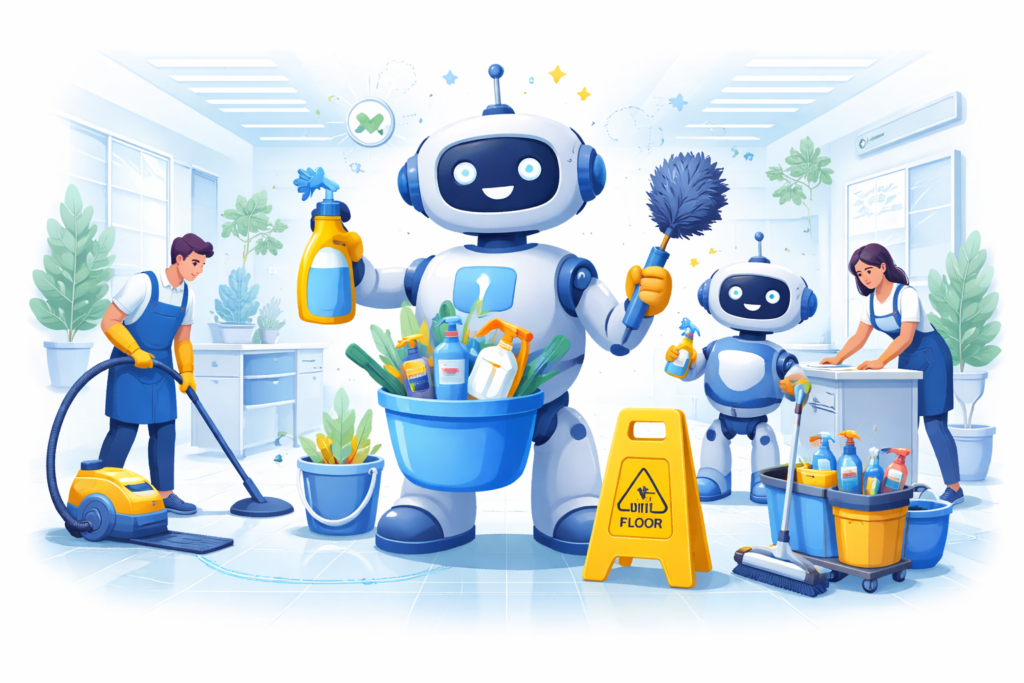
Commercial cleaning clients have more complex needs, including service-level agreements, compliance requirements, and customized schedules. AI chatbots support these requirements by handling structured B2B conversations efficiently.
A commercial cleaning chatbot can pre-qualify leads by gathering details such as facility size, industry type, and cleaning frequency. This ensures that sales teams receive high-quality inquiries rather than generic requests.
Chatbots also streamline proposal requests and follow-ups, reducing sales cycles. For facility managers, the ability to request services or updates instantly improves satisfaction and trust.
By automating repetitive B2B interactions, cleaning companies position themselves as professional and scalable partners—qualities essential in commercial markets.
Integrating Cleaning Chatbots with WhatsApp, Website, and Social Media
Modern customers interact across multiple platforms, making omnichannel communication essential. Chatbots enable consistent messaging across websites, WhatsApp, and social media channels.
According to Gartner’s insights on omnichannel customer engagement, businesses that maintain consistent communication across channels improve retention and satisfaction. For cleaning companies, this means capturing leads wherever customers are most active.
Integration ensures conversation continuity. A customer can start a chat on a website and continue on WhatsApp without repeating information. This seamless experience builds trust and professionalism.
AI Chatbots and Google’s E-E-A-T & Quality Guidelines
Google’s ranking systems increasingly prioritize E-E-A-T (Experience, Expertise, Authoritativeness, and Trustworthiness) when evaluating digital experiences—especially for service-based businesses. While E-E-A-T is often discussed in content marketing, it also applies directly to how users interact with your business, including chatbot-driven conversations.
A well-implemented cleaning services chatbot strengthens Experience by providing immediate, relevant answers based on real service workflows. Customers receive accurate information about pricing, availability, and service scope without confusion or delay. This aligns with Google’s expectation that businesses create genuinely helpful user experiences rather than shallow automation.
Expertise and Authoritativeness are reinforced when chatbot responses are consistent, professionally written, and aligned with verified business processes. Referencing established service standards and transparent policies ensures chatbot conversations reflect real-world operational knowledge. Google explicitly emphasizes this in its Google Search Quality Guidelines, which highlight the importance of accuracy, clarity, and user-first design.
Trustworthiness is further enhanced through visible transparency—clear pricing logic, service explanations, and easy escalation to human support. According to Google’s guidance on helpful content systems, user satisfaction and reliability signals matter more than keyword-heavy automation.
When chatbot experiences mirror Google’s quality expectations, they don’t just improve engagement—they reinforce brand credibility, improve dwell time, and support long-term SEO performance.
Reducing Operational Costs with Cleaning Service Automation
Operational efficiency is a critical growth factor for cleaning businesses, and AI chatbots play a major role in cost reduction through automation. Manual handling of repetitive inquiries—pricing questions, availability checks, booking confirmations—consumes time and labor that could be better allocated to service quality and expansion.
Chatbots reduce these costs by automating front-line communication without compromising accuracy. Once workflows are defined, the chatbot can handle unlimited conversations simultaneously, eliminating the need to scale customer support staff linearly with business growth. This efficiency aligns with principles outlined by Forbes in its analysis of business process automation, where automation is shown to reduce overhead while maintaining service consistency.
Another cost-saving advantage is error reduction. Manual scheduling errors, missed follow-ups, and delayed responses often lead to cancellations or lost leads. Chatbots minimize these issues through structured logic and automated reminders, improving staff utilization and reducing revenue leakage.
Automation also improves forecasting. Chatbots collect structured data on service demand, peak booking times, and customer preferences. This insight allows businesses to optimize staffing levels and resource allocation more effectively.
From a long-term perspective, automation supports sustainable scaling. Cleaning companies can expand service areas and offerings without increasing administrative complexity—making AI chatbots not just a convenience tool, but a strategic cost-control asset.
AI Chatbots for Lead Qualification and Conversion Optimization
Generating leads is only half the challenge—qualifying and converting them efficiently is where many cleaning businesses struggle. AI chatbots address this gap by acting as intelligent pre-screening agents that gather essential information before human involvement.
Through conversational workflows, chatbots ask targeted questions about property size, service type, frequency, and urgency. This allows businesses to segment leads based on intent and value. High-intent prospects receive faster follow-ups, while low-quality inquiries are filtered automatically. This approach mirrors widely adopted lead qualification framework models used in performance marketing.
Chatbots also improve conversion by reducing response time. Immediate engagement prevents lead drop-off and keeps prospects focused on booking. According to industry research, faster response times directly correlate with higher conversion rates—especially in service industries where urgency matters.
Additionally, chatbots create a frictionless conversion path by combining qualification, education, and booking into a single conversation. Customers don’t need to navigate multiple pages or wait for callbacks, which significantly improves user experience.
When integrated with CRM systems, chatbots ensure that sales teams receive clean, structured data—allowing for more effective follow-ups and higher close rates. This automation-driven optimization makes chatbots a powerful revenue enabler rather than just a support tool.
Data Privacy, Security, and Trust in Cleaning Chatbots
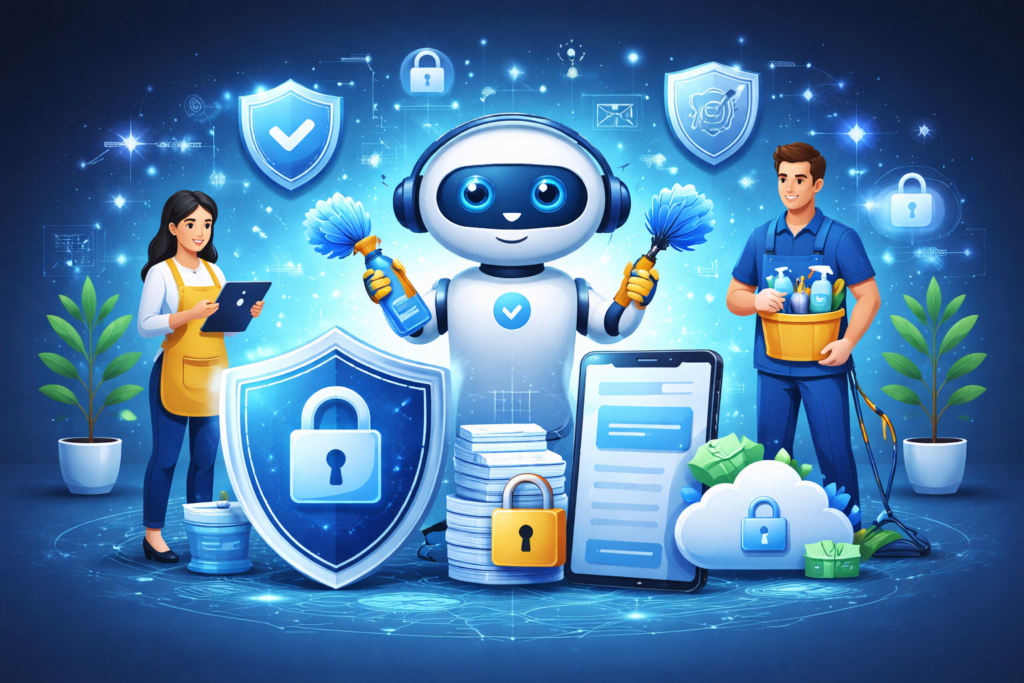
Trust is a foundational element of customer relationships, particularly when chatbots collect personal information such as addresses, contact details, and service preferences. Cleaning businesses must ensure their chatbot systems follow strict data privacy and security standards to maintain credibility and compliance.
Chatbots should be designed with transparent data handling practices, clearly informing users about how their information is collected, stored, and used. Compliance with data protection regulations such as GDPR is essential, especially for businesses operating in or serving customers within regulated regions.
Security measures such as encrypted data transmission, access controls, and secure integrations reduce the risk of data breaches. According to guidance from the UK Information Commissioner’s Office on data security best practices, organizations must implement both technical and organizational safeguards to protect user information.
Beyond compliance, trust is reinforced through user control. Allowing customers to request human assistance, opt out of data collection, or review privacy policies directly within the chatbot improves transparency and confidence.
By prioritizing privacy and security, cleaning businesses demonstrate responsibility and professionalism—qualities that strengthen customer trust, protect brand reputation, and align with Google’s trustworthiness expectations.
Common Mistakes Cleaning Businesses Make with Chatbots
Implementing a chatbot might seem straightforward, but many cleaning businesses stumble due to avoidable errors. Some of the most common mistakes include:
- Over-automation without human fallback: Fully automating conversations without an option to connect to a real agent can frustrate customers. Always include a human escalation path.
- Poor response accuracy: Chatbots must be trained with correct FAQs and service information. Inaccurate answers can erode trust quickly.
- Ignoring data privacy: Collecting personal information without proper safeguards can breach compliance laws and damage reputation. Always follow data protection standards.
- Lack of updates and optimization: Chatbots are not “set and forget.” Regularly updating responses, scripts, and AI training improves performance over time.
💡 Tip: Each mistake reduces trust and effectiveness if not addressed strategically. Prioritize chatbot accuracy, security, and optimization to maximize ROI.
Real-World Use Cases of AI Chatbots in Cleaning Services
AI chatbots are no longer a futuristic concept—they are transforming service industries today. According to Harvard Business Review, companies adopting AI chatbots see enhanced operational efficiency, faster response times, and higher customer satisfaction.
Cleaning companies benefit from AI in multiple ways:
- Faster bookings: Automated scheduling reduces human error and time lag.
- Better lead handling: Chatbots can qualify leads 24/7, ensuring no opportunity is missed.
- Improved customer satisfaction: Instant responses, reminders, and follow-ups increase reliability and brand trust.
💡 Pro Tip: Implement chatbots across multiple channels—website, WhatsApp, and social media—to maximize reach and engagement.
FAQs
Q1: What is a cleaning services chatbot?
A chatbot is an AI-powered tool that interacts with customers, handles inquiries, and automates bookings for cleaning services.
Q2: Can chatbots replace human staff?
No. They complement human staff by handling repetitive tasks, freeing employees for higher-value work.
Q3: Are chatbots secure for customer data?
Yes, if implemented with proper encryption, compliance, and privacy protocols.
Q4: How do chatbots improve bookings?
They allow instant booking confirmations, reminders, and lead qualification, reducing delays and missed appointments.
Q5: Can chatbots work on WhatsApp?
Absolutely. Platforms like engagerbot enable seamless WhatsApp integration for instant communication.
Q6: Are chatbots expensive to implement?
Costs vary, but AI chatbots provide long-term ROI by reducing manual labor and improving conversion rates.
Q7: Do chatbots help SEO?
Indirectly. Improved engagement and reduced bounce rates can enhance your search rankings.
Q8: Can chatbots handle commercial clients?
Yes, AI can handle both residential and commercial queries, adjusting responses accordingly.
Q9: How accurate are AI quotes?
Highly accurate when properly configured with your service pricing and parameters.
Q10: Can chatbots scale with business growth?
Yes, AI chatbots can manage increased inquiries and service expansions without proportional staffing increases.
Conclusion
Adopting AI chatbots is no longer optional for cleaning businesses aiming to stay competitive. Companies that implement smart, secure, and customer-friendly chatbots see measurable improvements in responsiveness, efficiency, and trust.
By balancing automation with human oversight, ensuring compliance, and continuously optimizing your AI system, your business can scale sustainably while exceeding customer expectations.
Engagerbot empowers cleaning businesses to deploy intelligent, secure, and conversion-focused chatbots. With robust AI, multi-channel support, and analytics-driven insights, engagerbot helps you streamline operations, boost customer satisfaction, and drive growth, all while aligning with Google’s quality standards.