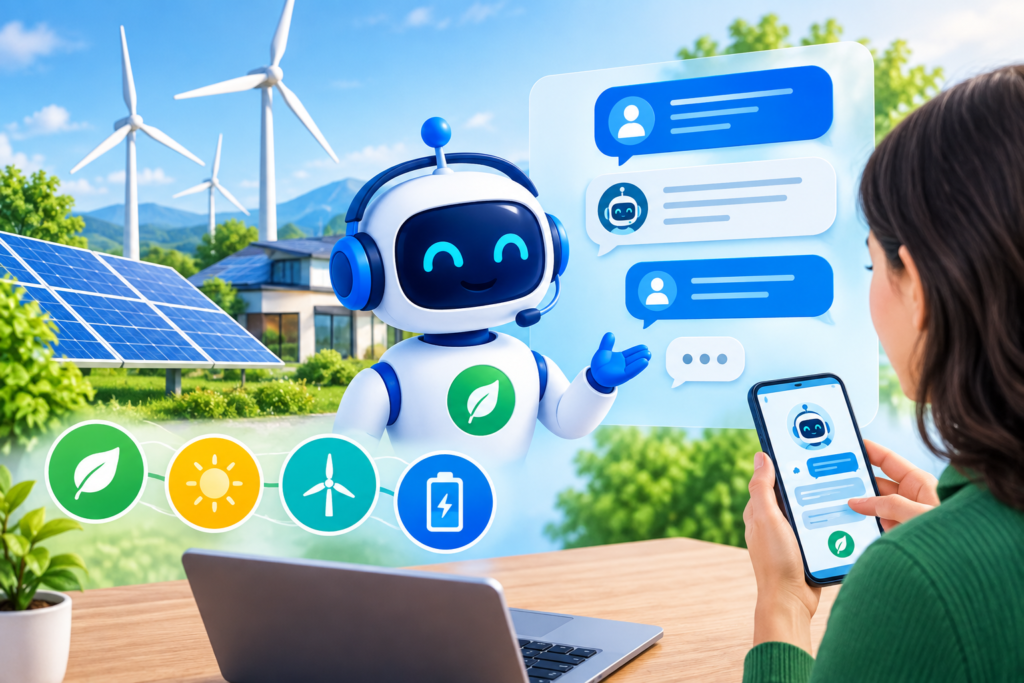
Discover how a Renewable Energy Chatbot can improve customer support, qualify clean-energy leads, educate visitors, streamline enquiries, and create better renewable energy customer experiences.
Introduction
The renewable energy industry is moving through a period of rapid digital transformation. Solar power, battery storage, wind energy, electric vehicle charging, energy management, and other clean-energy technologies are becoming increasingly important to homeowners, businesses, property developers, and organizations. As interest in these solutions grows, renewable energy companies must answer more questions, manage more enquiries, educate potential customers, and provide convenient ways for people to move from initial research toward meaningful action.
A Renewable Energy Chatbot can help businesses address these challenges through conversational digital experiences. Instead of requiring visitors to search through numerous pages, wait for business hours, or complete lengthy forms before receiving assistance, a chatbot can provide immediate responses to common questions and guide users toward relevant information. It can explain renewable energy concepts, collect enquiry details, qualify potential leads, help visitors find suitable resources, and connect customers with human specialists when a conversation requires professional assistance.
The most useful chatbot is not simply one that responds quickly. It should understand the visitor’s intent, provide information that is relevant to the current conversation, recognize the boundaries of its knowledge, and avoid making unsupported promises. This is particularly important in renewable energy because customers may ask about technical performance, installation requirements, energy consumption, costs, incentives, battery capacity, system suitability, or expected savings.
A responsible conversational strategy should therefore combine automation with reliable information and human expertise. The chatbot can handle repetitive informational tasks while qualified professionals remain available for technical assessments, project-specific recommendations, contractual matters, and other situations where human judgment is required.
For website content supporting this strategy, Google’s guidance on people-first content emphasizes creating useful, reliable information for visitors rather than producing content primarily to manipulate search rankings. people-first content
This guide explains how a Renewable Energy Chatbot can support customer engagement, lead generation, education, service, and business operations while maintaining a practical focus on accuracy, usability, trust, and long-term value.
What Is a Renewable Energy Chatbot?
A Renewable Energy Chatbot is a conversational software system designed to help visitors and customers interact with a renewable energy business through natural-language communication. It can operate on a website, landing page, customer portal, or other digital environment and may be configured to answer questions, provide educational information, collect enquiry details, qualify leads, support appointments, route requests, or connect users with human representatives.
The basic idea is simple: instead of making a visitor search through multiple sections of a website to find an answer, the chatbot allows that visitor to ask a question directly. Someone might ask, “How does solar battery storage work?” Another visitor might ask, “Do you install commercial solar systems?” A third person may want to know how to arrange a consultation. These requests represent different intentions, and the chatbot can guide each person toward the appropriate information or next step.
Different chatbot architectures can support these experiences. A basic system may rely on predefined questions and answers, while a more advanced AI chatbot can use natural-language processing, knowledge retrieval, business rules, APIs, customer-management integrations, and structured workflows. The right approach depends on the organization’s requirements, available content, technical infrastructure, and the complexity of its customer journey.
A renewable energy chatbot should also have clearly defined boundaries. It should not pretend to provide an engineering assessment when it only has general information. It should not invent system specifications, guarantee financial returns, or confidently answer questions when the required information is unavailable. Instead, it should recognize when additional information or human assistance is necessary.
This distinction makes conversational design particularly important. A chatbot is most valuable when it improves access to reliable information rather than attempting to replace every human interaction. It can answer repetitive questions, organize enquiries, explain terminology, collect project information, and help visitors understand what to do next.
The overall objective is to create a digital renewable energy assistant that supports the customer journey from discovery to enquiry and, where appropriate, ongoing support. When properly designed, it becomes part of the company’s wider digital experience rather than simply another website widget.
Why Renewable Energy Companies Need Conversational AI
Renewable energy customers frequently need information before they are ready to contact a sales or technical team. A homeowner may be interested in solar power but still have questions about installation, energy consumption, battery storage, system size, maintenance, monitoring, or project preparation. A business owner may need information about commercial energy requirements, system planning, equipment, or consultation processes.
This research stage creates an important opportunity for conversational AI. Instead of expecting visitors to understand the structure of a company’s website, a chatbot can guide them according to their actual questions. It can identify whether someone is looking for general education, product information, support, project assistance, or a consultation.
Another advantage is availability. A traditional customer service team may operate according to business hours, while website traffic can occur throughout the day and night. A chatbot can provide basic information outside normal operating hours and capture enquiries that can later be reviewed by staff. This can create continuity without requiring a business to maintain a full human support operation around the clock.
Conversational AI can also reduce friction in lead-generation processes. Rather than displaying a long form immediately, a chatbot can ask relevant questions progressively. For example, it might first ask whether the visitor is interested in residential or commercial renewable energy. It could then ask which technology they are researching and whether they want educational information, technical support, or a consultation.
The result can be a more natural customer journey. Instead of forcing every visitor through the same path, the chatbot can adapt the conversation based on the information provided.
However, automation should never be treated as a substitute for expertise. Renewable energy projects can involve substantial financial and technical considerations. A chatbot should therefore distinguish between general information and project-specific professional guidance.
The strongest implementation uses AI to improve accessibility, speed, organization, and communication, while humans remain responsible for decisions that require professional expertise. This balance can help businesses deliver a better customer experience without creating unrealistic expectations about what automation can safely accomplish.
How a Renewable Energy Chatbot Improves Customer Support
Customer support is one of the most practical applications for a Renewable Energy Chatbot. Renewable energy companies often receive repetitive questions about products, installation processes, maintenance, warranties, monitoring, appointments, documentation, troubleshooting, and general system operation.
When the same basic questions are repeatedly handled by support representatives, valuable staff time can be consumed by tasks that could potentially be automated. A chatbot can provide approved answers to suitable questions and allow human representatives to focus on issues that require investigation or professional judgment.
For example, a customer might ask how to access a monitoring portal or where to find a particular document. If the answer is available in the company’s approved support material, the chatbot can provide the relevant instructions immediately. Another customer might describe an unusual equipment problem. Instead of attempting an unsupported diagnosis, the chatbot can identify that the issue requires escalation and direct the customer toward the appropriate support process.
This distinction is essential. A support chatbot should not create false confidence by presenting guesses as facts. If a technical problem cannot be determined from the available information, the system should clearly state the limitation and guide the customer toward an appropriate human or professional channel.
A well-designed chatbot can also provide support navigation. Customers do not always know which department they need. Someone might have a billing question, maintenance request, installation enquiry, warranty concern, or technical problem. The chatbot can ask a few clarifying questions and route the conversation accordingly.
Over time, support conversations can also reveal useful patterns. If customers repeatedly ask questions that are missing from the knowledge base, the business can create new FAQ content or improve existing documentation. If a particular question frequently causes escalation, that may indicate that the chatbot needs better information or that the underlying process is unclear.
The chatbot therefore becomes more than an automated support tool. It can become a source of operational insight.
Businesses should regularly review chatbot performance, unanswered questions, failed intents, escalation patterns, and customer feedback. This creates a continuous improvement process in which conversational data helps identify opportunities to improve both the chatbot and the wider support experience.
Renewable Energy Lead Generation Through Conversational Experiences
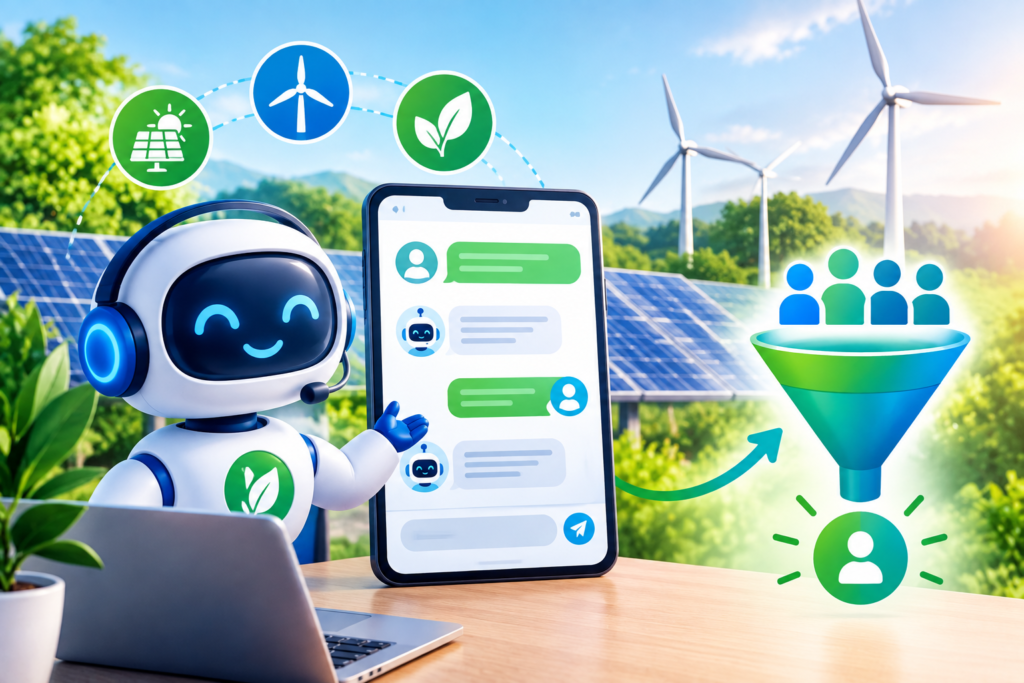
Lead generation is another important application of a Renewable Energy Chatbot. Renewable energy enquiries often require several pieces of information before a sales or consultation team can provide meaningful assistance. A chatbot can collect this information gradually through a conversational process.
For example, a visitor interested in solar energy might first identify themselves as a residential customer. The chatbot could then ask whether they are researching solar panels, battery storage, energy management, or another solution. Depending on the company’s requirements, it could collect additional project information and offer an appropriate consultation pathway.
This approach can make the enquiry process feel less complicated than a long static form. Instead of presenting many fields simultaneously, the chatbot can ask one relevant question at a time. Visitors can understand why information is being requested and can receive contextual guidance throughout the interaction.
A chatbot can also help distinguish between different stages of customer intent. Someone searching for “what is solar energy?” is likely looking for education, while someone asking about consultation availability may already be further along in the decision process.
This does not mean the chatbot should aggressively push every visitor toward a sales conversation. In fact, forcing sales-oriented messaging onto users who are still researching can create a poor experience. A more useful approach is to match the conversation to the visitor’s needs.
For example:
- An educational visitor can receive relevant guides.
- A product researcher can receive appropriate product information.
- A potential project customer can provide enquiry details.
- A customer seeking support can be routed to the support process.
- A visitor ready for human assistance can be offered a consultation.
The quality of leads should matter more than the raw number of conversations. A chatbot that generates thousands of incomplete enquiries may create additional work rather than improving sales operations.
Businesses should therefore measure meaningful outcomes such as qualified enquiries, completed forms, consultation requests, appointment bookings, human handoffs, and customer progression.
The chatbot can also improve lead quality by collecting context before a representative becomes involved. Instead of receiving a vague message such as “I want solar,” the sales team may receive a structured enquiry containing the visitor’s project type, area of interest, preferred contact method, and stated objectives.
This can make the first human conversation more productive while giving customers a smoother path from online research to professional assistance.
Educating Customers About Solar, Wind, Storage, and Clean Energy
Education is particularly valuable in renewable energy because customers may encounter unfamiliar concepts before they are ready to make decisions. Terms such as photovoltaic generation, battery capacity, inverter, energy storage, grid connection, monitoring, and energy efficiency can be confusing for people who are new to the industry.
A Renewable Energy Chatbot can transform this educational process into a conversational experience. Instead of forcing visitors to locate multiple articles, the chatbot can answer basic questions and direct users toward deeper resources when appropriate.
For example, someone could ask, “What does a solar inverter do?” The chatbot can provide a straightforward explanation and then offer related information about solar panels, battery storage, monitoring, or system components. Another visitor may ask about battery storage, in which case the conversation can focus on how batteries can store electricity and why storage may be considered in certain energy systems.
The key is to adjust the level of detail to the visitor. A beginner may need a simple explanation, while a technically experienced customer may want more detailed information. A chatbot should avoid unnecessary jargon when plain language can communicate the same idea.
Educational answers should also be carefully reviewed because renewable energy information can vary by technology, product, location, regulations, utility requirements, and project circumstances. The chatbot’s knowledge base should therefore be built from approved company information and trustworthy external sources where appropriate.
A business should also separate general education from personalized technical advice. Explaining how battery storage works is different from determining the correct battery size for a specific property. Describing how solar systems operate is different from guaranteeing a particular level of energy production.
This distinction helps maintain trust.
The chatbot can also encourage deeper learning by connecting users with relevant guides, FAQs, calculators, technical documents, and consultation pathways. In this way, the conversation becomes an entry point into a broader educational ecosystem.
The objective should be straightforward: after interacting with the chatbot, the visitor should understand the subject better and know what their next appropriate step is.
That approach supports a people-first digital experience because the chatbot is being used to improve understanding rather than simply increase the number of automated interactions.
Personalizing Renewable Energy Guidance Responsibly
Personalization can make a chatbot considerably more useful, but renewable energy businesses need to distinguish between personalized guidance and unsupported technical recommendations.
A visitor’s needs may vary significantly depending on whether they are a homeowner, business operator, property developer, facility manager, landlord, or another type of customer. A residential visitor may be interested in household electricity consumption and battery storage, while a commercial customer may need information about larger-scale projects, operational requirements, monitoring, and consultation processes.
The chatbot can personalize the conversation by asking relevant questions. For example, it may ask what type of property the visitor has, which renewable technology they are researching, what their primary objective is, or whether they are seeking general information or professional assistance.
This type of contextual personalization can improve relevance without requiring the chatbot to make assumptions.
The chatbot can also use information already provided during the current conversation. If a visitor explains that they are researching solar battery storage, the system should not repeatedly ask what topic they are interested in. Maintaining conversational context makes the interaction more natural and reduces unnecessary friction.
However, personalization should never become false precision.
Suppose a visitor asks, “How much money will I save by installing solar?” The chatbot may not have enough information to provide a reliable personalized figure. Actual outcomes can depend on electricity consumption, tariffs, system configuration, local conditions, financing, maintenance, equipment, and other variables.
Rather than inventing a precise number, the chatbot can explain the factors that influence savings and direct the visitor toward a qualified assessment.
This principle applies to system sizing, projected generation, installation costs, financial returns, incentives, and other project-specific matters. The chatbot can educate and collect information, but it should not imply certainty where professional analysis is required.
Responsible personalization also includes appropriate data handling. Businesses should collect only information that serves a clear purpose and should ensure that their chatbot workflows are consistent with applicable privacy requirements.
A trustworthy conversational experience should make users feel that the system understands their question—not that it is collecting every possible piece of information about them.
Essential Features of a High-Quality Renewable Energy Chatbot
A successful renewable energy chatbot requires more than an attractive chat interface. Its underlying capabilities should support real customer needs and business processes.
One of the most important features is intent recognition. The chatbot should understand whether a visitor is asking about solar technology, battery storage, commercial projects, maintenance, consultations, general renewable energy information, or customer support.
Contextual conversation is another important capability. If a user has already explained that they are interested in residential solar, the chatbot should use that information throughout the conversation instead of repeatedly requesting the same details.
A reliable knowledge base is equally important. The chatbot should be connected to approved information that the business can maintain. Product specifications, service processes, FAQs, warranty information, contact details, and other important information should have clear ownership and review procedures.
Lead capture can connect the chatbot to the sales process. Where appropriate, the system can collect enquiry details and pass them into a CRM or another approved workflow. Appointment scheduling can similarly allow visitors to request or arrange consultations.
Human escalation should be available for complex situations. Users should know how to reach a person when they need technical assistance, have a sensitive issue, or ask something outside the chatbot’s supported scope.
Analytics are also valuable. Businesses can measure:
- Most common questions
- Conversation completion rates
- Unanswered questions
- Escalation rates
- Lead qualification rates
- Appointment requests
- Frequently misunderstood topics
- Customer support patterns
These measurements can help identify opportunities for improvement.
Website performance should not be overlooked either. A chatbot is part of the page experience, so it should load efficiently, work correctly on mobile devices, remain accessible, and avoid interfering with the primary content.
Google’s page experience guidance highlights areas such as Core Web Vitals, secure delivery, mobile presentation, intrusive elements, and the ability for users to distinguish the main content from other page elements. page experience
A chatbot should therefore improve the website rather than making the page slower, more confusing, or harder to navigate.
Designing an Effective Renewable Energy Chatbot Conversation Flow
A successful chatbot conversation should be designed around real customer journeys. Before building the system, businesses should identify the most common visitor intents and define what outcome each conversation should achieve.
A simple starting point might present options such as:
- Learn about renewable energy
- Explore solar solutions
- Learn about battery storage
- Ask a support question
- Request a consultation
- Contact a specialist
From there, the chatbot can ask context-specific questions.
For example, a visitor interested in solar might be asked whether they are researching a residential or commercial project. A visitor requesting support might be asked to describe the general nature of their issue. A person seeking a consultation might be asked for the information required to arrange the next step.
The chatbot should avoid asking unnecessary questions. Every question should have a clear purpose.
Clarification is particularly important. If a user writes, “I need a solar system,” the chatbot should not assume the property type, energy requirements, or project size. It can ask a concise follow-up question that helps determine which information is relevant.
This creates a more accurate conversation while reducing the possibility of misleading answers.
Response length also matters. Users generally do not want every answer to become a lengthy technical explanation. A chatbot can provide the essential information first and then offer additional resources if the user wants more detail.
Error handling should be equally thoughtful. If the system does not understand a question, it should not repeatedly provide unrelated information. It can acknowledge the problem, offer a few likely categories, or provide a route to human support.
A useful conversation should also have a logical ending. The next step might be reading a detailed resource, submitting an enquiry, requesting a consultation, contacting support, or continuing the conversation.
The objective is not to keep visitors chatting indefinitely. The objective is to help them accomplish something useful.
A well-designed renewable energy conversation can therefore follow a simple framework:
Understand the question → clarify when necessary → provide useful information → recognize limitations → offer the appropriate next step.
This structure can create a more trustworthy customer experience while giving the business a practical framework for managing automation.
How Renewable Energy Chatbots Support Sales and Marketing Teams
A Renewable Energy Chatbot can connect marketing activity with sales conversations by helping visitors move through different stages of the customer journey. Renewable energy purchases are rarely impulsive decisions. Customers often compare technologies, research costs, investigate installation requirements, evaluate potential benefits, and look for trustworthy information before contacting a provider. A chatbot can support this research process while identifying when a visitor is ready for a more direct sales conversation.
For marketing teams, the chatbot can become an interactive destination for campaign traffic. A visitor arriving from a solar-energy article, paid campaign, search result, or social media post can receive assistance that relates to the subject they were already exploring. Instead of sending every visitor to the same generic contact page, the chatbot can offer relevant options based on the visitor’s stated interest. This creates a more connected experience between content marketing and conversion activities.
Sales teams can benefit from structured information collected during the conversation. Rather than receiving an enquiry containing only a name and short message, representatives may receive additional context about the customer’s interests, project category, questions, and preferred next step. This can help the representative prepare before making contact. However, businesses should avoid collecting unnecessary information simply because the chatbot makes data collection easy. Every requested field should have a clear business purpose and appropriate privacy handling.
The chatbot can also support lead nurturing without becoming overly promotional. A visitor who is not ready to request a consultation may be offered educational resources, technical guides, FAQs, or an option to return later. Someone who is ready to discuss a project can be directed toward a consultation process. This allows the experience to reflect different levels of buying intent.
Another useful application is identifying frequently asked pre-sales questions. If potential customers repeatedly ask about battery storage, installation timelines, maintenance, financing, or system compatibility, marketing teams can use those insights to develop stronger content. The chatbot therefore becomes a source of customer-language research.
This supports a broader content strategy because businesses can create pages around real questions rather than relying entirely on assumptions about what customers want to know.
For SEO, the chatbot should complement—not replace—useful crawlable website content. Important educational information should remain available in accessible webpages, while the chatbot provides an additional conversational route for visitors who prefer interactive assistance. Google’s guidance on search essentials emphasizes fundamental requirements for making web content eligible to appear in Google Search.
The strongest model is therefore a combined approach: helpful content attracts visitors, conversational AI helps them navigate information, and human specialists handle qualified project discussions.
Integrating a Renewable Energy Chatbot With Business Systems
The value of a chatbot can increase significantly when it connects with the systems that already operate behind a renewable energy business. A standalone chatbot may answer questions, but an integrated system can also transfer information, trigger workflows, schedule appointments, organize enquiries, and support internal teams.
A common integration is a customer relationship management platform. When a visitor completes a qualifying conversation, relevant information can be transferred into the appropriate lead or customer workflow. Sales representatives can then review the conversation context rather than asking the customer to repeat everything from the beginning.
Appointment scheduling is another useful integration. A visitor who has completed the relevant qualification questions can be offered an appropriate consultation pathway. Depending on the business process, the chatbot may direct the visitor to a scheduling interface or initiate a booking workflow. This can reduce the number of steps between initial interest and human contact.
Knowledge management is equally important. The chatbot needs access to current information, but that information should have clear ownership. Businesses should determine who is responsible for reviewing product details, service processes, support instructions, pricing information, and other frequently changing content. A chatbot should not become a separate information silo that continues using outdated material.
Other possible integrations include customer-support systems, email workflows, analytics platforms, document repositories, appointment systems, product databases, and approved calculation tools. The exact architecture should depend on the business’s needs rather than the availability of technology.
Security should also be considered from the beginning. Businesses should evaluate what information the chatbot can access, what information it can send, which systems it can interact with, and what permissions are required. Sensitive actions should not automatically be made available simply because an API exists.
A useful principle is minimum necessary access. If the chatbot only needs to create a consultation request, it may not need broad access to a complete customer database. Restricting permissions can reduce unnecessary exposure and make the system easier to govern.
Testing should occur before integrations are released to customers. Teams should verify what happens when information is incomplete, a connection fails, an API becomes unavailable, a customer changes their answer, or an unexpected request reaches the chatbot.
The integration layer should therefore be designed as carefully as the conversation itself. A chatbot that provides excellent answers but sends inaccurate information into the CRM can create operational problems. Conversely, a well-integrated system can transform conversations into useful business workflows.
Using Renewable Energy Chatbots for 24/7 Customer Engagement
One of the most recognizable benefits of conversational AI is its ability to provide assistance outside conventional business hours. Renewable energy websites can receive visitors at any time, including evenings, weekends, holidays, and periods when support teams are unavailable.
A 24/7 renewable energy chatbot can provide basic information during these periods and help visitors determine what to do next. Someone researching solar energy late at night can receive educational information immediately. A customer looking for a support process can find the correct pathway without waiting until the next business day. A potential lead can provide project details for later follow-up.
The value of this availability is not that the chatbot must solve every problem at every hour. Instead, it can maintain continuity between the visitor and the business. If human assistance is unavailable, the chatbot can explain the available options and collect an enquiry so the customer does not have to start the process again later.
This is particularly useful for businesses serving customers across multiple time zones. A single support team may not be able to provide live assistance to every customer simultaneously, while an automated first-line experience can provide consistent access to general information.
However, 24/7 availability should not be confused with 24/7 human expertise. The chatbot should clearly distinguish between automated assistance and human support. If a question requires a specialist, the system should explain when and how a human representative will become involved.
This is also important for urgent or potentially hazardous situations. If a customer describes an electrical, equipment, fire, structural, or other potentially dangerous issue, the chatbot should not attempt to improvise a technical solution. It should follow the company’s approved escalation and safety procedures and direct the customer toward appropriate professional or emergency resources where relevant.
Businesses should also monitor overnight conversations. Questions received outside business hours may reveal important gaps in the customer experience. If a large percentage of users request information that the chatbot cannot provide, that information can guide future knowledge-base improvements.
A well-managed 24/7 system can therefore provide three major benefits: continuous information access, better enquiry capture, and smoother transition to human support.
The chatbot’s availability should always be paired with clear expectations. Customers should know whether they are interacting with an automated system, what the system can help with, and how to reach a person when necessary.
This transparent approach makes extended availability useful without creating the impression that an AI system has unlimited expertise.
Renewable Energy Chatbots for Customer Retention and Ongoing Support
The customer journey does not end when someone submits a renewable energy enquiry or completes an installation. Customers may continue to need information about system operation, monitoring, maintenance, documentation, support procedures, warranties, and related services. A chatbot can support these ongoing interactions when it is connected to reliable customer-service information.
For example, customers may ask how to access monitoring information, where to find support documentation, how to request assistance, or what general maintenance guidance applies to their system. A chatbot can provide approved information or direct users to the correct support channel.
This can improve the post-purchase experience because customers do not always know where to find the answer they need. A conversational interface provides another route to information without requiring them to search through the entire website.
Retention can also benefit from educational engagement. Customers who understand how their renewable energy system works may be better positioned to use available monitoring features, understand normal system behavior, and identify when professional assistance may be appropriate.
However, the chatbot should avoid making assumptions about a customer’s specific equipment unless the system has reliable access to the relevant information. A generic response should not be presented as an individualized technical diagnosis.
A mature implementation can also help customers discover related services. For example, after answering a support question, the chatbot might offer information about maintenance, energy monitoring, storage, or other relevant resources. This should be presented as useful information rather than aggressive upselling.
Customer retention can also be supported through feedback. After a conversation, the chatbot may ask whether the user found the information helpful. More detailed feedback can be routed into customer-service processes.
The business can then analyze recurring problems and identify opportunities to improve documentation, onboarding, installation communication, or support workflows.
Another benefit is consistency. If several support representatives provide different explanations for the same general question, customers may become confused. A carefully maintained knowledge base can help ensure that routine informational responses remain consistent across digital and human channels.
The chatbot should not replace human relationship-building, especially for complex commercial accounts or technically demanding projects. Instead, it can reduce routine friction and make it easier for customers to find the correct information.
The most valuable long-term role is therefore supporting customers after the sale while keeping professional assistance accessible when needed.
Measuring the Performance of a Renewable Energy Chatbot
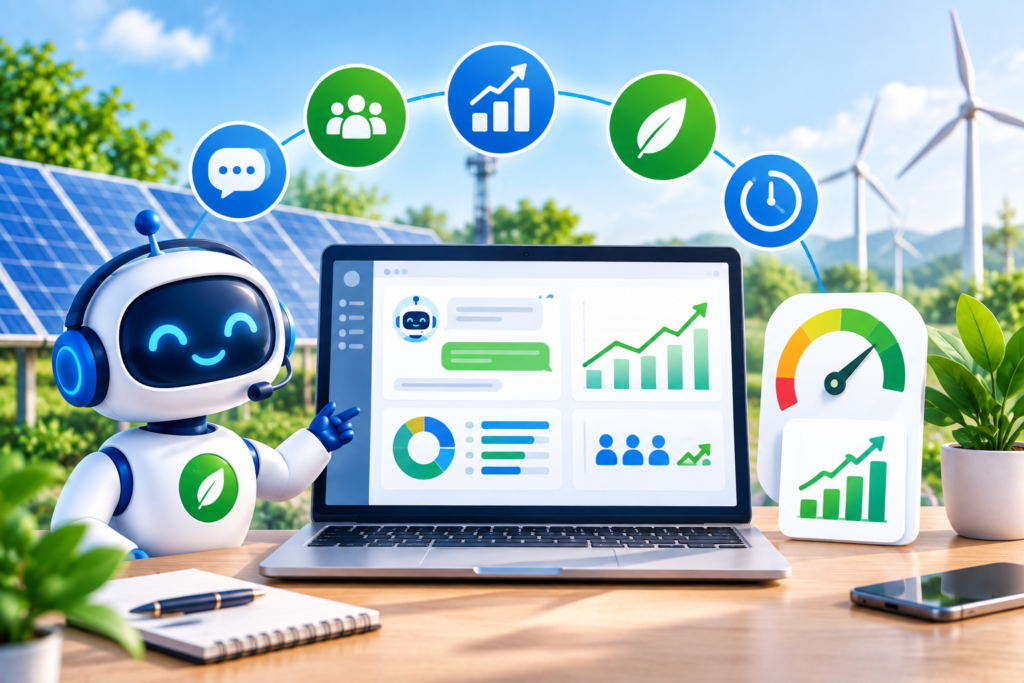
Launching a chatbot without measuring its performance makes it difficult to determine whether the system is actually improving the customer experience. Businesses should establish meaningful metrics before implementation and review them regularly after launch.
One useful measurement is the conversation completion rate. This shows how many users reach the intended end of a conversation. However, completion alone does not indicate quality. A chatbot could technically complete many conversations while providing little useful information.
For this reason, businesses should also monitor successful outcomes. These may include qualified enquiries, consultation requests, completed support interactions, useful human handoffs, appointment requests, or access to relevant resources.
Another important measurement is the fallback rate. If users frequently receive responses such as “I don’t understand,” the chatbot may lack information or may have difficulty recognizing common user language. Reviewing fallback conversations can reveal exactly where improvements are required.
Businesses can also analyze escalation patterns. High escalation is not automatically negative. Some subjects genuinely require human expertise. The more useful question is whether the chatbot escalates the right conversations while successfully handling appropriate routine enquiries.
Lead quality should be measured downstream rather than only inside the chatbot. For example, a business might compare chatbot-generated enquiries with enquiries received through conventional forms and evaluate factors such as completeness, relevance, consultation attendance, or progression through the sales process.
Customer feedback is another valuable signal. Short feedback prompts can identify whether visitors found the chatbot useful, confusing, slow, or incomplete.
Technical metrics should also be monitored. These can include response latency, integration failures, uptime, mobile usability, and errors caused by external services.
Search performance should be measured separately. A chatbot does not automatically make a website rank better. The website still needs useful content, accessible pages, sound technical implementation, and content that satisfies user needs.
Google’s documentation on Search Console provides tools for website owners to monitor search performance and understand how their sites perform in Google Search.
A practical reporting framework can therefore include:
| Measurement Area | Example Metric |
|---|---|
| Engagement | Conversations started |
| Completion | Successful conversation rate |
| Understanding | Fallback or misunderstood-intent rate |
| Lead generation | Qualified enquiries |
| Sales support | Consultation requests |
| Customer service | Resolved routine enquiries |
| Escalation | Human handoff rate |
| Experience | User feedback |
| Technical | Response and integration errors |
| Search | Organic search performance |
The goal is not to maximize one number. The goal is to determine whether the chatbot is helping users accomplish useful tasks while supporting measurable business outcomes.
Common Mistakes When Implementing a Renewable Energy Chatbot
One of the biggest mistakes businesses make is launching a chatbot without defining its purpose. A chatbot that attempts to answer everything can quickly become difficult to maintain. Businesses should identify the specific customer problems the system is designed to address before selecting technology.
Another common mistake is allowing the chatbot to provide unsupported information. Renewable energy involves technical and financial topics, and inaccurate answers can damage trust. Businesses should establish approved sources and clearly define subjects that require human escalation.
A third mistake is treating the chatbot as a replacement for website content. Important educational information should remain accessible through normal website pages. The chatbot should provide an additional conversational route rather than hiding essential information behind an interaction.
Poor conversation design is another frequent problem. Long introductions, unnecessary questions, repetitive prompts, and overly complicated menus can frustrate visitors. The chatbot should get to the user’s intent quickly and ask only questions that serve a clear purpose.
Businesses may also collect too much information. Just because a chatbot can ask dozens of questions does not mean it should. Excessive data collection increases friction and can create unnecessary privacy and governance concerns.
Another mistake is failing to plan for human escalation. Some visitors will always need a person. If the chatbot prevents users from reaching human support, it can turn a useful automation system into a source of frustration.
Ignoring mobile users is another problem. A large percentage of website interactions may occur on smartphones, so the chatbot interface must remain easy to read and operate on smaller screens.
Businesses should also avoid measuring success purely by conversation volume. A high number of conversations does not necessarily indicate customer value. Meaningful outcomes matter more.
Finally, failing to maintain the knowledge base can gradually reduce chatbot quality. Product information, policies, services, pricing structures, support procedures, and other details can change. The chatbot should therefore have a defined review process.
Real-World Mistakes to Avoid
- Launching without a clearly defined purpose.
- Allowing unsupported technical claims.
- Using outdated product or service information.
- Asking unnecessary personal questions.
- Creating overly long conversation flows.
- Making human support difficult to reach.
- Ignoring mobile usability.
- Measuring conversations instead of meaningful outcomes.
- Connecting the chatbot to systems with excessive permissions.
- Failing to test integration failures.
- Treating AI-generated answers as automatically accurate.
- Allowing the knowledge base to become outdated.
- Hiding important information exclusively inside the chatbot.
- Using aggressive sales messaging for research-stage visitors.
- Failing to review actual customer conversations after launch.
Avoiding these mistakes can significantly improve both trust and long-term operational value.
Best Practices for Renewable Energy Chatbot Implementation
A successful implementation should begin with the customer rather than the technology. Before selecting a chatbot platform, businesses should document the questions customers commonly ask, the tasks they want to complete, and the points where human support is currently required.
The next step is to build a controlled knowledge foundation. Approved website content, FAQs, service information, support documentation, product information, and other authoritative material can be organized into a structured knowledge system. Each category should have an owner responsible for reviewing information and updating it when necessary.
Conversation design should then be developed around real use cases. Businesses can create separate flows for education, lead generation, support, consultation requests, and escalation. Each flow should have a defined objective and clear exit conditions.
Human handoff should be treated as a core feature rather than an emergency fallback. The chatbot should recognize situations where professional assistance is required and provide a straightforward path to the appropriate team.
Testing should happen before launch and continue afterward. Teams should test normal questions, incomplete questions, unexpected wording, ambiguous requests, unsupported topics, integration failures, and escalation scenarios.
Security and privacy should also be considered throughout implementation. Businesses should determine what information the chatbot can access and transmit and ensure that permissions are appropriate for its role.
Performance should be monitored after launch. Businesses should examine conversations, unanswered questions, fallback rates, customer feedback, qualified leads, and technical errors. This information should feed into an ongoing improvement process.
Website quality should remain a priority. Google provides technical guidance through Google Search Central, including documentation covering crawling, indexing, structured data, search appearance, and other aspects of search-friendly website development.
Businesses should also avoid trying to manipulate search engines through chatbot-generated content. The chatbot should serve users, while public website content should be developed according to genuine informational needs.
Best Practices Summary
1. Define the purpose clearly.
Know exactly which customer problems the chatbot is intended to solve.
2. Use reliable information.
Build responses from approved and regularly reviewed sources.
3. Keep answers useful and understandable.
Use plain language and provide deeper information when necessary.
4. Personalize responsibly.
Use relevant context without pretending to provide unsupported technical certainty.
5. Provide human escalation.
Make professional assistance accessible for complex situations.
6. Integrate carefully.
Connect the chatbot only to systems and information it genuinely needs.
7. Protect customer information.
Minimize unnecessary data collection and review access permissions.
8. Test extensively.
Evaluate normal, unexpected, ambiguous, and unsupported requests.
9. Measure meaningful outcomes.
Focus on useful conversations, qualified enquiries, support outcomes, and customer satisfaction.
10. Improve continuously.
Use real conversation data to identify gaps and update the system.
These principles create a foundation for a renewable energy chatbot that can remain useful as the business, technology, and customer expectations evolve.
Frequently Asked Questions
1. What is a Renewable Energy Chatbot?
A Renewable Energy Chatbot is an AI-powered conversational system designed to help visitors and customers interact with renewable energy businesses. Depending on its configuration, it can answer questions, explain renewable technologies, qualify enquiries, collect project information, provide support, schedule consultations, and transfer complex conversations to human specialists.
2. Can a Renewable Energy Chatbot generate solar leads?
Yes. A chatbot can ask relevant qualification questions, understand visitor intent, collect enquiry details, and direct qualified visitors toward consultation or contact processes. The quality of the lead depends heavily on the questions asked, the business workflow, and how the collected information is handled.
3. Can a chatbot calculate solar savings?
A chatbot may be able to explain the factors that influence solar savings or use an approved calculation system when appropriate data and validated formulas are available. However, it should not invent precise financial projections or present estimates as guaranteed results. Project-specific financial assessments may require additional information and qualified professional review.
4. Can a Renewable Energy Chatbot provide technical support?
It can provide approved general support information, documentation, troubleshooting guidance, and service navigation. However, situations requiring technical diagnosis, engineering judgment, electrical work, or other professional intervention should be escalated appropriately.
5. Can the chatbot work 24/7?
Yes. A chatbot can provide automated assistance outside normal business hours. It can answer suitable questions, collect enquiries, provide resources, and explain how customers can obtain human assistance. Businesses should clearly communicate when users are interacting with an automated system.
6. Can a chatbot integrate with a CRM?
Yes. Depending on the chatbot platform and business architecture, it can integrate with CRM systems, lead-management tools, scheduling platforms, support systems, analytics solutions, and other approved services. Integration permissions should be carefully controlled.
7. Is a chatbot useful for existing renewable energy customers?
Yes. Existing customers may use a chatbot to find support information, documentation, service instructions, appointment options, and other resources. The chatbot can also help route complex issues to the correct human team.
8. Does adding a chatbot automatically improve SEO?
No. A chatbot by itself does not guarantee improved search rankings. SEO depends on many factors, including useful content, technical accessibility, site quality, relevance, authority, and user needs. A chatbot can improve the user experience, but it should complement rather than replace high-quality website content.
Conclusion
A Renewable Energy Chatbot can become a valuable part of a modern renewable energy company’s digital customer experience when it is implemented around genuine customer needs. It can provide faster access to information, support lead generation, educate visitors, streamline enquiries, assist customers outside normal business hours, and connect people with human specialists when conversations become more complex.
The most effective implementations do not attempt to make AI responsible for everything. Instead, they establish clear boundaries between automated assistance and professional expertise. The chatbot can handle routine information and conversational navigation while qualified people remain responsible for technical assessments, complex project discussions, and decisions requiring professional judgment.
Trust should remain central to the implementation. Accurate information, transparent AI communication, appropriate escalation, responsible data handling, useful website content, and continuous quality review all contribute to a better customer experience.
For renewable energy businesses, the opportunity is broader than simply adding a chat window to a website. A well-designed conversational system can become a bridge between education, engagement, lead qualification, customer support, and human expertise.
As renewable energy adoption continues to expand, customers will increasingly expect digital experiences that are convenient, informative, and responsive. Businesses that approach conversational AI strategically can use it to make complex information easier to access while creating more organized paths toward the right human and digital resources.
For businesses ready to explore this approach, Engagerbot can be positioned as part of a broader conversational engagement strategy for renewable energy customers.
Want to Implement This Easily?
Renewable Energy Chatbot Implementation Prompt
You are an expert consultant. Based on the blog post titled “Renewable Energy Chatbot”, provide a step-by-step, practical implementation guide. Include tools, best practices, common mistakes to avoid, and advanced tips. Assume the reader wants to implement everything discussed in this article effectively.
Want our help implementing this? Just reach out to us via our website contact form: https://www.engagerbot.com/contact-us/