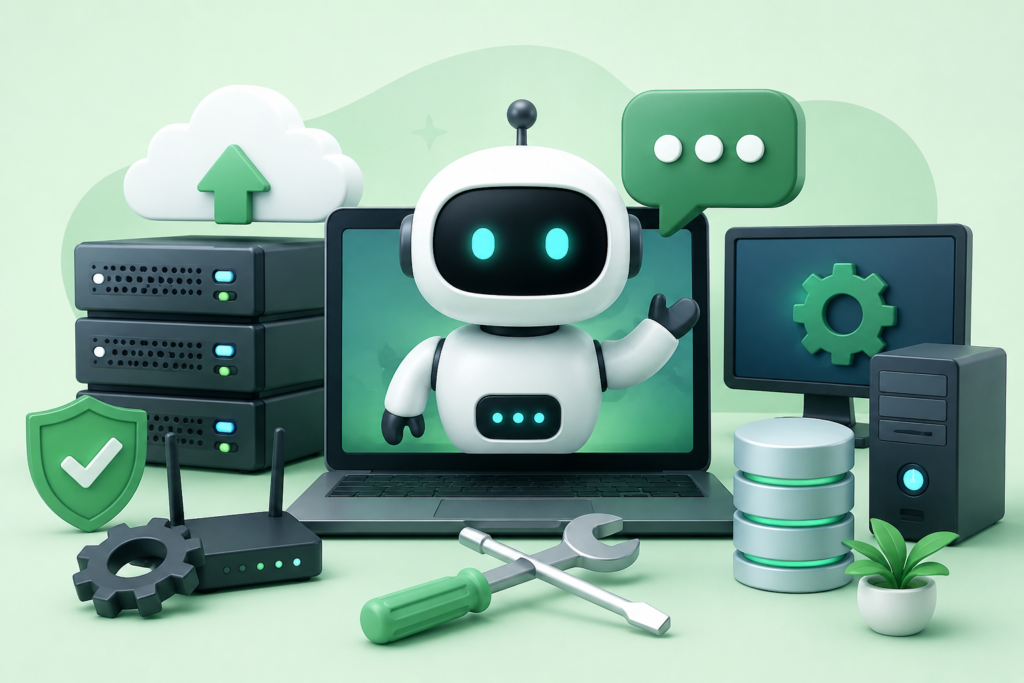
IT & Computing Chatbot: Discover how AI-powered IT & Computing Chatbots transform technical support, automate IT service management, improve cybersecurity assistance, reduce operational costs, and deliver faster, smarter customer and employee support. Learn the features, benefits, implementation strategies, and best practices for deploying an intelligent IT chatbot that enhances business efficiency and user satisfaction.
Introduction
Technology has become the backbone of modern organizations, making reliable IT support more important than ever. Whether businesses operate in healthcare, finance, education, manufacturing, retail, or professional services, employees and customers expect immediate assistance whenever technical issues arise. Traditional help desks often struggle to meet growing demand due to limited staffing, repetitive requests, and increasing infrastructure complexity. This is where an IT & Computing Chatbot provides significant value by offering instant, intelligent, and scalable support around the clock.
Modern AI-powered chatbots can answer technical questions, troubleshoot common problems, guide users through software installations, reset passwords, assist with network connectivity, recommend knowledge base articles, and automate repetitive IT workflows. By combining Artificial Intelligence (AI), Natural Language Processing (NLP), Machine Learning (ML), and workflow automation, these chatbots significantly reduce response times while improving user satisfaction and operational efficiency.
Businesses implementing intelligent conversational AI often experience reduced support costs, increased employee productivity, and faster issue resolution. Rather than replacing IT professionals, chatbots handle routine requests, allowing technical teams to focus on complex incidents, infrastructure improvements, cybersecurity, and strategic projects.
At Engagerbot, organizations can implement customized AI chatbot solutions designed to improve technical support experiences while integrating seamlessly with existing IT infrastructure, ticketing systems, and enterprise software.
What Is an IT & Computing Chatbot?
An IT & Computing Chatbot is an AI-powered virtual assistant specifically designed to provide automated technical assistance, answer IT-related questions, troubleshoot common computing problems, and streamline IT service management. Unlike traditional rule-based chatbots that rely solely on predefined responses, modern IT chatbots leverage Artificial Intelligence, Natural Language Processing, contextual understanding, and machine learning algorithms to interpret user intent and deliver accurate, personalized responses.
These intelligent assistants can support employees, customers, developers, system administrators, and IT support teams across various communication channels, including websites, mobile applications, collaboration platforms, live chat systems, and messaging applications. Instead of waiting in lengthy support queues, users receive immediate assistance regardless of business hours. This significantly improves user experience while reducing pressure on internal IT departments.
An IT chatbot performs numerous technical tasks, including password reset assistance, software troubleshooting, operating system guidance, printer support, VPN configuration, cloud service navigation, hardware diagnostics, application onboarding, security awareness education, and knowledge base recommendations. More advanced implementations integrate with IT Service Management (ITSM) platforms to create support tickets, update incident records, monitor infrastructure alerts, and escalate unresolved issues to human technicians when necessary.
Modern conversational AI also enables chatbots to understand natural language instead of requiring users to enter rigid commands. For example, employees can type, “My laptop won’t connect to the office Wi-Fi,” or “Outlook keeps crashing,” and the chatbot interprets the request, identifies likely causes, asks relevant follow-up questions, and recommends practical troubleshooting steps.
Organizations adopting intelligent IT chatbots benefit from consistent support quality, faster response times, lower operational expenses, and increased availability. Instead of replacing experienced IT professionals, these chatbots enhance overall service delivery by automating repetitive tasks while allowing human experts to focus on advanced troubleshooting, infrastructure optimization, cybersecurity initiatives, and digital transformation projects.
As businesses continue adopting cloud computing, hybrid work environments, and complex software ecosystems, IT & Computing Chatbots have evolved into strategic digital assistants that improve operational efficiency, employee productivity, and customer satisfaction simultaneously.
Why Businesses Need IT & Computing Chatbots
Modern organizations rely heavily on technology to perform daily operations, collaborate with distributed teams, serve customers, and manage digital infrastructure. Consequently, IT support requests have increased dramatically over the past decade. Help desks receive thousands of repetitive inquiries involving password resets, application access, software updates, email configuration, printer connectivity, VPN issues, account permissions, and device troubleshooting. Managing these requests manually consumes valuable time and resources while creating long wait times for users.
An intelligent IT & Computing Chatbot addresses these challenges by providing immediate, automated support twenty-four hours a day, seven days a week. Employees no longer need to wait for business hours or available technicians to receive assistance. Instead, the chatbot instantly answers frequently asked questions, guides users through troubleshooting processes, and automates repetitive administrative tasks.
Businesses also benefit financially from chatbot implementation. By automating common support interactions, organizations reduce operational costs associated with large support teams while improving first-contact resolution rates. Human IT professionals become more productive because they spend less time answering repetitive questions and more time resolving complex technical problems, improving cybersecurity, planning infrastructure upgrades, and supporting digital innovation initiatives.
Remote and hybrid work environments have made intelligent virtual support even more valuable. Employees working from home frequently encounter connectivity issues, authentication problems, software installation challenges, and cloud platform questions. AI-powered chatbots provide immediate assistance regardless of location, ensuring business continuity and minimizing productivity disruptions.
Additionally, IT chatbots improve consistency across support operations. Human responses can vary depending on experience levels, workload, or documentation availability. Chatbots deliver standardized guidance based on approved knowledge bases, reducing errors while ensuring compliance with organizational policies and security standards.
Beyond support automation, modern IT chatbots generate valuable analytics regarding recurring technical issues, frequently requested services, user behavior, system performance trends, and support bottlenecks. These insights enable organizations to improve documentation, optimize infrastructure, enhance employee training, and make data-driven decisions that strengthen overall IT service quality.
As technology ecosystems become increasingly sophisticated, implementing an intelligent IT chatbot is no longer simply a convenience—it has become a strategic investment that improves operational efficiency, employee satisfaction, service quality, and long-term digital transformation success.
Key Features of Modern IT & Computing Chatbots
Modern IT & Computing Chatbots have evolved far beyond simple question-and-answer systems. Powered by Artificial Intelligence (AI), Natural Language Processing (NLP), Machine Learning (ML), and automation technologies, these chatbots act as intelligent virtual IT assistants capable of supporting employees, customers, developers, and technical teams. They understand natural conversations, provide contextual responses, automate repetitive tasks, and integrate with enterprise systems to deliver a seamless support experience. As organizations continue to embrace digital transformation, the capabilities of IT chatbots continue to expand, making them an essential component of modern IT service management.
One of the most valuable features is 24/7 technical support availability. Unlike traditional help desks that operate during business hours, AI chatbots remain available around the clock to answer questions, troubleshoot issues, and guide users through technical processes. This is particularly beneficial for global organizations with distributed teams working across different time zones. Employees can receive immediate assistance for password resets, account access, VPN configuration, software installation, printer connectivity, cloud platform navigation, and many other common IT requests without waiting for a support representative. This constant availability reduces downtime, improves employee productivity, and enhances the overall support experience.
Another major capability is intelligent automation. Rather than simply responding with predefined answers, modern chatbots can automate workflows such as creating IT support tickets, assigning priority levels, escalating incidents, checking system status, updating ticket progress, scheduling software installations, and notifying users about maintenance windows. Integration with IT Service Management (ITSM) platforms allows chatbots to communicate directly with service desks, ensuring accurate incident tracking and faster resolution times. Organizations also benefit from chatbot analytics, which identify recurring issues, monitor response quality, measure user satisfaction, and highlight opportunities for continuous improvement.
Security and compliance are equally important features. Enterprise-grade IT chatbots include user authentication, role-based access control, encrypted communications, secure API integrations, audit logging, and compliance support for industry regulations. These capabilities help organizations protect sensitive information while maintaining a consistent and secure support environment. Additional features often include multilingual support, voice interaction, contextual memory, personalized recommendations, knowledge base integration, proactive notifications, cloud service management, and compatibility with collaboration platforms such as Microsoft Teams, Slack, and enterprise communication tools. Together, these features transform IT chatbots into intelligent digital assistants that improve operational efficiency, reduce support costs, and deliver exceptional user experiences across the organization.
How AI, Natural Language Processing, and Machine Learning Power IT Chatbots
The intelligence behind modern IT & Computing Chatbots comes from the combination of Artificial Intelligence (AI), Natural Language Processing (NLP), and Machine Learning (ML). These technologies enable chatbots to understand user intent, interpret natural language, analyze context, learn from previous interactions, and continuously improve their responses. Instead of relying on rigid decision trees or scripted conversations, AI-powered chatbots engage in dynamic, human-like conversations that provide more accurate and personalized technical support.
Artificial Intelligence serves as the foundation of an intelligent chatbot. AI algorithms analyze incoming user requests, identify patterns, predict user needs, and determine the most relevant responses based on available information. For example, if an employee types, “My laptop won’t connect to the office network,” the chatbot evaluates the request, recognizes it as a network connectivity issue, and begins a guided troubleshooting process. AI can also recommend relevant knowledge base articles, automate diagnostic procedures, and initiate workflows without requiring human intervention. As organizations accumulate more support data, AI models become increasingly effective at recognizing common problems and providing faster solutions.
Natural Language Processing (NLP) enables chatbots to understand human language rather than requiring users to type specific commands. Employees can communicate naturally using complete sentences, informal language, or technical terminology. NLP identifies keywords, intent, entities, sentiment, and contextual meaning, allowing the chatbot to interpret requests accurately even when wording varies. For instance, the chatbot understands that “I forgot my password,” “Can’t log in,” and “Need account access” may all require the same authentication assistance. Advanced NLP also supports multilingual communication, making chatbots accessible to diverse workforces and global customers.
Machine Learning continuously enhances chatbot performance by learning from previous interactions, successful resolutions, user feedback, and support trends. Each conversation contributes valuable data that improves future recommendations, identifies emerging technical issues, and optimizes response accuracy. Machine learning also enables predictive support by recognizing patterns that indicate potential system failures before they become major incidents. Combined with cloud computing, automation platforms, analytics, and enterprise integrations, AI, NLP, and Machine Learning create intelligent IT assistants capable of delivering scalable, reliable, and personalized technical support. As these technologies continue to advance, organizations can expect even more sophisticated chatbot capabilities, including proactive infrastructure monitoring, automated cybersecurity recommendations, predictive maintenance, and highly personalized user experiences that significantly improve overall IT service delivery.
IT Help Desk Automation: Transforming Technical Support with AI Chatbots
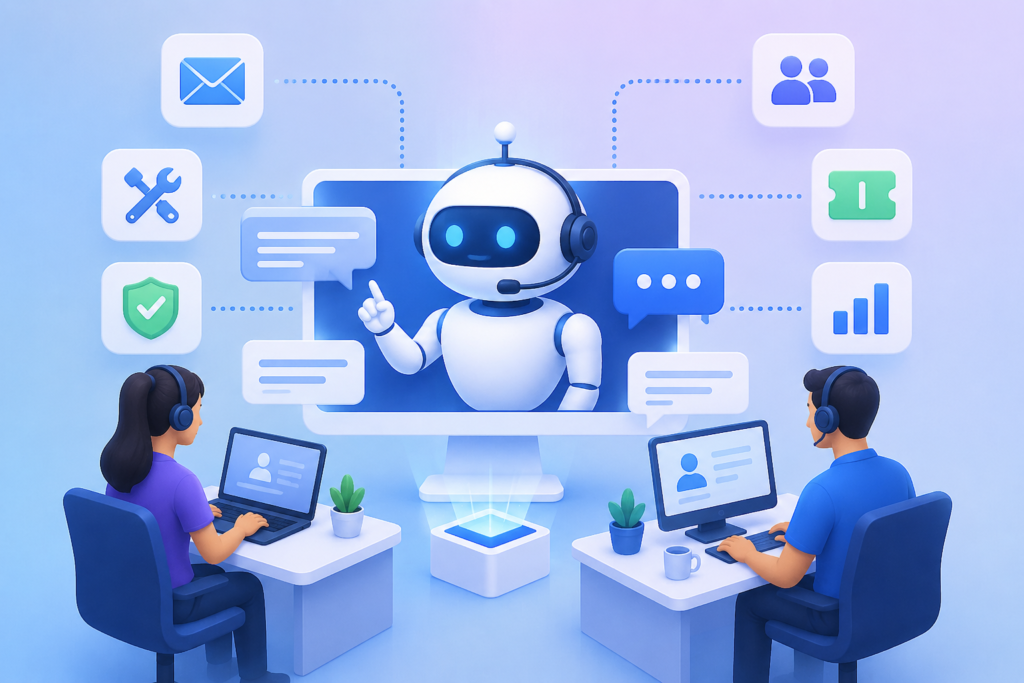
Traditional IT help desks are essential for maintaining business operations, but they often face challenges such as high ticket volumes, repetitive requests, long response times, and increasing user expectations. Employees expect immediate assistance when they encounter issues like forgotten passwords, software installation errors, VPN connectivity problems, email synchronization failures, printer malfunctions, or application access requests. Manually handling these recurring issues consumes valuable IT resources and prevents technical specialists from focusing on strategic initiatives. An IT & Computing Chatbot addresses these challenges by automating routine support processes while providing users with instant, accurate, and consistent assistance. Organizations implementing AI-driven help desk automation can significantly reduce operational costs, improve response times, and enhance employee productivity.
One of the greatest advantages of chatbot-powered help desk automation is its ability to resolve common technical issues without human intervention. Using Artificial Intelligence, Natural Language Processing, and workflow automation, the chatbot understands user requests, identifies the appropriate solution, and guides users through troubleshooting steps. For example, if an employee cannot access a corporate application, the chatbot can verify authentication status, recommend corrective actions, reset passwords through secure identity verification, or create a support ticket if advanced assistance is required. Integration with IT Service Management (ITSM) platforms enables the chatbot to automate ticket creation, categorize incidents, assign priority levels, and route requests to the appropriate support teams. Organizations following the guidance provided by Google Workspace Admin Help can further streamline identity management and administrative processes, while the Google Cloud Architecture Framework offers best practices for designing scalable and reliable enterprise systems. Businesses operating hybrid cloud environments can also leverage recommendations from Amazon Web Services Documentation and Microsoft Azure Architecture Center when integrating chatbot solutions into existing infrastructure.
Beyond resolving technical issues, AI-powered help desk automation provides valuable business intelligence through detailed reporting and analytics. Every interaction generates data that helps IT leaders identify recurring incidents, monitor service performance, measure first-contact resolution rates, evaluate user satisfaction, and optimize knowledge base content. These insights support continuous improvement initiatives while reducing support bottlenecks across the organization. Intelligent chatbots can also proactively notify employees about scheduled maintenance, software updates, security alerts, and service disruptions before users experience problems. As organizations continue expanding their digital ecosystems, help desk automation becomes an important component of operational resilience, enabling IT departments to deliver faster, more reliable, and more scalable technical support without compromising service quality. By combining conversational AI with enterprise automation, businesses create an efficient support environment that benefits both end users and IT professionals while supporting long-term digital transformation objectives.
Cybersecurity Support Through Chatbots
Cybersecurity has become a top priority for organizations as cyber threats continue to evolve. An IT & Computing Chatbot helps strengthen security by providing instant guidance on password management, multi-factor authentication, phishing awareness, malware reporting, and secure remote access. Employees often become the first line of defense against cyberattacks, and a chatbot can deliver immediate, policy-based responses whenever users have security-related questions. It can also automate security awareness reminders and direct employees to approved security procedures.
By integrating with security platforms, chatbots can assist users in reporting suspicious emails, compromised accounts, or unusual system behavior while automatically creating incident tickets for the security team. Organizations should follow the recommendations provided by the NIST Cybersecurity Framework and regularly review the OWASP Top 10 to reduce common security risks. AI-powered chatbots can also notify users about scheduled security updates, password expiration, and critical vulnerabilities, helping businesses maintain a proactive cybersecurity strategy while reducing the workload on IT security teams.
Cloud Infrastructure and DevOps Assistance
Cloud computing has transformed the way organizations build, deploy, and manage applications. Modern IT chatbots support cloud operations by helping administrators and developers access documentation, troubleshoot deployment issues, monitor cloud resources, and answer infrastructure-related questions. Whether an organization uses public, private, or hybrid cloud environments, chatbots simplify technical support through intelligent automation and conversational assistance.
Integration with cloud platforms enables chatbots to provide deployment status, server health information, resource utilization reports, and guidance for infrastructure management. Businesses can follow best practices from the Google Cloud Architecture Framework, Amazon Web Services Documentation, and the Microsoft Azure Architecture Center to design reliable and scalable cloud environments. Development teams using containers and orchestration platforms can also benefit from resources available in the Kubernetes Documentation and Docker Documentation. This integration improves collaboration between IT operations and development teams while accelerating software delivery.
Software Development and Technical Documentation Support
Software developers frequently require quick access to coding standards, APIs, technical documentation, troubleshooting guides, and development best practices. An AI-powered IT chatbot serves as a centralized knowledge assistant by providing instant answers without requiring developers to search through multiple documentation repositories. This improves productivity and reduces interruptions during software development projects.
Modern chatbots can integrate with internal knowledge bases, version control systems, and documentation platforms to recommend relevant coding examples, API references, debugging procedures, and deployment instructions. Developers can also benefit from official resources such as the Mozilla Developer Network (MDN), Python Documentation, and the OpenAPI Specification when building modern applications and APIs. By reducing the time spent searching for technical information, chatbots enable development teams to focus on writing quality code, improving collaboration, and delivering software projects more efficiently.
Improving Customer Experience with IT Chatbots
An IT & Computing Chatbot enhances customer experience by providing instant technical assistance, reducing wait times, and delivering consistent support across multiple channels. Customers can receive immediate answers to software issues, account-related questions, troubleshooting guidance, and product information without waiting for a live agent. AI-powered chatbots improve satisfaction by offering personalized recommendations based on previous interactions while seamlessly transferring complex issues to human support representatives. Organizations should continuously monitor chatbot performance using analytics and customer feedback to ensure accurate responses and ongoing service improvements.
Integrating IT Chatbots with Business Systems
The effectiveness of an IT chatbot increases significantly when integrated with existing business applications. Modern chatbots can connect with CRM platforms, ERP software, IT Service Management systems, cloud infrastructure, identity management solutions, and collaboration platforms. These integrations allow chatbots to create support tickets, retrieve customer information, automate workflows, schedule maintenance activities, and provide real-time updates. Following integration best practices from the Google Cloud Architecture Framework helps ensure secure, scalable, and reliable implementations across enterprise environments.
Analytics and Performance Monitoring
Continuous monitoring is essential for maximizing chatbot performance. AI-powered analytics provide insights into conversation quality, response accuracy, ticket resolution rates, customer satisfaction, frequently asked questions, and system performance. These metrics enable organizations to identify recurring technical issues, improve knowledge base content, and optimize chatbot workflows. Businesses should regularly review chatbot reports, user feedback, and operational metrics to ensure the chatbot continues meeting changing business and user requirements while delivering measurable operational improvements.
Best Practices for Implementing an IT & Computing Chatbot
Successful chatbot implementation begins with clearly defined objectives and well-documented support processes. Organizations should build comprehensive knowledge bases, integrate the chatbot with existing IT systems, maintain strong security controls, and continuously update chatbot responses based on user feedback. Human escalation paths should always be available for complex issues requiring technical expertise. Regular testing, employee training, and performance monitoring ensure the chatbot remains accurate, secure, and aligned with organizational goals. Continuous improvement is key to maintaining long-term value.
Future Trends in AI-Powered IT Chatbots
The future of IT chatbots will be shaped by advances in generative AI, predictive analytics, autonomous troubleshooting, and intelligent automation. Future chatbots will proactively identify infrastructure problems, recommend preventive actions, automate system maintenance, and provide more personalized support experiences. Integration with voice assistants, augmented reality, and advanced AI models will further improve technical assistance while reducing manual intervention. Businesses adopting these innovations early will strengthen operational efficiency and remain competitive in rapidly evolving digital environments.
Choosing the Right IT & Computing Chatbot Solution
Selecting the right chatbot requires careful evaluation of business requirements, scalability, security, integration capabilities, AI functionality, reporting features, and ongoing maintenance needs. Organizations should prioritize platforms that support Natural Language Processing, workflow automation, multilingual capabilities, enterprise security, and seamless integration with existing business applications. Reviewing vendor experience, customer support, implementation services, and future product development ensures organizations invest in a solution capable of supporting long-term digital transformation initiatives.
Measuring ROI and Business Success
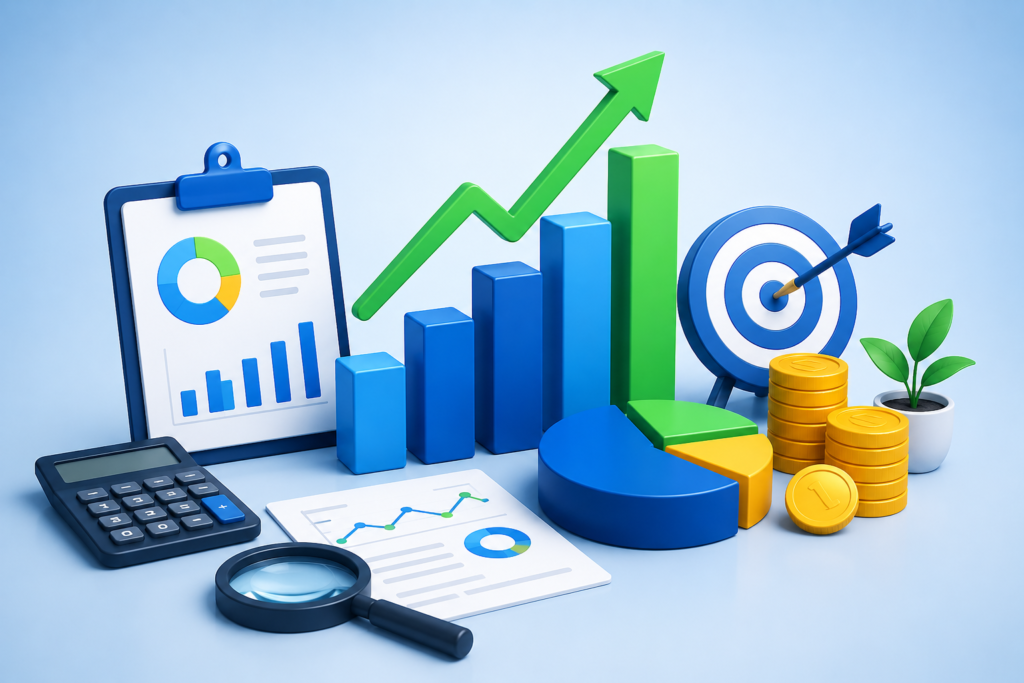
Measuring chatbot success involves tracking key performance indicators such as first-response time, ticket resolution speed, customer satisfaction, employee productivity, operational cost savings, automation rates, and overall service quality. Organizations should compare chatbot performance against predefined business objectives while continuously optimizing workflows based on analytics and user feedback. A well-implemented IT chatbot delivers measurable improvements in efficiency, support availability, user experience, and return on investment, making it a valuable asset for organizations pursuing sustainable digital transformation.
Common Mistakes When Implementing an IT & Computing Chatbot
Many organizations assume that simply deploying a chatbot will immediately improve IT support. However, successful implementation requires planning, continuous optimization, and integration with existing IT processes. One common mistake is launching a chatbot with a limited knowledge base, resulting in inaccurate or incomplete responses that frustrate users. Another frequent issue is failing to provide a smooth escalation path to human support when the chatbot cannot resolve complex technical problems.
Organizations also overlook regular content updates. As software, security policies, and IT infrastructure evolve, chatbot knowledge must be updated to remain accurate. Ignoring user feedback, conversation analytics, and performance reports prevents continuous improvement. Security is another critical concern. Chatbots handling sensitive information should implement authentication, encryption, and role-based access controls while following guidance from the NIST Cybersecurity Framework and the OWASP Top 10. Finally, organizations should avoid replacing human expertise entirely. The most successful chatbot deployments combine AI automation with skilled IT professionals to deliver accurate, efficient, and trustworthy support.
Best Practices Summary
To maximize the value of an IT & Computing Chatbot, organizations should define clear business objectives before implementation. Develop a comprehensive knowledge base that includes frequently asked questions, troubleshooting procedures, software documentation, and security policies. Integrate the chatbot with IT Service Management (ITSM), CRM, cloud platforms, collaboration tools, and enterprise applications to automate repetitive workflows and improve operational efficiency.
Regularly review chatbot conversations, monitor performance metrics, and update responses based on user feedback and changing business requirements. Prioritize security by implementing strong authentication, encryption, and compliance controls. Follow industry best practices from Google Search Central, the NIST Cybersecurity Framework, and OWASP. Finally, provide employees with training on how to use the chatbot effectively while maintaining seamless access to human IT specialists whenever advanced technical support is required.
Frequently Asked Questions
1. What is an IT & Computing Chatbot?
An IT & Computing Chatbot is an AI-powered virtual assistant that automates technical support by answering IT questions, troubleshooting issues, creating support tickets, and assisting users with common technology-related tasks.
2. How does an IT chatbot improve IT support?
It provides instant responses, automates repetitive tasks, reduces ticket volumes, offers 24/7 assistance, improves first-contact resolution, and allows IT professionals to focus on more complex technical issues.
3. Can an IT chatbot integrate with existing business systems?
Yes. Modern IT chatbots integrate with ITSM platforms, CRM systems, cloud services, collaboration tools, identity management solutions, and enterprise applications through secure APIs and automation workflows.
4. Are IT chatbots secure?
Enterprise chatbot platforms include authentication, encryption, audit logs, role-based access controls, and compliance features. Organizations should also follow recognized cybersecurity standards such as the NIST Cybersecurity Framework and OWASP recommendations.
5. Which industries benefit from IT & Computing Chatbots?
Almost every industry can benefit, including healthcare, finance, education, manufacturing, retail, logistics, telecommunications, government, software development, and professional services.
6. Can AI chatbots replace human IT support?
No. AI chatbots are designed to automate repetitive tasks and provide first-level support. Complex incidents, infrastructure problems, cybersecurity investigations, and strategic IT decisions still require experienced human professionals.
7. How can businesses measure chatbot success?
Organizations should monitor key performance indicators such as response time, resolution rate, customer satisfaction, ticket reduction, operational cost savings, employee productivity, and chatbot engagement metrics.
8. What should businesses consider before implementing an IT chatbot?
Businesses should evaluate their support requirements, integration needs, security policies, scalability, AI capabilities, reporting features, and long-term maintenance strategy before selecting a chatbot solution.
Conclusion
Modern organizations require intelligent, scalable, and always-available technical support to meet growing user expectations. An IT & Computing Chatbot helps businesses automate routine IT tasks, improve service quality, strengthen cybersecurity awareness, accelerate issue resolution, and enhance employee productivity. By combining Artificial Intelligence, Natural Language Processing, Machine Learning, and enterprise automation, organizations can create efficient support experiences while reducing operational costs and allowing IT professionals to focus on higher-value initiatives.
Whether supporting internal employees or external customers, AI-powered chatbots have become a strategic component of digital transformation. When implemented with clear objectives, secure integrations, continuous optimization, and industry best practices, they deliver measurable improvements in operational efficiency and user satisfaction. Engagerbot helps organizations build intelligent chatbot solutions tailored to their technical support needs, enabling businesses to modernize IT operations and deliver exceptional digital experiences.
Want to Implement This Easily?
Prompt
You are an expert consultant. Based on the blog post titled “IT & Computing Chatbot”, provide a step-by-step, practical implementation guide. Include tools, best practices, common mistakes to avoid, and advanced tips. Assume the reader wants to implement everything discussed in this article effectively.
Call to Action
Want our help implementing this? Just reach out to us via our website contact form: