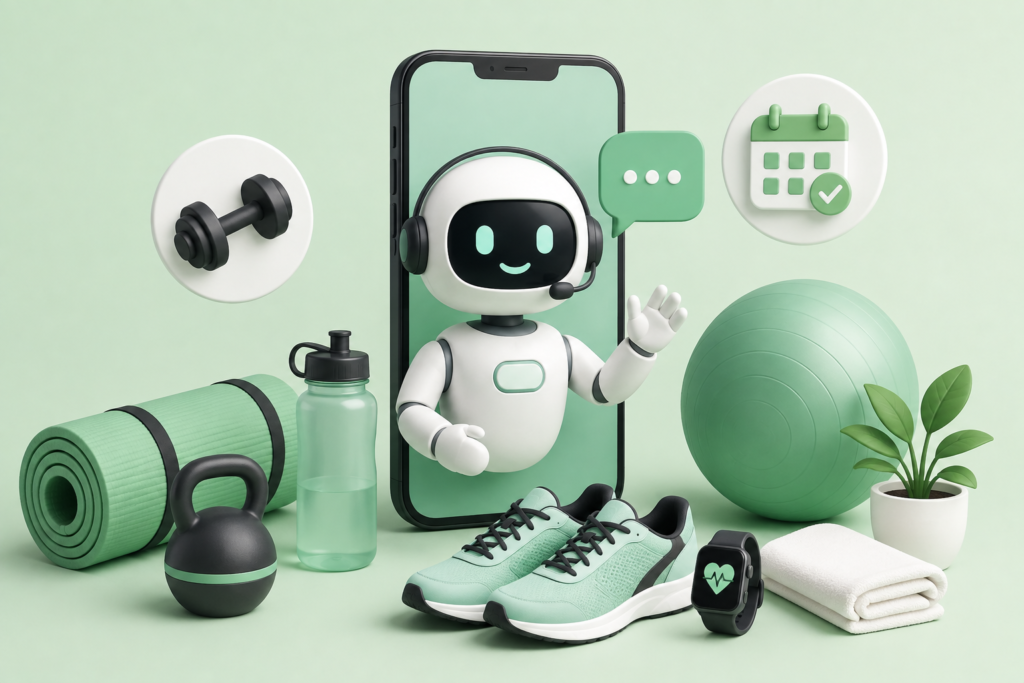
Learn how a Fitness & Leisure Chatbot can improve customer engagement, automate support, generate qualified leads, simplify bookings, personalize experiences, and strengthen fitness and leisure businesses.
Introduction
The fitness and leisure industry is increasingly shaped by customer expectations for convenience, speed, personalization, and easy digital communication. People searching for a gym, fitness studio, sports club, wellness center, recreational facility, personal trainer, swimming program, or leisure activity often want answers immediately. They may need information about memberships, class schedules, prices, opening hours, facilities, bookings, cancellation policies, personal training, or introductory programs. If that information is difficult to locate or the business takes too long to respond, a potential customer may leave and choose another provider.
A Fitness & Leisure Chatbot provides a practical way to improve this experience. It creates a conversational layer through which visitors can ask questions, discover relevant programs, receive guidance, submit inquiries, and find the correct next step without navigating through numerous pages. When properly implemented, the chatbot can support customers throughout the buying journey while reducing repetitive communication tasks for employees.
For businesses using Engagerbot, the goal should not be to replace every human interaction. Instead, automation should handle predictable conversations while staff members remain available for situations requiring professional judgment, empathy, personal attention, or specialized expertise. This distinction is especially important for fitness and leisure businesses because conversations can sometimes involve injuries, medical conditions, nutrition, physical limitations, or other sensitive subjects.
The website supporting the chatbot should also provide genuinely useful information. Google’s current Search guidance emphasizes creating helpful content for people rather than content primarily designed to manipulate rankings. Its spam policies specifically address practices such as keyword stuffing, deceptive functionality, link spam, and scaled low-value content. Google Search spam policies
A strong chatbot strategy therefore combines useful content, thoughtful conversation design, accurate information, responsible automation, and human oversight. The objective is not simply to add AI to a website. The objective is to make it easier for customers to accomplish what they came to the website to do.
What Is a Fitness & Leisure Chatbot?
A Fitness & Leisure Chatbot is an automated or AI-assisted conversational system designed to help fitness, sports, recreation, wellness, and leisure businesses communicate with visitors and customers. Depending on its configuration, it can answer frequently asked questions, explain memberships, provide class information, collect leads, guide users toward booking options, direct visitors to relevant website pages, and initiate human support when automation is not appropriate.
A simple chatbot may rely on predefined questions and answers. A more advanced conversational system can understand natural-language requests and identify the intent behind them. For example, a visitor might type, “I work until late and need a class after 8 PM.” Instead of requiring the person to know the exact name of a class, the chatbot can recognize that the visitor is looking for a suitable evening fitness option and guide the conversation toward available information.
This distinction is important because customers rarely communicate exactly as businesses organize their internal service categories. A fitness business may call something “Functional Strength Conditioning,” while a customer might describe it as “a beginner class that helps me build strength.” A useful chatbot needs to understand the customer’s objective instead of forcing the customer to learn the organization’s terminology.
The chatbot can support multiple audiences. A prospective member may want to compare plans, an existing member may need help locating a class, a personal training customer may want appointment information, and a parent may be researching youth activities. These conversations have different purposes, but they all depend on the same principle: give the customer an accurate and useful next step.
The chatbot must also be transparent about its capabilities. If it cannot access live availability, it should not claim that it has confirmed a booking. If it cannot provide professional medical advice, it should not present itself as a medical authority. Google’s spam guidance includes misleading functionality among practices that can create problems in Search. Google Search spam policies
A trustworthy Fitness & Leisure Chatbot is therefore not the one that attempts to answer every question. It is the one that knows what it can answer, what it cannot answer, and when a human should take over.
Why Fitness and Leisure Businesses Need Conversational Automation
Fitness and leisure businesses receive a large volume of repetitive questions. Reception teams may repeatedly explain membership options, opening times, class schedules, cancellation rules, parking arrangements, facility access, age requirements, guest policies, and booking procedures. Each individual question may be simple, but answering hundreds of similar questions can consume substantial staff time.
A chatbot can provide an immediate first layer of support for these predictable conversations. This becomes especially valuable outside normal operating hours. A potential customer may visit a website late at night and decide that they want to join a gym, book a class, inquire about personal training, or arrange a facility tour. If no assistance is available, that customer may postpone the decision or continue researching competitors.
Conversational automation can also improve the experience for existing members. Someone who simply wants to know when a facility opens should not necessarily have to call reception. A member looking for the class timetable should not need to send an email. A visitor wanting directions should not have to search through several pages.
The chatbot can handle straightforward requests such as:
- “What time do you open on Saturday?”
- “Do you have beginner Pilates?”
- “How much does membership cost?”
- “Can I book a personal trainer?”
- “Do you offer swimming lessons?”
- “Are there evening classes?”
- “What facilities are included?”
- “How do I cancel a booking?”
- “Where can I find the class schedule?”
These interactions are valuable because they remove friction without requiring staff involvement every time.
Automation can also improve internal efficiency. Staff can spend less time responding to repetitive inquiries and more time assisting people who are physically present, dealing with unusual situations, supporting customers with complex questions, or focusing on sales conversations.
However, the purpose of automation should not be to eliminate human support. A good system provides human escalation whenever necessary. Complaints, account problems, accessibility concerns, unusual circumstances, health-related questions, and complex booking situations may all require human attention.
The best model is therefore not “chatbot instead of people.” It is chatbot plus people, with each handling the work they are best suited to perform.
Key Features of a High-Performing Fitness & Leisure Chatbot
A high-performing Fitness & Leisure Chatbot should be designed around actual customer needs. The first requirement is a reliable knowledge base containing accurate information about memberships, classes, facilities, opening hours, locations, booking procedures, policies, and frequently asked questions.
FAQ automation is one of the simplest and most effective capabilities. Customers should be able to ask common questions and receive clear answers without navigating through multiple pages. However, the chatbot should avoid excessively long responses. When a topic requires more detail, it should summarize the answer and direct the customer to the relevant page.
Lead qualification is another important feature. The chatbot can identify visitors interested in memberships, personal training, fitness programs, group classes, sports activities, or facility tours. Instead of immediately demanding contact information, it can first understand the visitor’s needs and then offer a relevant next step.
For example:
Visitor: “I am not sure which membership is right for me.”
Chatbot: “I can help you compare the options. Are you mainly interested in gym access, group classes, swimming facilities, or a combination?”
This type of conversation provides value before requesting additional information.
Booking assistance is also highly useful. Depending on the technology available, the chatbot may guide visitors to a scheduling platform, explain the booking process, collect appointment requests, or work with an integrated booking system. It should always distinguish between requesting a booking and confirming a booking.
Other useful capabilities include:
- Membership assistance
- Class discovery
- Personal training inquiries
- Lead qualification
- Appointment requests
- Customer support
- Human-agent escalation
- Facility information
- Location guidance
- Contact collection
- Conversation analytics
- CRM integration
- Booking integration
- Mobile-friendly conversations
- Knowledge-base management
Accessibility should also be part of the design. The chatbot should work effectively on mobile devices and should not unnecessarily prevent users who rely on keyboard navigation or assistive technologies from accessing important information.
Most importantly, businesses should avoid adding features simply because they sound impressive. A chatbot that reliably solves the ten most important customer problems can be more valuable than a complex system containing dozens of poorly maintained functions.
The guiding principle should always be usefulness first, automation second.
How AI Is Changing Fitness and Leisure Customer Experiences
Artificial intelligence has expanded conversational systems beyond simple predefined menus. Modern AI-powered chatbots can interpret natural language, recognize intent, maintain conversational context, and respond according to approved business information.
This makes conversations more natural for customers. A visitor does not necessarily need to know the exact name of a service. They can describe what they want.
For example:
“I am new to exercise and want something beginner-friendly.”
Or:
“I need something challenging that fits into my lunch break.”
Or:
“I want an activity for my teenager on weekends.”
These statements contain useful information about customer intent. An intelligent chatbot can use that context to guide the conversation.
AI can also support personalization. Someone interested in swimming should receive different guidance from someone searching for strength training. A parent asking about youth programs should not receive the same conversation as an individual researching personal training.
However, personalization should be responsible. A business should not collect unnecessary personal information merely because an AI system can ask for it. Data collection should have a clear purpose, and customers should receive understandable information about relevant data practices.
Health-related questions require additional caution. Fitness customers may ask about injuries, pain, medical conditions, supplements, weight management, exercise restrictions, or recovery. A chatbot should not confidently diagnose a condition or present unsupported individualized medical recommendations.
Instead, it can provide approved general information and recommend appropriate professional assistance when necessary.
This is one of the most important differences between responsible automation and careless automation. The chatbot needs clearly defined boundaries.
Businesses should also monitor chatbot performance continuously. New customer questions will appear, policies will change, schedules will be updated, and new services will be introduced. A chatbot that was accurate six months ago can become unreliable if nobody maintains its knowledge.
The most effective approach is therefore to treat AI as an ongoing customer-experience capability, not as a one-time installation.
How a Fitness & Leisure Chatbot Generates Better Leads
Lead generation is one of the strongest commercial applications for a Fitness & Leisure Chatbot. Traditional forms can be effective, but they often require visitors to enter several details before receiving assistance. A conversational experience can reduce this friction by allowing visitors to explain what they need naturally.
The chatbot can begin by identifying the visitor’s goal. Someone may be interested in membership, personal training, classes, swimming, sports programs, youth activities, or facility information. Once the intent is understood, the chatbot can provide useful information and offer a relevant action.
This creates a value-first lead-generation journey.
Instead of:
“Enter your name, phone number, email, age, location, and message.”
The experience can become:
“What are you interested in?”
Then:
“Great. Are you looking for individual training or group classes?”
Then:
“Would you like a team member to contact you about the available options?”
The second approach feels more conversational and can reduce the psychological barrier associated with long forms.
Lead qualification can also improve. Not every website visitor has the same level of purchase intent. Some are ready to join immediately. Others are comparing providers. Some may only want to know the opening hours.
The chatbot can identify these differences without aggressively pushing visitors toward a sale.
Useful qualification questions may include:
- What type of program are you interested in?
- Are you looking for individual or group sessions?
- What type of schedule works for you?
- Are you interested in membership information?
- Would you like to arrange a consultation?
- Would you like someone from the team to contact you?
The number of questions should remain appropriate. Asking for unnecessary information can create friction and reduce trust.
Another advantage is conversational context. When a qualified prospect is transferred to a staff member, the relevant conversation history can help the employee understand what the customer already asked.
This avoids forcing the visitor to repeat the same information.
The objective should therefore be higher-quality leads and better customer experiences, rather than simply increasing the number of conversations.
Using Chatbots for Gym Memberships, Classes, and Personal Training
Membership questions are among the most common interactions for gyms and fitness organizations. Visitors may want to understand pricing, contract terms, access levels, facilities, joining fees, cancellation policies, guest rules, or differences between membership plans.
A chatbot can turn this information into a guided comparison. Instead of requiring visitors to read every membership page, it can ask what they need and direct them toward relevant information.
For example, someone who wants basic gym access may need a different membership from someone who wants gym access, group classes, and swimming facilities.
The chatbot can help organize this information without making the customer search manually.
Class discovery is another major opportunity. Fitness businesses may offer yoga, Pilates, cycling, strength training, functional training, swimming, dance, martial arts, and other activities across different schedules.
Customers often need help matching these options with their own circumstances.
A visitor might say:
“I want a beginner class after work.”
The chatbot can ask about the preferred activity and schedule, then guide the person toward relevant information.
Personal training conversations can follow a similar process. The chatbot can explain what personal training includes, describe the consultation process, answer general questions, collect an inquiry, and direct visitors toward scheduling.
It should not, however, pretend to create an individualized medical or exercise prescription without qualified professional involvement.
Existing members can also benefit. They may need help locating booking pages, understanding class procedures, finding facility information, or contacting the correct department.
This means the chatbot can support both customer acquisition and customer retention.
Accuracy remains critical. If membership prices, schedules, trainer availability, or policies change, the chatbot’s information must also be updated.
A chatbot with outdated information is not merely inconvenient. It can undermine the credibility of the entire business.
For this reason, every fitness business should establish a process for reviewing chatbot information and updating it whenever operational changes occur.
Designing a Fitness & Leisure Chatbot Around Real Customer Intent
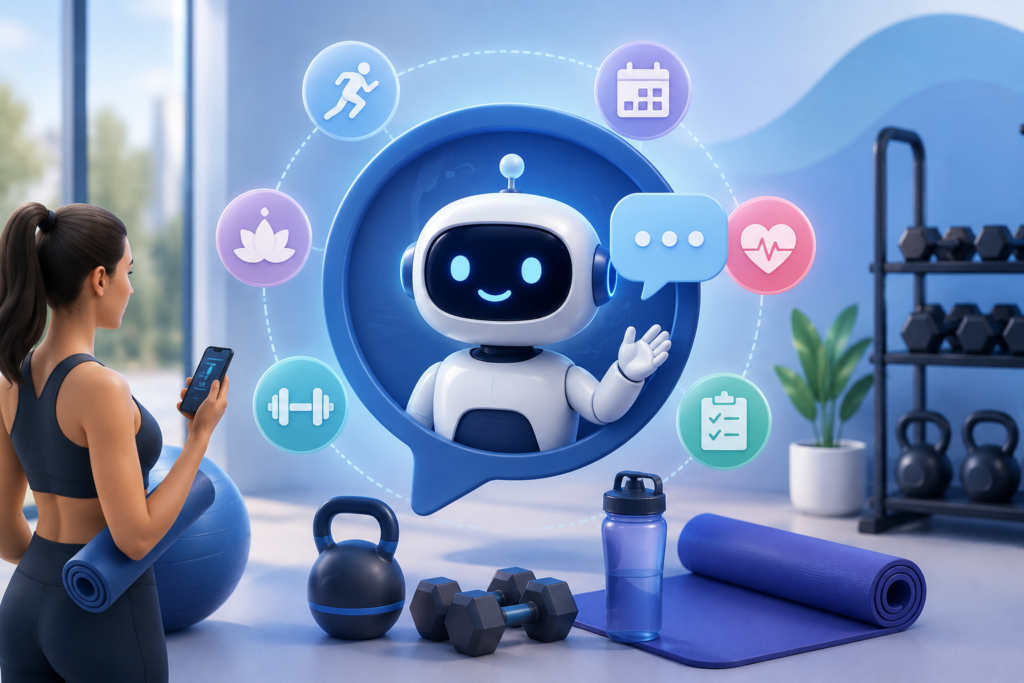
A chatbot should be built around what customers are trying to accomplish rather than simply copying the business’s internal structure.
A company might organize its website around “Membership,” “Facilities,” “Classes,” and “Personal Training.” Customers may express their needs very differently.
They might say:
“I want to become stronger but I only have three evenings free.”
Or:
“I have never used a gym before. What would you recommend?”
Or:
“Do you have something my teenager can do on Saturday?”
Each statement represents an intent.
Intent-based chatbot design begins by collecting real customer language. Businesses can review:
- Website search queries
- Reception questions
- Sales inquiries
- Customer-support tickets
- Emails
- Social media questions
- Contact-form submissions
- Existing FAQ pages
- Booking-related questions
These sources can reveal the language customers actually use.
The next step is to organize the questions into meaningful conversational intents.
Common intents include:
- Membership information
- Pricing
- Class discovery
- Personal training
- Booking support
- Cancellation
- Opening hours
- Facility information
- Directions
- Youth activities
- Accessibility
- General support
- Human assistance
Each intent should have a clear response strategy.
The chatbot should also know when an interaction is outside its scope. A customer requesting medical diagnosis should not receive an invented diagnosis. Someone with a serious complaint should not be trapped in an automated loop.
A clear human handoff is better than an inaccurate answer.
Conversation design should prioritize clarity, accuracy, and efficiency. Personality can make a chatbot friendlier, but personality should never interfere with the customer’s ability to understand the answer.
Testing is equally important.
Businesses should test the chatbot with new customers, existing members, mobile users, people who phrase questions differently, people who ask vague questions, and people who deliberately ask questions outside the system’s scope.
The objective is not to make the chatbot answer everything.
It is to make the chatbot excellent at the conversations that matter most.
Making a Fitness & Leisure Chatbot SEO-Friendly
A chatbot should support an SEO strategy rather than attempt to replace one.
Search engines need useful, accessible website content. Customers also need detailed information that may be difficult to communicate through short chatbot messages.
The strongest approach is to maintain comprehensive website pages while allowing the chatbot to guide users toward them.
A fitness business may maintain dedicated pages for:
- Gym memberships
- Fitness classes
- Personal training
- Swimming
- Sports activities
- Leisure programs
- Booking information
- Cancellation policies
- Frequently asked questions
When someone asks the chatbot about one of these subjects, the system can provide a concise answer and direct the visitor to the relevant page.
This creates a connection between search visibility and conversational usability.
Relevant keywords can help define the subject area. Potential terms include fitness chatbot, gym chatbot, fitness center chatbot, leisure chatbot, personal training chatbot, gym membership chatbot, fitness class chatbot, sports club chatbot, wellness chatbot, and fitness booking chatbot.
However, keywords should appear naturally.
Google explicitly defines keyword stuffing as filling a page with keywords or numbers in an attempt to manipulate search rankings. Keyword stuffing
That means repeatedly inserting “fitness chatbot” into every paragraph would be counterproductive. The better approach is to cover the subject comprehensively and naturally.
Internal links should also use meaningful anchor text that accurately describes the destination. Google’s current documentation specifically discusses the importance of clear and descriptive anchor text. Google Search Central documentation
The website should also maintain sound technical foundations. Google’s Search Essentials cover the fundamental requirements and best practices that help content become eligible to appear in Search. Google Search Essentials
The chatbot should therefore complement, not replace, crawlable website content.
The goal is to make the website useful for searchers and make that information easier for visitors to discover through conversation.
Fitness & Leisure Chatbots for Customer Support and Member Retention
Customer support continues long after someone purchases a membership. Members may need help with schedules, bookings, facilities, policies, payments, account-related questions, or program information.
A chatbot can provide a first layer of self-service support for predictable issues.
For example, a member may ask:
“Where can I find the latest class schedule?”
Or:
“What time does the pool close?”
Or:
“How do I change my booking?”
If the chatbot can answer these questions accurately, staff members can spend more time on complex issues.
This can also improve member satisfaction because customers do not always need to wait for business hours to receive basic information.
Retention can benefit from better engagement as well. A chatbot can help members discover programs they may not have considered, explain new classes, provide information about facility features, or direct customers toward relevant resources.
However, communication should remain useful rather than excessive. Too many automated messages can become annoying and may reduce engagement.
One of the most valuable uses of chatbot analytics is identifying customer friction.
Suppose hundreds of members ask:
“How do I book a class?”
That may indicate that the booking system is difficult to understand.
The solution may not be to make the chatbot better at answering the question. The business may need to improve the booking interface itself.
This is why chatbot analytics should be used as a customer-experience research tool.
Businesses can monitor:
- Most common questions
- Unanswered questions
- Conversation abandonment
- Human handoff rates
- Successful task completion
- Lead conversion
- Booking-related interactions
- Customer feedback
- Repeated support problems
These insights can inform website improvements, staff training, content development, and operational changes.
Customer information should also be handled responsibly. Businesses should establish appropriate data-access controls and privacy processes rather than allowing conversational data to become an unmanaged information source.
A chatbot becomes most valuable when it helps the business understand why customers need assistance, not simply when it answers their questions.
Advanced Personalization Strategies for Fitness & Leisure Chatbots
Personalization can make a chatbot significantly more useful when it is based on information that genuinely helps the customer.
A visitor searching for beginner classes should not receive the same guidance as someone looking for advanced performance training. A parent researching children’s activities has different requirements from an individual looking for personal training.
The chatbot can personalize conversations based on information the customer voluntarily provides during the interaction.
For example, it may ask:
“What type of activity are you interested in?”
Then:
“Are you looking for beginner, intermediate, or advanced options?”
Then:
“What days or times are convenient for you?”
Each answer can improve the relevance of the next response.
This creates progressive personalization rather than forcing customers to complete a large questionnaire.
Personalization can also be useful after someone becomes a member. If a customer frequently asks about a particular type of class, the chatbot can make relevant information easier to access.
However, businesses should avoid creating the impression that the chatbot knows more about a customer than the customer expects.
Transparency matters.
Customers should understand when information is being used to personalize their experience, particularly when conversations involve account data or potentially sensitive information.
Personalization should also never become discriminatory. A chatbot should not make inappropriate assumptions about a person’s fitness level, age, health, ability, or goals simply because of limited information.
The safest approach is to ask when information matters.
For example, instead of assuming a customer is a beginner, ask:
“Would you prefer beginner-friendly options or more advanced sessions?”
This gives the customer control.
Advanced personalization can also include contextual recommendations. Someone asking about a specific class could be guided toward related programs, provided the recommendations are genuinely relevant.
The objective should not be maximizing the number of promotional recommendations.
The objective should be helping customers discover something useful.
When personalization is transparent, relevant, and controlled by the user, it can improve engagement without compromising trust.
Integrating a Fitness & Leisure Chatbot With Business Systems
A chatbot becomes considerably more useful when it can work with the systems the business already uses.
A fitness organization may have separate platforms for:
- Membership management
- Class scheduling
- Appointment booking
- CRM
- Email marketing
- Customer support
- Payment processing
- Website analytics
- Lead management
Without integration, the chatbot may only provide information. With appropriate integrations, it may be able to support actual workflows.
For example, a chatbot could guide a customer toward a booking system instead of simply explaining how bookings work. It could collect lead information and pass it to a CRM. It could help a customer find the appropriate account-support process.
However, integrations must be designed carefully.
A chatbot should not automatically receive access to every system simply because an integration is technically possible. Access should be limited according to the task.
Authentication is particularly important for account-related actions. Public information such as opening hours may not require authentication, while account changes, payment information, or personal records may require stronger verification.
The business should also consider what happens when an integration fails.
If the booking platform is temporarily unavailable, the chatbot should not pretend that the booking succeeded. It should explain the limitation and provide an alternative.
This is another example of why transparent failure handling is important.
Businesses should also maintain clear ownership of integrated workflows. Someone should know which system is the source of truth for membership information, schedules, pricing, and availability.
If the chatbot and booking platform contain different information, customers will quickly notice.
Integration architecture should therefore prioritize:
- Accuracy
- Security
- Reliability
- Clear ownership
- Graceful failure
- Appropriate authentication
- Data minimization
The purpose of integration is not to make the chatbot technically impressive.
It is to allow the customer to complete useful tasks with fewer unnecessary steps.
Privacy, Security, and Trust in Fitness & Leisure Chatbots
Trust is one of the most important requirements for a fitness chatbot because customers may voluntarily share personal information during conversations.
The business should decide what information genuinely needs to be collected.
For basic questions, the answer may be very little.
A visitor asking about opening hours does not need to provide their phone number.
A customer asking about class schedules does not need to disclose private health information.
A lead requesting a consultation may reasonably provide contact information.
This principle of data minimization helps reduce unnecessary privacy risk.
Businesses should also define who can access conversation data, how long it is retained, and how it is used. Staff members should only have access to information necessary for their responsibilities.
Security should also be considered across the chatbot’s integrations. If the chatbot connects to customer-management systems, booking platforms, or account systems, those connections should use appropriate authentication and authorization controls.
Sensitive actions should receive additional protection.
For example, a public visitor might be able to ask:
“What are your membership options?”
But changing account details should require an appropriate authenticated process.
The chatbot should also avoid exposing information about one customer to another customer.
Error messages should be carefully designed. Technical errors should not accidentally reveal internal system details, credentials, database information, or other sensitive implementation information.
Businesses should also establish procedures for handling suspicious conversations, abusive inputs, and attempts to manipulate the chatbot.
Trust extends beyond security.
Customers should know when they are communicating with automation and when they are being transferred to a person. The chatbot should not falsely represent itself as a human.
It should also avoid making unsupported claims.
A trustworthy chatbot is honest about what it knows, what it does, what information it uses, and when it needs human assistance.
This is especially important for fitness and leisure businesses because customer confidence can directly influence whether someone feels comfortable joining, booking, or returning.
Measuring Fitness & Leisure Chatbot Performance and ROI
A chatbot should not be judged solely by the number of conversations it receives.
High conversation volume may actually indicate that users are confused and repeatedly asking for help.
A stronger measurement framework evaluates whether conversations produce useful outcomes.
Important metrics can include:
Lead Generation
Measure the number of qualified inquiries generated through the chatbot rather than simply counting conversations.
Conversion Rate
Track how many chatbot-assisted visitors ultimately complete a meaningful business action.
Booking Assistance
Measure how effectively the chatbot helps visitors reach or complete appropriate booking workflows.
Resolution Rate
Determine how many common questions are answered successfully without unnecessary human intervention.
Human Handoff Rate
A high handoff rate is not automatically negative. It may indicate that the chatbot is correctly recognizing situations requiring human expertise.
Abandonment Rate
Identify where visitors leave conversations before reaching a useful outcome.
Unresolved Intent Rate
Track questions the chatbot cannot understand or answer.
Customer Feedback
Ask users whether the interaction was useful and whether they found what they needed.
Revenue Attribution
Where reliable tracking is available, compare chatbot-assisted leads or bookings with actual commercial outcomes.
Analytics should also be segmented.
For example, compare performance across:
- New visitors
- Existing members
- Mobile users
- Desktop users
- Membership inquiries
- Class inquiries
- Personal training inquiries
- Support conversations
This can reveal where the chatbot creates the greatest value.
Businesses should also review conversations qualitatively.
Numbers alone cannot explain why customers abandon an interaction.
A monthly conversation review can identify new customer questions, outdated information, confusing responses, and opportunities for improvement.
The most mature chatbot programs therefore use a continuous optimization cycle:
Measure → Review → Improve → Test → Measure again.
This prevents the chatbot from becoming a neglected website feature.
ROI should also consider operational savings.
If the chatbot resolves thousands of routine inquiries, staff may have more time for higher-value work. If it improves lead qualification, sales teams may spend more time with serious prospects. If it makes booking information easier to find, customer frustration may decline.
The real value comes from the combined effect on revenue, efficiency, customer experience, and retention.
Step-by-Step Strategy for Implementing a Fitness & Leisure Chatbot
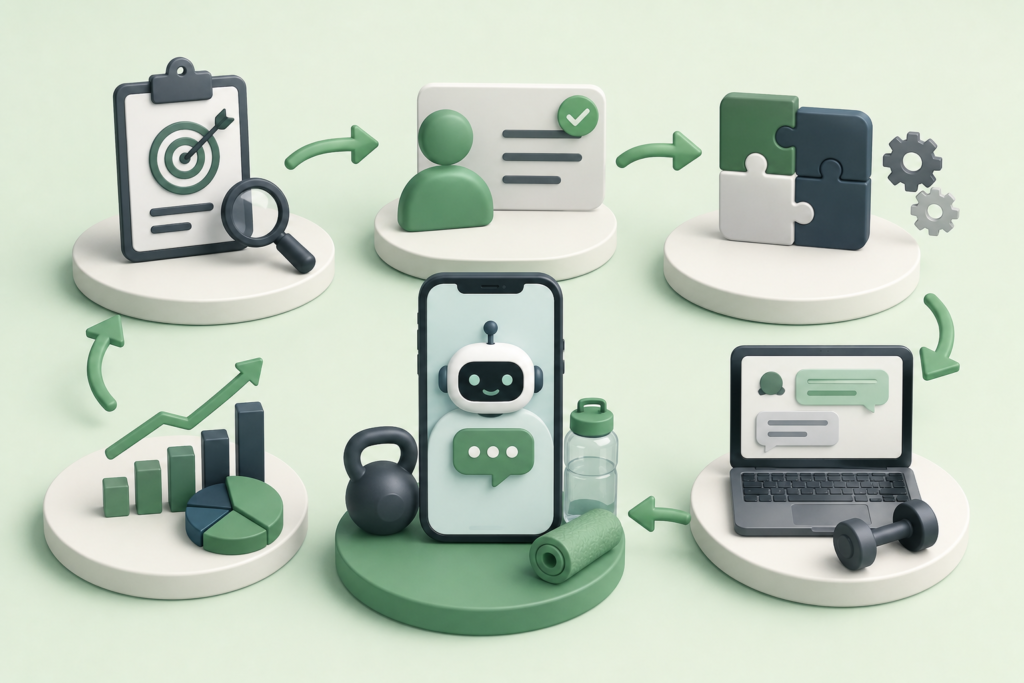
The first step is to define the business objectives. Decide what the chatbot should accomplish. Examples include generating membership leads, answering common questions, assisting with class discovery, supporting bookings, reducing repetitive support requests, or improving customer engagement.
The second step is to collect real customer questions. Review emails, support tickets, sales conversations, website searches, contact forms, and reception inquiries.
The third step is to organize those questions into conversational intents.
The fourth step is to create approved answers for the highest-priority intents. These answers should be accurate, concise, and written in language customers understand.
The fifth step is to define escalation rules.
Determine which questions should always be transferred to humans.
Examples may include:
- Complaints
- Account problems
- Sensitive health questions
- Complex booking issues
- Payment disputes
- Accessibility concerns
- Requests outside the chatbot’s scope
The sixth step is to determine what integrations are actually necessary.
Avoid connecting every available system. Start with the workflows that produce the greatest customer benefit.
The seventh step is to design the user experience for mobile and desktop.
The eighth step is to test real conversations before launch.
Do not test only ideal questions.
Test misspellings, vague questions, unexpected requests, repeated questions, unsupported topics, and requests for human help.
The ninth step is to launch gradually.
Monitor conversations closely during the initial period.
The tenth step is continuous improvement.
Review unanswered questions and conversation abandonment. Update outdated information and improve confusing responses.
Google’s documentation is regularly updated, so businesses should also periodically review their SEO practices against current official guidance rather than relying on outdated advice. Google Search Central documentation updates
A successful implementation is not finished when the chatbot goes live.
It is finished only when the organization has established a process for maintaining, measuring, and improving it over time.
Common Mistakes When Implementing a Fitness & Leisure Chatbot
One of the biggest mistakes is launching a chatbot without clearly defining its purpose.
A business may install a chatbot simply because competitors have one. Without specific goals, the chatbot can become a generic tool that provides little measurable value.
Another common mistake is using outdated information.
Fitness schedules, prices, promotions, instructors, policies, and facilities can change frequently. If the chatbot continues giving old answers, customers may lose trust.
Businesses should therefore establish clear ownership of chatbot content.
Another problem is over-automation.
Customers should never feel trapped in an endless automated loop.
A visible and easy-to-understand human assistance option should be available when appropriate.
Poorly designed lead forms can also reduce conversions. Asking for too much information too early can discourage visitors.
Businesses should collect only information that serves a clear purpose.
Health-related overreach is another serious mistake.
A chatbot should not diagnose injuries or medical conditions or make unsupported professional claims.
Another problem is excessive promotional messaging.
If every conversation becomes a sales pitch, customers may stop trusting the chatbot.
The system should answer the customer’s question first.
Mobile usability is also frequently overlooked.
A chatbot that works well on desktop but is difficult to use on a smartphone can create unnecessary friction.
Businesses should also avoid treating conversation volume as the main performance metric.
More conversations do not necessarily mean more success.
Finally, SEO teams should avoid filling chatbot-supported pages with repetitive keywords or mass-producing low-value pages solely to capture search traffic. Google’s current spam policies explicitly address keyword stuffing and scaled content abuse. Google Search spam policies
The strongest approach is always quality over quantity.
Best Practices Summary
A successful Fitness & Leisure Chatbot should begin with real customer needs rather than technology.
Define specific goals.
Collect real customer questions.
Build conversations around user intent.
Provide accurate information.
Keep responses clear and concise.
Create strong human escalation paths.
Protect customer information.
Avoid unnecessary data collection.
Integrate only the systems that provide meaningful value.
Test mobile usability.
Review conversations regularly.
Track meaningful business outcomes.
Keep the knowledge base updated.
Use analytics to identify customer friction.
Avoid keyword stuffing.
Avoid low-value scaled content.
Maintain high-quality website content alongside the chatbot.
Use descriptive internal links where they help customers discover more information.
Follow current official Google guidance rather than outdated SEO assumptions. Google’s current Search documentation emphasizes people-first content and provides regularly updated guidance for Search practices. Google Search Central
Most importantly, remember that automation should serve the customer.
The purpose of a Fitness & Leisure Chatbot is not to make the business look more technologically advanced.
Its purpose is to make the customer’s experience faster, clearer, easier, and more useful.
Frequently Asked Questions
What is a Fitness & Leisure Chatbot?
A Fitness & Leisure Chatbot is an automated conversational system designed for gyms, fitness studios, sports clubs, wellness businesses, recreational facilities, and other leisure organizations. It can answer questions, provide information, generate leads, support bookings, guide customers toward relevant pages, and transfer complex requests to human staff.
Can a Fitness & Leisure Chatbot generate gym membership leads?
Yes. A chatbot can ask visitors what they are interested in, provide relevant membership information, answer questions, qualify prospects, and invite interested visitors to request a consultation or contact from the business.
The strongest approach is to provide useful information before asking for contact details.
Can a chatbot help customers book fitness classes?
It can, depending on the business’s booking technology and integrations. A chatbot may explain booking procedures, direct visitors to the appropriate scheduling system, collect booking requests, or interact with an integrated booking workflow.
The chatbot should never claim a booking is confirmed unless the system can actually verify the booking.
Can a fitness chatbot answer health or injury questions?
It can provide carefully reviewed general information where appropriate, but it should not pretend to diagnose medical conditions or replace qualified healthcare professionals.
Questions requiring professional medical judgment should be escalated appropriately.
Can a chatbot support existing gym members?
Yes. It can help members locate class schedules, find facility information, understand policies, access booking resources, request assistance, and find answers to common questions.
This can reduce repetitive support requests and make information easier to access.
Is a chatbot useful outside business hours?
Yes. One of the major benefits is the ability to provide approved information and collect inquiries when staff are unavailable.
This can help businesses respond to potential customers who visit their websites outside normal operating hours.
Does a Fitness & Leisure Chatbot improve SEO?
A chatbot does not automatically improve search rankings. Its primary purpose is customer interaction.
However, it can support a broader SEO strategy by helping visitors discover useful website content and revealing common questions that can inform future content development.
SEO should continue to focus on useful, people-first website content. Google Search Essentials
How should businesses measure chatbot success?
Businesses should track meaningful outcomes such as qualified leads, booking assistance, successful resolutions, human handoffs, unresolved intents, abandonment rates, customer feedback, and revenue or conversion outcomes where reliable attribution is possible.
Conversation volume alone is not a sufficient measure of success.
Conclusion
A Fitness & Leisure Chatbot can become a valuable part of the modern customer journey when it is designed around genuine customer needs. From answering membership questions and helping visitors discover classes to generating qualified leads, supporting existing members, simplifying booking journeys, and identifying customer-service friction, conversational technology can create meaningful improvements across the business.
The most successful implementations are not necessarily the most complicated. They are the ones that provide accurate information, understand customer intent, minimize unnecessary friction, protect customer trust, and know when human assistance is required.
For fitness and leisure businesses, the opportunity is especially strong because customers frequently need quick answers and convenient access to information. A well-designed chatbot can provide that support while allowing staff to focus on higher-value interactions.
SEO should remain part of the broader strategy, but it should never come at the expense of usefulness. Google continues to emphasize people-first experiences and actively addresses manipulative practices such as keyword stuffing and low-value scaled content. Google Search spam policies
The right approach is therefore straightforward: build useful content, design helpful conversations, protect customer information, measure real outcomes, and continuously improve the experience.
When those principles are followed, a Fitness & Leisure Chatbot can become more than a website feature. It can become a practical digital assistant that supports customer acquisition, engagement, service, and retention.
For businesses ready to move from basic website communication toward a more convenient conversational experience, the next step is to identify the highest-value customer journeys and design automation around them.
Want to Implement This Easily?
Prompt Text:
You are an expert consultant. Based on the blog post titled “(Fitness & Leisure Chatbot)”, provide a step-by-step, practical implementation guide. Include tools, best practices, common mistakes to avoid, and advanced tips. Assume the reader wants to implement everything discussed in this article effectively.
Call to Action: Want our help implementing this? Just reach out to us via our website contact form: contact form