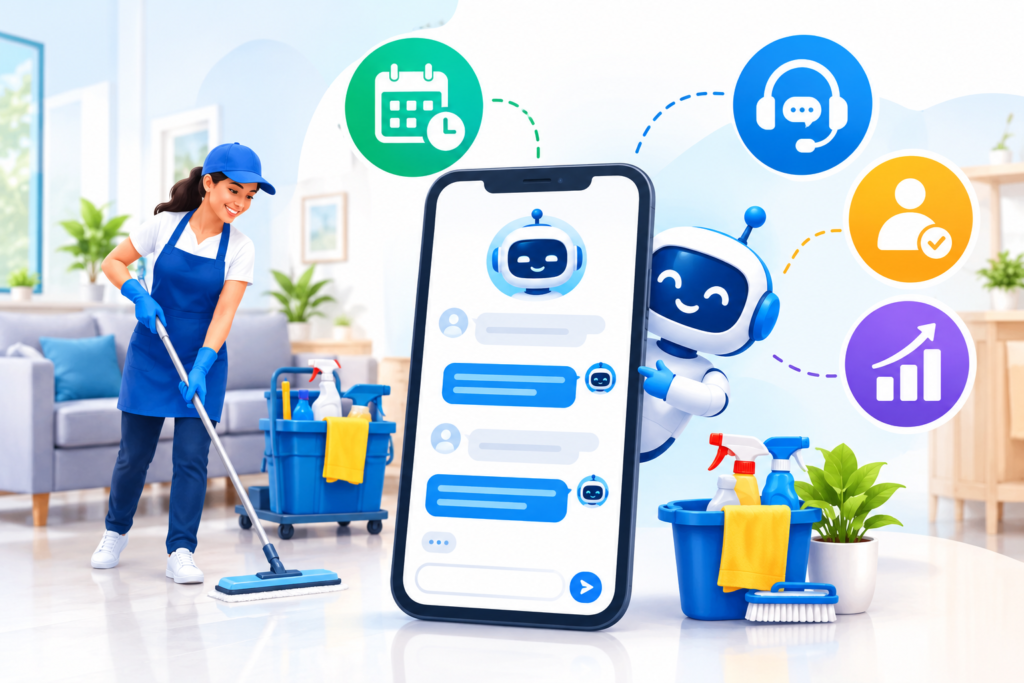
Discover how a cleaning services chatbot automates bookings, answers customer questions, generates leads, improves scheduling, and helps cleaning businesses grow.
Introduction
The cleaning industry depends on fast communication, reliable scheduling, consistent service quality, and strong customer relationships. Whether a company provides residential cleaning, commercial cleaning, office maintenance, deep cleaning, carpet cleaning, or move-in and move-out cleaning, customers expect convenient ways to request information and arrange appointments. When potential customers cannot get answers quickly, they may contact another provider. A cleaning services chatbot helps businesses respond to inquiries, collect essential booking details, qualify leads, and guide customers toward the right cleaning solution without requiring a staff member to handle every routine conversation manually.
A chatbot for a cleaning company is an automated conversational assistant that interacts with website visitors and, depending on the platform, customers using other supported messaging channels. It can explain available cleaning options, ask about property size, collect preferred appointment times, answer frequently asked questions, and direct customers toward a booking form or human representative. More advanced systems can connect with scheduling software, customer relationship management platforms, payment tools, and customer support systems. The objective is not simply to automate conversations. It is to make the customer journey easier while helping the business organize inquiries and use its time more effectively.
For cleaning companies exploring conversational automation, Engagerbot provides a relevant starting point for understanding how chatbot technology can support customer communication and lead generation. However, successful implementation requires more than adding a chat window to a website. Businesses must design useful conversation flows, protect customer information, maintain accurate service details, and provide a clear route to human assistance. This guide explains how a cleaning services chatbot works, which features matter most, how to implement it responsibly, and how to measure whether it delivers meaningful business value.
What Is a Cleaning Services Chatbot?
A cleaning services chatbot is a digital assistant designed to communicate with customers, answer questions about cleaning options, collect service requirements, and support the booking process. It operates through a conversational interface, usually displayed as a chat window on a business website or integrated into another supported messaging channel. Instead of requiring visitors to search through several pages or wait for a callback, the chatbot can guide them through a series of relevant questions and present the next appropriate step. For example, a customer looking for a residential cleaning appointment might be asked whether the property is an apartment or house, how many bedrooms require cleaning, which services are needed, and what date would be convenient. The chatbot can then collect contact details and direct the customer to an available booking process.
Unlike a basic contact form, a conversational assistant can gather information progressively. It can ask follow-up questions based on earlier answers, explain unfamiliar services, and help visitors understand the difference between standard cleaning, deep cleaning, end-of-tenancy cleaning, and specialized treatments. This makes the experience particularly useful for customers who know they need cleaning but are uncertain about which package fits their circumstances. Depending on its configuration and integrations, the chatbot may also provide estimated pricing based on predefined rules, share preparation instructions, or send booking information to a customer management system. However, it should clearly distinguish between an estimate and a confirmed quotation, especially when final prices depend on property condition, access requirements, or additional work.
There are several types of cleaning chatbots. A rule-based chatbot follows predefined questions, decision paths, and responses, making it suitable for straightforward inquiries and structured bookings. An AI-powered chatbot can interpret a wider variety of natural-language questions and respond using approved business information. Some systems combine both approaches, using predictable workflows for collecting essential details and AI for understanding less structured requests. The appropriate choice depends on the company’s service range, conversation volume, budget, and technical resources. A small residential cleaning company may need only a simple booking assistant, while a commercial cleaning provider might require lead qualification, site-visit scheduling, and integration with sales operations. In every case, the chatbot should have a clear purpose, accurate information, and an easy handoff to a person when a request falls outside its capabilities.
Why Cleaning Businesses Need Chatbot Automation
Cleaning businesses frequently receive inquiries while employees are cleaning properties, driving between appointments, supervising teams, or managing supplies. Answering every telephone call and website message immediately can be difficult, particularly for small businesses with limited administrative support. A cleaning company chatbot helps address this operational challenge by handling suitable routine conversations automatically. Visitors can learn about services, understand booking requirements, and submit inquiries even when the office is busy or temporarily unavailable. This does not guarantee that every visitor will become a customer, but it creates a more accessible first point of contact and reduces the likelihood that a simple question will remain unanswered solely because staff members are occupied.
Another reason to introduce chatbot automation is the amount of information required before a cleaning appointment can be arranged accurately. A company may need to know the property type, approximate size, location, preferred service date, cleaning frequency, and any special requirements. When these details arrive through scattered emails, incomplete contact forms, and informal messages, staff may need to contact the customer repeatedly to clarify the request. A structured chatbot can gather these details in a consistent sequence, helping employees review more complete inquiries before preparing quotations or assigning cleaning teams. The resulting information can also make it easier to distinguish between customers seeking a one-time deep clean and businesses exploring recurring commercial cleaning contracts.
Chatbot automation can also support more consistent customer service as a company expands. Without documented response procedures, different employees may describe the same service differently, overlook important booking conditions, or provide conflicting information about cancellation policies. A well-maintained chatbot can present approved answers consistently and route exceptions to the appropriate employee. Nevertheless, automation should complement rather than eliminate personal communication. Customers dealing with property access concerns, complaints, unusual cleaning requirements, or urgent changes may need direct assistance. The strongest approach is to automate repetitive administrative work while preserving human judgment for situations that require empathy, negotiation, or operational decision-making. By treating automation as a practical support system rather than a complete replacement for staff, cleaning businesses can improve communication without sacrificing the personal service that often distinguishes a trusted local provider.
Key Benefits of a Cleaning Company Chatbot
One major benefit of a cleaning company chatbot is improved accessibility. Customers often research cleaning providers outside conventional office hours, including evenings and weekends. A chatbot can answer approved questions about service categories, operating policies, service areas, and booking procedures whenever the website is available. This is particularly valuable when customers are comparing multiple companies and want basic information before making contact. The assistant can also explain what information is needed for a quotation, helping customers prepare a more useful inquiry. Businesses should avoid describing this capability as guaranteed round-the-clock customer support unless the entire support operation, including escalation arrangements, genuinely provides that level of coverage.
A second benefit is more organized lead generation. Instead of collecting only a name and email address, the chatbot can ask visitors about their cleaning requirements and record relevant details with appropriate consent. A commercial prospect, for example, might identify an office location, approximate floor area, required cleaning frequency, and desired contract start date. A residential customer might provide the number of rooms, preferred appointment window, and whether the request concerns regular or one-time cleaning. This information can help the business prioritize follow-ups, assign inquiries to suitable employees, and prepare more relevant quotations. When integrated with a customer relationship management system, it may also reduce duplicate data entry and make follow-up processes easier to track.
A third benefit is operational efficiency. Staff members spend time answering recurring questions, checking basic booking details, sending reminders, and explaining standard policies. Automating appropriate portions of these activities can create more time for service delivery, quality control, employee coordination, and customer relationships. The chatbot may also improve the consistency of information provided to customers, provided that its content is regularly reviewed. Its actual financial value depends on implementation costs, usage, integration quality, and whether the business uses the resulting time productively. Companies should therefore measure practical outcomes such as qualified inquiries, completed bookings, response time, administrative workload, and customer satisfaction rather than assuming that installing a chatbot automatically increases revenue. A carefully configured system can become a useful part of the customer experience, but its benefits depend on the quality of the process surrounding it.
Essential Features Every Cleaning Services Chatbot Should Have
The most important feature is a structured service inquiry and booking workflow. The chatbot should identify the type of cleaning requested, collect relevant property details, ask about the customer’s preferred date, and explain the next step. It should request only information needed for the task and make each question easy to understand. For example, asking a visitor to select between residential, commercial, deep, and move-out cleaning may be more practical than displaying a long list of every available service at the beginning. Follow-up questions can then adapt to the selected category. A commercial inquiry might require business premises details, while a residential request might need the approximate number of bedrooms and bathrooms.
A second essential feature is an accurate service information library. The chatbot should answer common questions about cleaning packages, service areas, operating hours, preparation requirements, cancellation terms, and quotation procedures. Information about specialist services should be included only when the business genuinely provides them. If carpet extraction, exterior window cleaning, post-construction cleaning, or environmentally focused products are not available, the chatbot must not imply otherwise. Where pricing depends on property conditions or an inspection, it should explain the quotation process rather than inventing a price. A useful assistant can also collect questions it cannot answer, allowing the company to identify gaps in its published information and improve the customer experience over time.
A third essential feature is human handoff. Customers should be able to request an employee when they have a complaint, need a customized quotation, want to discuss a large contract, or encounter an answer that does not address their concern. The handoff should preserve the conversation summary and collected details where technically possible and permitted, so the customer does not have to repeat everything. Other useful features include appointment confirmations, reminder workflows, lead qualification, multilingual support when properly configured, analytics, and integrations with scheduling or customer management software. Security controls are equally important: restrict staff access to customer information, protect connected accounts, and establish appropriate data retention practices. A feature should be included because it solves a real customer or operational problem, not simply because it appears on a chatbot platform’s feature list.
How to Automate Cleaning Service Bookings
Automating cleaning bookings begins with mapping the existing booking process. Before configuring a chatbot, the business should document how an inquiry becomes a confirmed appointment, including quotation approval, availability checks, payment requirements, service preparation, and confirmation messages. This reveals which steps are suitable for automation and which require employee approval. For example, collecting a customer’s address and preferred time is relatively straightforward, but promising a particular cleaning team at a particular hour requires access to reliable scheduling information. If the business uses a manual calendar, the chatbot should collect a preferred appointment window and explain that staff will confirm availability instead of presenting the request as a confirmed booking.
The conversation should then guide the customer through a short, logical sequence. First, establish the service category and property type. Next, collect the details required to estimate the workload, such as property size, room count, cleaning frequency, and special requirements. Ask for the service location and preferred appointment window when these details are needed to assess coverage and availability. The chatbot can then provide an approved estimate, request additional information, or route the inquiry to an employee. For an integrated booking system, it may display genuinely available appointment slots and allow the customer to select one. The system should create the booking only after the required conditions are satisfied, including any necessary customer confirmation or payment authorization.
After booking, automation can continue through confirmation messages, reminders, and preparation instructions. A customer might receive guidance about arranging access, securing pets, identifying priority areas, or notifying the company about delicate surfaces. Reminders should be sent through channels the customer has agreed to use and should contain the relevant appointment details without exposing unnecessary personal information. Businesses should also establish workflows for rescheduling, cancellations, late arrivals, and failed payments where applicable. A booking chatbot is successful when it reduces uncertainty for both the customer and the cleaning team. It should never treat an unverified request as a confirmed appointment, promise unavailable time slots, or charge a customer without the required authorization. Reliable integrations and clear booking rules are more important than making the conversation appear fully automated.
Using a Cleaning Chatbot for Lead Generation and Qualification
A cleaning services chatbot can serve as an initial lead qualification assistant by identifying what potential customers need and whether the business is equipped to provide it. This is important because cleaning inquiries vary widely in value and complexity. A household requesting a weekly cleaning appointment may need a simple service recommendation, while a property management company seeking cleaning across multiple buildings may require a site assessment and a detailed commercial proposal. A structured conversation helps distinguish between these requests before staff invest time in follow-up. The chatbot should use relevant questions rather than attempting to collect every possible detail from every visitor.
For residential prospects, useful qualification questions may cover property type, approximate size, requested cleaning category, preferred frequency, service location, and desired start date. For commercial prospects, the workflow may ask about the business premises, estimated square footage, operating schedule, cleaning frequency, and whether the inquiry concerns a one-time project or a recurring agreement. The assistant can then categorize inquiries for appropriate follow-up. A request within the normal service area might go to the residential scheduling team, whereas a large office contract could be assigned to a commercial sales representative. Qualification rules should be transparent and practical. The chatbot should not reject a potential customer merely because an answer does not fit an overly narrow template; it should allow an alternative response or provide a route to human review.
Once a lead is qualified, the business can connect the conversation to a customer relationship management workflow. Depending on the platform and the customer’s consent, the system may create a lead record, attach a conversation summary, assign a follow-up task, and record the lead source. Staff can then track whether the inquiry resulted in a quotation, scheduled visit, confirmed appointment, or lost opportunity. This information is useful for identifying which services generate the most relevant inquiries and where customers abandon the process. Businesses should collect only information that supports a legitimate business purpose, explain how submitted information will be used, and avoid intrusive follow-up practices. The goal is to make the next interaction more relevant and timely, not to pressure visitors into purchasing a service they do not need.
Integrating a Chatbot With Cleaning Business Software
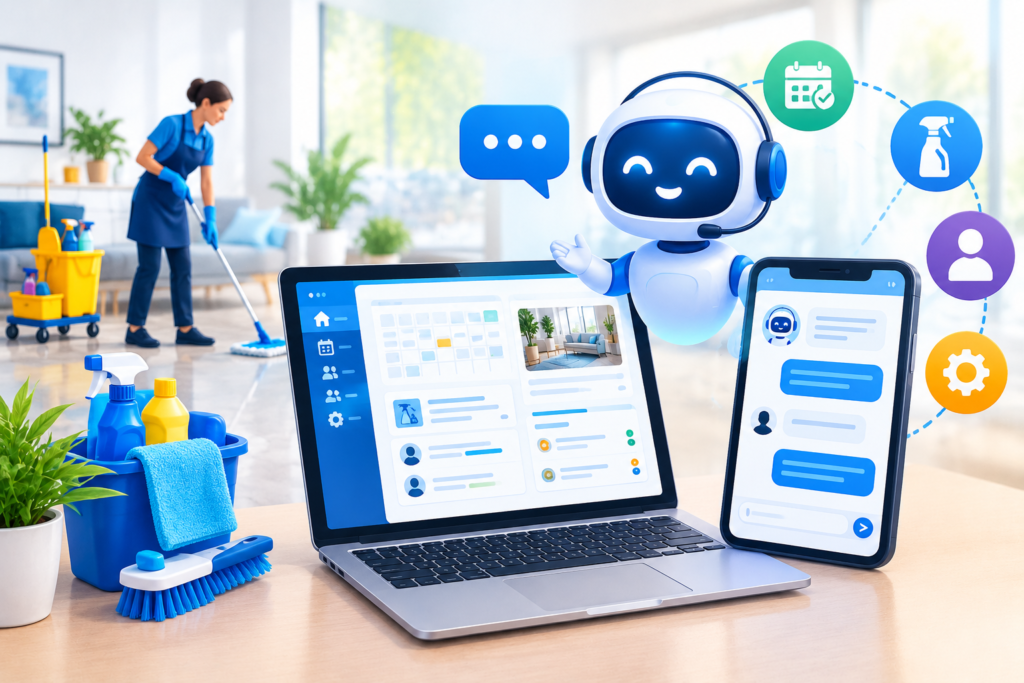
A chatbot becomes more useful when it can exchange information with the systems that already support the cleaning business. Scheduling software, customer relationship management platforms, invoicing applications, email tools, and customer support systems may each hold a different part of the customer journey. Without integration, employees may need to copy information from chat conversations into calendars or spreadsheets manually. This creates additional work and increases the possibility of missed details, duplicate records, and inconsistent appointment information. A carefully planned integration can reduce these problems by sending relevant data to the appropriate system while preserving the business’s existing operational procedures.
Scheduling integration is especially important when a chatbot offers appointment selection. The chatbot should rely on the actual availability provided by the scheduling system, taking into account cleaning team capacity, travel time, service duration, location, and any other constraints the company uses. If a requested appointment is unavailable, it should present legitimate alternatives or collect the customer’s preferred times for staff review. CRM integration can store inquiry details, service preferences, consent records, and follow-up status. Email or messaging integrations may send confirmations and reminders, while invoicing or payment integrations can support authorized payment workflows. Each connection should have a clearly defined purpose, and the company should avoid granting the chatbot broader access to business data than the task requires.
Integration planning should also cover reliability, permissions, and failure handling. Before launch, test what happens when an external service is unavailable, a booking request is submitted twice, a customer changes an appointment, or a payment confirmation is delayed. The chatbot should explain when it cannot complete an action and offer an alternative rather than falsely reporting success. Where possible, use secure, documented integration methods, limit credentials to necessary permissions, and monitor failed transactions or synchronization errors. For technical implementations, the official Google Search Central documentation can help teams understand website search requirements, while the OWASP Web Security Testing Guide offers guidance for assessing web application security. These resources do not replace platform-specific integration documentation, but they help establish a stronger foundation for a dependable, secure customer-facing system.
Personalizing Customer Conversations for Different Cleaning Services
A cleaning services chatbot should adapt its questions and recommendations to the service a customer needs. Residential cleaning, commercial maintenance, deep cleaning, move-out cleaning, and post-construction cleaning involve different requirements, time estimates, and preparation procedures. A single generic conversation can frustrate visitors if it asks irrelevant questions or fails to collect essential details. A better approach is to begin with a simple service selection and then display questions relevant to that category. Someone requesting routine apartment cleaning might be asked about the number of bedrooms, bathrooms, and preferred cleaning frequency. A customer requesting post-renovation cleaning may need to describe the condition of the property, the approximate area, and whether construction work has been completed.
Personalization should also reflect the customer’s stage in the buying process. A first-time visitor may need an explanation of available packages and what each service includes. A returning customer may want to arrange another appointment, update an existing booking, or ask about an additional cleaning task. A commercial prospect may need to discuss a site inspection, service schedule, insurance documentation, or a recurring contract. The chatbot can recognize these different intentions through menu choices, structured questions, or an AI-powered conversation system. If the business has permission to use relevant customer history, it may also provide a more convenient experience for returning clients. However, personalization should not depend on collecting unnecessary personal details or making assumptions about a customer’s circumstances.
Effective personalization requires accurate service information and regular review. The business should define what each package includes, which tasks cost extra, what conditions may affect the final quotation, and which requests require employee approval. The chatbot should explain these boundaries clearly before a customer makes a decision. For example, a standard cleaning package should not be presented as including specialist stain treatment if that service requires a separate quotation. Customers should also be able to describe unusual requirements in their own words rather than being forced into unsuitable categories. By combining relevant questions, transparent service descriptions, and appropriate human assistance, cleaning companies can make chatbot conversations feel more helpful and less mechanical while keeping expectations realistic.
Improving Customer Support and Retention With a Chatbot
Customer retention is particularly important for cleaning businesses because many services are recurring. A household may need weekly or fortnightly cleaning, while an office may require maintenance several times a week. A chatbot can support these relationships by making routine interactions easier throughout the customer lifecycle. Customers may use it to confirm appointment details, ask what is included in their package, request a change to their preferred schedule, or find the correct contact method for a service concern. When these interactions are handled consistently, customers spend less time searching for information and employees can focus on issues that genuinely require individual attention.
After a cleaning appointment, the chatbot can help collect feedback and identify opportunities for service recovery. A short conversation might ask whether the scheduled work was completed, whether any areas require follow-up, and whether the customer would like assistance with a future booking. If a customer reports a missed task or expresses dissatisfaction, the chatbot should acknowledge the concern, record the relevant details, and route the issue to a responsible employee. It should not argue with the customer, dismiss the complaint, or promise a refund that has not been approved. A clearly defined escalation process allows the company to respond appropriately and identify recurring problems, such as inconsistent service delivery, unclear package descriptions, or scheduling difficulties.
Retention workflows can also support useful reminders and repeat bookings. With appropriate customer permission, a business might send a reminder before a regular appointment, invite a customer to arrange the next visit, or share preparation instructions before a scheduled deep clean. The timing and frequency of these messages should respect customer preferences and applicable communication rules. Excessive reminders can create irritation rather than loyalty. Businesses should therefore monitor repeat booking rates, complaint resolution times, customer feedback, and opt-out rates to determine whether their communication strategy is helping. A chatbot can make follow-up easier, but lasting customer loyalty still depends on dependable cleaners, transparent pricing, punctual arrivals, and consistent service quality. Automation supports these fundamentals; it cannot replace them.
Using AI and Natural Language Processing in Cleaning Chatbots
Artificial intelligence can make a cleaning chatbot more flexible by helping it interpret customer questions that do not follow a fixed script. Natural language processing enables software to analyze human language, while intent recognition attempts to identify what a person wants to accomplish. A customer might write, “I need someone to clean my apartment before my family arrives,” rather than selecting a predefined deep-cleaning option. An AI-enabled assistant may recognize that the person is requesting residential cleaning and ask follow-up questions about property size, timing, and the type of cleaning required. This can make conversations more natural, especially when customers use different expressions for similar needs.
However, AI should operate within a controlled information environment. The business can provide approved descriptions of its services, pricing rules, operating policies, service areas, and booking procedures. The chatbot should use these materials as its primary source of business information and acknowledge when an answer is unavailable. It should not invent service packages, claim that a team is available without checking the scheduling system, or calculate a binding quotation from incomplete information. Where a question involves a complex commercial contract, a property safety concern, or a disputed charge, the system should collect the relevant details and direct the conversation to a qualified employee. Structured workflows are often preferable for critical actions such as confirming bookings or collecting payment authorization.
AI implementation also requires testing and ongoing monitoring. The company should evaluate realistic questions, misspellings, ambiguous requests, unusual service combinations, and attempts to obtain information that the chatbot should not disclose. Responses should be reviewed for accuracy, clarity, consistency, and appropriate escalation. Businesses using generative AI should also consider how customer information is processed by the chosen provider, whether conversations may be used to improve external models, and which contractual or privacy controls are available. The NIST AI Risk Management Framework provides a useful foundation for thinking about AI-related risks and governance. The practical objective is not to make the chatbot appear intelligent at all costs. It is to help customers complete useful tasks accurately, predictably, and safely.
Website SEO and Conversion Optimization for Cleaning Chatbots
A chatbot can support a cleaning company’s conversion strategy by helping visitors move from research to a relevant inquiry. Someone visiting a residential cleaning page may want to understand package differences, check whether their area is covered, or request a quotation. A commercial cleaning visitor may be evaluating recurring maintenance contracts and need to arrange a site visit. By directing each visitor toward a relevant next step, the chatbot can reduce friction in the customer journey. Its effectiveness depends on the quality of the underlying website content, the relevance of the questions, and how easily visitors can reach a human representative when necessary.
Search engine optimization remains a separate but complementary activity. Search engines need useful, accessible page content to understand a company’s services, locations, and expertise. A chatbot should not replace detailed service pages, location pages, pricing explanations, or helpful articles with an empty chat interface. Businesses should publish original content explaining what their services include, who they are suitable for, how quotations work, and which factors influence cleaning costs. The Google SEO Starter Guide offers guidance on creating search-friendly websites, while Google Search Essentials explains foundational requirements for appearing in Google Search. These resources are useful when planning the website content surrounding a chatbot.
Conversion optimization should be based on measured customer behavior rather than assumptions. A business can compare the number of visitors who open the chatbot with the number who complete a relevant action, such as submitting a qualified inquiry or scheduling a confirmed appointment. It should also examine whether chatbot users experience more friction, abandon conversations, or contact support because the automated answers were insufficient. The chat interface must work well on mobile devices, avoid obstructing important content, and remain accessible to people using keyboards or assistive technology. The Web Content Accessibility Guidelines provide a recognized reference for accessible web experiences. A useful chatbot should make the website easier to use, not interfere with navigation, readability, or access to essential information.
Data Privacy, Cybersecurity, and Customer Trust
A cleaning chatbot may collect names, email addresses, telephone numbers, property addresses, appointment preferences, access instructions, and details about customer requests. Some of this information is necessary to arrange a cleaning appointment, but it should not automatically be collected in every conversation. Businesses should determine which details are required for each workflow, explain the purpose of collection, and establish suitable retention periods. If a customer needs to provide sensitive access information, the company should consider whether it belongs in the chatbot at all or should be handled through a more appropriate secure process. Customer convenience should never be used as a reason to collect more personal information than the service requires.
Security controls should cover the chatbot platform, connected business applications, employee accounts, and the systems where conversation records are stored. Use strong authentication, multi-factor authentication where available, limited account permissions, secure integration credentials, and appropriate access logging. Keep software and integrations updated, review third-party providers, and establish a process for handling suspected security incidents. Businesses should also determine which employees can view customer conversations and prevent unnecessary sharing of property details. For broader website security planning, the CISA Secure by Design guidance offers recommendations for building security into technology decisions, while the OWASP Top 10 highlights common web application security risks.
Trust also depends on transparent communication. The chatbot should identify itself as an automated assistant where appropriate and avoid pretending to be a human employee. It should explain when a request will be reviewed by staff and should never claim that an appointment, refund, or payment has been completed unless the relevant system confirms the action. Businesses should review the privacy terms of their chatbot provider and any connected AI service, particularly where information may be processed by external organizations. Applicable privacy and marketing requirements depend on the jurisdictions in which the company operates and serves customers. A documented privacy policy, sensible data handling practices, accurate automated responses, and a reliable human escalation process help customers understand what happens to their information and what to expect from the service.
Step-by-Step Guide to Implementing a Cleaning Services Chatbot
The first step is to define a specific business objective. A cleaning company might want to increase qualified inquiries, reduce missed calls, simplify appointment requests, improve response consistency, or make recurring bookings easier. Selecting one or two measurable priorities helps prevent the project from becoming unnecessarily complicated. Next, review the existing customer journey and identify the questions employees answer repeatedly. Examine recent inquiries, common booking problems, incomplete quotation requests, and customer complaints. This evidence helps determine which conversations should be automated first. The business should also define what the chatbot must not do, including confirming unverified availability, approving unqualified discounts, or making promises outside established company policy.
The second step is to select the platform and build the conversation workflow. Compare available solutions based on ease of setup, supported channels, booking functionality, integration options, analytics, accessibility, data protection, and total cost. A small cleaning company may begin with a website chatbot that collects leads and routes booking requests to staff. A larger operation may need a connection to scheduling software and a customer management system. Prepare an approved knowledge base containing service descriptions, operating hours, coverage areas, package details, quotation rules, and frequently asked questions. Then build a short conversation that identifies the requested service, collects essential details, and explains the next step. Include a human handoff for complex inquiries and a fallback response when the chatbot cannot understand a request.
The third step is to test, launch, and improve the system. Test the chatbot on desktop and mobile devices using typical customer questions, unusual requests, incomplete answers, and unsuccessful integration scenarios. Verify that booking confirmations reflect real scheduling data, that customer details reach the correct system, and that privacy controls work as intended. Train employees to review chatbot-generated leads, handle escalations, and maintain the information library. After launch, monitor conversation completion, qualified inquiries, confirmed bookings, customer feedback, and system errors. Start with a limited rollout if possible, then expand automation when the results justify it. Review performance regularly and update the workflow whenever services, prices, policies, or operating procedures change. Successful implementation is an ongoing operational process rather than a one-time software installation.
Measuring Chatbot Performance, Conversions, and Return on Investment
A cleaning services chatbot should be evaluated using measurable business outcomes rather than the number of conversations it handles. High conversation volume does not necessarily indicate success if visitors cannot complete bookings or receive useful answers. The business should begin by recording baseline performance before launch, including inquiry volume, average response time, booking conversion rate, missed inquiries, administrative workload, and customer satisfaction. Once the chatbot is active, these measurements can help determine whether automation is improving the customer journey. Comparing similar periods and accounting for seasonal demand can provide a more meaningful picture than relying on a single week of activity.
Several key performance indicators are particularly useful. Qualified lead rate measures the proportion of inquiries that meet the company’s defined requirements. Booking conversion rate tracks the proportion of relevant prospects who become confirmed bookings, with the denominator clearly defined. Conversation completion rate shows how many visitors finish the intended chatbot workflow. Human escalation rate identifies how often the chatbot needs employee assistance, while customer satisfaction scores can reveal whether its responses are genuinely helpful. Businesses should also monitor booking cancellations, duplicate inquiries, failed integrations, and abandonment at individual questions. These metrics help identify specific problems. For example, if many visitors abandon the conversation when asked for property details, the form may be too long or the questions may not be sufficiently clear.
Return on investment should account for both costs and benefits. Costs may include subscription fees, setup, integrations, employee training, maintenance, and ongoing monitoring. Benefits may include reduced administrative time, fewer missed inquiries, more completed bookings, and improved follow-up consistency. A simple calculation is:
\[ \text{ROI}=\frac{\text{Benefits}-\text{Costs}}{\text{Costs}}\times100\% \]
For example, suppose a company estimates that a chatbot produces $1,200 in monthly operational benefits and costs $400 per month to operate and maintain. The estimated monthly net benefit is $800, and the corresponding ROI is 200%. These figures are illustrative, not a promise of actual performance. Businesses should avoid counting the same benefit twice or treating every chatbot-assisted inquiry as incremental revenue. The most useful reporting connects chatbot activity to confirmed bookings, service delivery, customer retention, and actual operating costs. Regular review allows the company to improve weak conversation steps, remove unnecessary questions, and invest in integrations that demonstrate measurable value.
The Future of Cleaning Services Chatbots and Business Automation
Cleaning industry automation is likely to become more connected, personalized, and operationally useful as conversational AI and business software continue to develop. Rather than functioning only as a website question-and-answer tool, a chatbot may coordinate several stages of the customer journey, from initial service discovery to quotation requests, scheduling, reminders, feedback collection, and repeat bookings. For example, a customer could describe a need for recurring office cleaning, provide the required premises information, and receive a structured proposal request without navigating several separate forms. With appropriate integrations and authorization, the system could also help employees organize follow-ups and identify inquiries requiring faster attention. These capabilities depend on the platform and implementation; they should not be assumed to exist automatically in every chatbot.
A second area of development is the connection between customer conversations and operational planning. Cleaning companies need to consider staff availability, travel distance, service duration, equipment, and customer preferences when scheduling appointments. Integrated systems could use approved business rules to help identify suitable appointment windows and reduce avoidable scheduling conflicts. Analytics may also reveal recurring demand patterns, frequently requested services, and common customer questions. These insights can inform staffing decisions, service package design, and website content. However, businesses should not treat automated recommendations as unquestionable decisions. Unexpected property conditions, employee availability changes, access restrictions, and complex customer requirements may still require a supervisor to review the situation and make the final decision.
The strongest long-term strategy is to introduce automation gradually while preserving service quality, transparency, and human accountability. Companies should first improve their booking and customer information processes, then introduce more advanced AI features where there is a clear business need. They should establish standards for data protection, response accuracy, escalation, and performance evaluation before expanding the system’s responsibilities. Regular testing and employee feedback will remain important as customer expectations and technology change. A chatbot should make it easier for customers to receive reliable cleaning services, not create another layer of complexity. Businesses that combine practical automation with well-trained staff, accurate information, dependable scheduling, and consistent cleaning standards will be better positioned to turn conversational technology into a sustainable operational advantage.
Frequently Asked Questions
1. What is a cleaning services chatbot?
A cleaning services chatbot is an automated assistant that communicates with customers and helps them access information about a cleaning company’s services. It can answer common questions, collect property details, explain booking procedures, qualify potential leads, and guide customers toward requesting a quotation or scheduling an appointment. Depending on the platform and its integrations, it may also send reminders, provide booking updates, and transfer complex requests to employees. It is particularly useful for cleaning businesses that receive repetitive inquiries and want to make customer communication more convenient.
2. How can a chatbot help a cleaning business get more customers?
A chatbot can help generate and organize leads by responding to website visitors, explaining service options, and collecting the information needed for follow-up. It allows potential customers to submit inquiries without waiting for a staff member to become available. It can also direct visitors toward relevant services and help distinguish between residential cleaning requests and commercial contract opportunities. However, a chatbot cannot guarantee additional customers. Results depend on website traffic, service quality, pricing, the relevance of the conversation, and how effectively the business follows up on qualified inquiries.
3. Can a cleaning services chatbot schedule appointments automatically?
Yes, if the chatbot is connected to a suitable scheduling system and configured with the necessary booking rules. It can collect the customer’s service requirements, check available time slots, and help the customer select an appointment. A properly integrated system should consider actual team availability and other scheduling constraints before confirming a booking. If no scheduling integration exists, the chatbot can collect preferred dates and send the request to an employee for confirmation. Businesses should clearly distinguish between a booking request and a confirmed appointment to prevent misunderstandings.
4. Can a chatbot provide cleaning service prices and quotations?
A chatbot can provide approved prices, explain package rates, or calculate estimates using predefined rules. For example, a company might use property size, cleaning frequency, and selected services to prepare an initial estimate. However, some jobs require an inspection or additional information about property condition, specialist treatments, access, or unusual cleaning requirements. In these cases, the chatbot should explain that the final quotation requires review. Businesses should keep pricing information updated and ensure that the chatbot never presents an estimate as a guaranteed final price when important details remain unknown.
5. Is an AI-powered chatbot suitable for a small cleaning company?
An AI-powered chatbot can be suitable for a small cleaning company, but the business does not necessarily need an advanced AI system. A straightforward rule-based chatbot may be sufficient when most inquiries involve a limited number of services, common questions, and simple booking requests. AI becomes more useful when customers describe their needs in varied language or ask questions that require interpreting a broader set of approved information. Small businesses should compare platform costs, setup complexity, integrations, and ongoing maintenance before choosing a solution. Starting with a simple workflow and expanding it after measuring results can reduce unnecessary expenses.
6. How does a cleaning chatbot support residential and commercial cleaning differently?
For residential cleaning, a chatbot can ask about property type, room count, cleaning frequency, preferred dates, and special household requirements. It can help customers choose between routine cleaning, deep cleaning, and move-in or move-out services. For commercial cleaning, it may collect premises size, business type, operating hours, required cleaning frequency, and contract requirements. Larger commercial inquiries may need a site inspection or consultation with a sales representative. Separate workflows help each customer receive relevant questions and prevent residential customers from being presented with unnecessary commercial information.
7. Is customer information safe when using a cleaning services chatbot?
Customer information can be protected through appropriate security controls, but safety depends on the chatbot provider, integrations, configuration, and internal business practices. Cleaning companies should collect only necessary information, restrict employee access, protect accounts, review third-party data processing terms, and establish appropriate retention policies. They should also consider how conversation records are stored and whether information is shared with external AI providers. Property addresses and access instructions deserve particular care. Businesses should document their privacy practices, follow applicable legal requirements, and avoid collecting sensitive information through an unsuitable channel.
8. How can a cleaning company measure whether its chatbot is successful?
A cleaning company can measure success by tracking qualified inquiries, confirmed bookings, conversation completion rates, response times, customer satisfaction, and administrative workload. It should also examine the number of visitors who abandon conversations and how frequently the chatbot needs human assistance. To estimate financial value, compare implementation and operating costs with measurable benefits, such as time saved and additional bookings attributable to the system. Reviewing these results regularly helps identify ineffective questions, missing information, and opportunities to improve the customer journey. The goal is better business performance and customer service, not simply more chatbot conversations.
Common Mistakes to Avoid When Building a Cleaning Services Chatbot
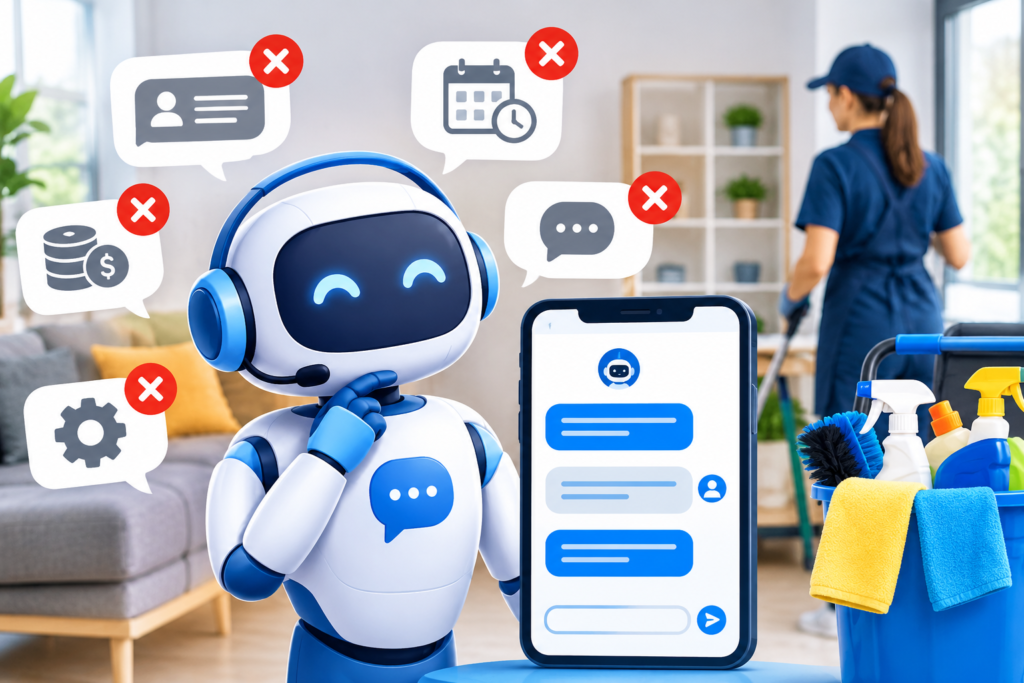
1. Creating an overly complicated conversation
One common mistake is asking too many questions before explaining what the chatbot can help with. Customers may abandon a conversation if they are required to complete a lengthy questionnaire before they can request a quotation. Businesses should begin with the customer’s primary need and collect additional details only when they are relevant. Optional questions should be clearly identified, and the assistant should provide a simple way to contact an employee. Short, purposeful conversations usually create a more manageable experience than complicated workflows filled with unnecessary steps.
2. Providing inaccurate pricing or service information
Outdated prices, incorrect service areas, and misleading descriptions can damage customer trust. A chatbot that promises a particular cleaning package or appointment without verifying the relevant details may create disputes and additional administrative work. Businesses should maintain a single approved source for service information and review it whenever prices, packages, or policies change. The assistant should explain when an estimate is provisional and route unusual requests for employee review. Accuracy should take priority over producing an immediate answer to every question.
3. Failing to connect the chatbot with scheduling procedures
A chatbot that collects booking requests but does not send them to the appropriate employee or scheduling system can create more work rather than reduce it. Requests may be missed, appointments may be duplicated, and customers may assume that an unconfirmed time is guaranteed. Businesses should define how requests are recorded, who reviews them, and when customers receive confirmation. Where automatic scheduling is available, test availability checks, rescheduling, cancellations, and error handling before launch. The booking process must remain reliable even when an integration fails.
4. Removing access to human support
Customers should not be forced to continue interacting with a chatbot when they need personal assistance. Complaints, special service requirements, payment disputes, and complex commercial inquiries may require employee judgment. Businesses should provide a clear escalation option and ensure that the receiving employee gets the information needed to understand the issue. The chatbot should also explain expected response times when immediate assistance is unavailable. Human support is an essential part of a dependable automated service, not a feature that should be hidden to maximize automation.
5. Ignoring mobile usability and accessibility
Many customers browse cleaning service websites on mobile devices. A chat window that covers booking buttons, displays poorly on small screens, or requires difficult interactions can discourage potential customers. Businesses should test the interface across common screen sizes and ensure that important information remains accessible. Keyboard navigation, readable text, clear labels, and appropriate compatibility with assistive technologies also matter. The WCAG accessibility standards can help guide accessibility reviews. The chatbot should improve the website experience rather than interfere with it.
6. Collecting too much customer information
Requesting unnecessary personal details creates friction and increases the amount of information the company must protect. The chatbot should ask only for details required to answer the question, prepare a quotation, or arrange the requested service. Property access instructions, payment details, and other sensitive information should be handled through appropriate secure processes. Businesses should document why information is collected, who can access it, and when it should be deleted. Data minimization improves both customer trust and operational discipline.
7. Launching without testing or ongoing maintenance
A chatbot may appear to work during a short demonstration but fail when customers ask unexpected questions or submit incomplete information. Businesses should test realistic conversations, booking changes, integration failures, and requests outside their service area. After launch, staff should review unsuccessful conversations and update responses when business policies change. Performance monitoring should include both customer outcomes and technical reliability. Without maintenance, even a well-designed chatbot can become inaccurate and less useful over time.
Best Practices Summary for a Cleaning Services Chatbot
Implementing a chatbot successfully requires a balance between customer convenience, operational efficiency, information accuracy, and responsible data handling. The following practices provide a practical checklist for cleaning businesses.
– Define clear business objectives. Decide whether the chatbot should prioritize lead generation, appointment requests, customer support, recurring bookings, or a combination of these goals.
– Use short, relevant conversation flows. Ask only the questions necessary to understand the customer’s request and guide them toward a useful next step.
– Maintain accurate service information. Keep cleaning packages, service areas, prices, availability rules, and business policies up to date.
– Make booking status explicit. Clearly distinguish between an inquiry, a pending request, a provisional estimate, and a confirmed appointment.
– Provide a reliable human handoff. Allow customers to reach an employee for complaints, unusual requests, complex quotations, and questions the chatbot cannot answer confidently.
– Integrate carefully with business systems. Connect scheduling, customer management, and messaging tools only when they improve the workflow and can be maintained reliably.
– Protect customer information. Apply appropriate access controls, secure integrations, data minimization, retention rules, and transparent privacy practices.
– Test AI responses before launch. Evaluate factual accuracy, unexpected questions, unclear requests, and situations where the chatbot should defer to a person.
– Optimize for mobile users. Keep the chat interface readable, accessible, and unobtrusive across desktop and mobile devices.
– Measure meaningful outcomes. Track qualified leads, confirmed bookings, customer satisfaction, operational time saved, and overall costs.
– Train employees to manage automation. Make sure staff know how to review leads, handle escalations, resolve errors, and update the chatbot’s information.
– Improve continuously. Review analytics and customer feedback, remove ineffective questions, and revise workflows as services and customer expectations evolve.
These practices help businesses build a chatbot that supports real operations instead of simply adding another digital feature. The best implementation is the one that makes booking easier, improves communication, and helps staff deliver a more reliable cleaning service.
Conclusion
A cleaning services chatbot can help cleaning companies simplify customer communication, organize booking requests, qualify leads, and improve the consistency of their customer support. From residential cleaning appointments to large commercial maintenance inquiries, a well-designed assistant can guide customers toward appropriate services while reducing the time employees spend answering repetitive questions. When connected to scheduling software and customer management tools, it can also help businesses organize follow-ups, communicate appointment details, and identify opportunities to improve the customer journey.
However, automation delivers the greatest value when it supports a dependable service operation. Accurate information, realistic pricing, secure customer data handling, reliable booking procedures, and accessible human support are essential. Businesses should begin with clear objectives, introduce features gradually, test the customer experience, and measure results against meaningful performance indicators. A chatbot should never replace the judgment required to handle unusual cleaning requirements, resolve complaints, or make important operational decisions.
For businesses exploring conversational automation, Engagerbot is a starting point for considering how chatbot technology can support customer engagement and lead generation. The next step is to identify the most time-consuming communication tasks, choose a suitable chatbot platform, and develop a workflow that fits the company’s services and customers. With thoughtful implementation and continuous improvement, cleaning businesses can make their booking process more convenient, strengthen customer relationships, and build a more organized foundation for sustainable growth.
Want to Implement This Easily?
You are an expert consultant. Based on the blog post titled “(Cleaning Services Chatbot)”, provide a step-by-step, practical implementation guide. Include tools, best practices, common mistakes to avoid, and advanced tips. Assume the reader wants to implement everything discussed in this article effectively.
Call to Action: Want our help implementing this? Just reach out to us via our website contact form: https://www.engagerbot.com/contact-us/