

Discover how a bank and finance chatbot improves customer support, automates banking tasks, strengthens digital engagement, and delivers secure, personalized financial assistance.
Introduction
Banking and financial services are changing rapidly as customers expect faster answers, convenient digital experiences, and personalized assistance whenever they need it. Traditional customer support channels, including telephone banking, email, and physical branches, remain important, but they cannot always provide immediate responses to every customer. Long waiting times, repetitive inquiries, complicated application processes, and limited support hours can frustrate customers and increase operational pressure on financial institutions. A bank and finance chatbot offers a practical way to address these challenges by helping customers access information, navigate digital services, and complete supported tasks through conversational interfaces.
A banking chatbot is a software application that communicates with users through text or voice. Depending on its design, it may answer questions about account access, explain banking products, guide users through loan applications, provide information about payment procedures, and connect customers with human representatives when additional assistance is required. More advanced solutions use artificial intelligence (AI), natural language processing (NLP), approved financial knowledge sources, and secure connections to banking systems. However, an effective chatbot is not simply an automated messaging window. It must be designed around customer needs, data protection, operational reliability, accessibility, and the regulatory responsibilities associated with financial services.
For organizations exploring conversational automation, Engagerbot provides a starting point for considering how chatbot technology can support digital customer interactions. The right implementation depends on the institution’s size, service model, technology infrastructure, risk tolerance, and customer expectations. A small financial advisory firm may need a straightforward website assistant that explains services and collects inquiries, while a large bank may require a carefully governed system connected to authenticated digital banking workflows. In both cases, the goal should be to make financial information easier to access without sacrificing customer trust, security, or human judgment.
This guide explains how bank and finance chatbots work, which customer problems they can solve, how AI supports financial conversations, and what organizations should consider before deploying a solution. It also examines security, privacy, personalization, system integration, performance measurement, implementation challenges, and practical best practices. The focus is on building a useful, responsible chatbot that improves the customer experience while supporting measurable business outcomes.
What Is a Bank and Finance Chatbot?
A bank and finance chatbot is a digital assistant that communicates with customers through a website, mobile application, messaging platform, or another supported digital channel. It responds to questions, presents relevant information, and guides users through defined financial service journeys. Its responsibilities may range from answering basic questions about business hours to helping authenticated customers navigate approved account functions. The precise capabilities depend on the underlying technology, connected systems, permissions, and controls established by the financial institution. A chatbot that only answers general questions should not be described as having access to account balances or transaction histories unless those capabilities have actually been implemented securely.
Traditional rule-based chatbots operate using predefined questions, decision trees, keywords, and responses. For example, when a customer asks about a personal loan, the chatbot may present the institution’s published eligibility criteria, explain the application process, and direct the customer to the relevant application page. If the customer chooses a different topic, the conversation follows another predefined route. This approach is relatively straightforward to test and can work well for predictable inquiries. AI-powered chatbots can interpret a wider range of natural-language questions, identify the user’s likely intent, and retrieve information from approved knowledge sources. Some systems combine both approaches, using conversational AI for understanding and controlled workflows for actions that require greater precision.
The distinction between a financial chatbot and a general-purpose virtual assistant is particularly important. Financial conversations can involve confidential information, significant monetary consequences, and legal obligations. Therefore, a chatbot must distinguish between general education, product information, account-specific support, and regulated financial advice. It should not invent interest rates, guarantee loan approvals, promise investment returns, or present uncertain answers as verified facts. When a question falls outside its authorized scope, the system should explain its limitations and offer a suitable next step. Organizations can use the NIST AI Risk Management Framework to help structure their approach to identifying, assessing, and managing AI-related risks. A well-designed banking chatbot combines conversational convenience with clear boundaries, dependable information, and appropriate human oversight.
Why Banks and Financial Institutions Need Chatbot Automation
Customer expectations have changed as people increasingly manage everyday activities through digital channels. Banking customers may want to understand a transaction, locate a branch, compare account types, check application requirements, or learn how to report a lost payment card without searching through several pages. When the information is difficult to find, they may contact a call center even when the question is simple. Repeated low-complexity inquiries consume staff time that could otherwise be devoted to complicated complaints, financial hardship cases, identity verification problems, and situations requiring individual attention. A banking chatbot can reduce this friction by providing a clear starting point for common questions and directing customers toward the correct process.
Automation can also improve service availability. A website assistant can provide approved product information and procedural guidance outside normal branch hours, including weekends and public holidays. This does not mean every banking operation can be completed at any time. Some transactions depend on maintenance windows, payment networks, verification procedures, or the availability of authorized employees. Nevertheless, even a limited chatbot can help customers understand what to do next instead of leaving them without guidance. Financial institutions should build answers around actual service availability and display relevant limitations whenever a process cannot be completed immediately.
Operational efficiency is another reason organizations explore conversational automation. When the chatbot resolves routine questions accurately, it may reduce avoidable transfers, repetitive email exchanges, and unnecessary calls. It can also collect structured information before transferring a complex case to a support representative, allowing the employee to understand the issue more quickly. These benefits should be measured rather than assumed. A chatbot that gives confusing answers or repeatedly sends customers to human agents may increase workload instead of reducing it. Institutions should establish baseline measurements for response times, resolution rates, customer satisfaction, and escalation frequency before launch. The resulting evidence can show whether automation is genuinely improving service quality and where further improvements are needed.
Key Benefits of a Finance Chatbot for Customer Experience
One of the main benefits of a finance chatbot is faster access to useful information. Customers often ask similar questions about savings accounts, loan documentation, credit card features, payment deadlines, fees, and application procedures. A well-maintained assistant can provide concise answers and direct users to the official pages containing the complete terms. This reduces the effort required to locate information and creates a more consistent experience across digital channels. It is particularly useful when the chatbot explains unfamiliar financial terminology in straightforward language, gives customers clear choices, and avoids overwhelming them with lengthy product descriptions.
Another advantage is consistency. Human employees may explain a process differently depending on their experience, workload, or the information available to them. A chatbot connected to approved and regularly reviewed content can present standardized explanations of published policies and procedures. Consistency is especially valuable when customers need to understand eligibility requirements, application stages, documentation standards, or complaint procedures. However, consistency does not automatically mean accuracy. If the underlying information is outdated or incomplete, the chatbot may repeat the same mistake to many people. Institutions should assign content owners, establish review schedules, maintain version histories, and provide a clear process for correcting inaccurate responses.
Personalization can improve the experience further when it is based on appropriate information and valid permissions. For example, a customer who selects a mortgage inquiry can receive relevant explanations about required documents, repayment terminology, and application steps. An authenticated customer might also receive account-specific assistance when the bank has implemented suitable access controls and approved integrations. Personalization should never become an excuse to collect unnecessary personal data or make unsupported assumptions about a customer’s financial circumstances. Organizations should disclose relevant data practices, respect consent requirements, and offer human support for sensitive questions. To evaluate the results, institutions can track customer satisfaction, task completion, repeat contact rates, accessibility, and successful escalation. The strongest chatbot experience is not necessarily the most conversational one; it is the one that helps customers reach an accurate, understandable, and appropriate outcome.
Essential Features of an Effective Banking Chatbot
An effective banking chatbot begins with reliable intent recognition. Customers rarely phrase questions in exactly the same way, so the system must recognize that expressions such as asking about borrowing costs, loan eligibility, or repayment schedules may relate to the same general topic. Rule-based intent menus can handle predictable requests, while natural language processing can support more flexible conversations. When confidence is low, the chatbot should ask a clarifying question rather than guessing. For important financial matters, the system should prioritize accuracy over conversational fluency and provide an easy route to an employee when it cannot interpret a request reliably.
A second essential feature is access to approved information. The chatbot should retrieve answers from maintained sources such as current product documentation, fee schedules, customer support procedures, application instructions, and published policies. If generative AI is used, retrieval-based methods can help ground responses in relevant institutional material. However, retrieval alone does not guarantee correctness: documents may conflict, permissions may be misconfigured, and generated answers may still misrepresent the source. The system should identify when it lacks sufficient evidence, avoid presenting unverified information as official policy, and direct users to authoritative documents when the exact wording matters. Content owners should regularly test the assistant against common questions and known edge cases.
Security-conscious escalation and accessibility are equally important. Customers should be able to request a human representative without repeatedly explaining that they need one. The chatbot should also communicate clearly on mobile devices, support keyboard navigation where applicable, use understandable language, and avoid relying on color alone to communicate important information. Additional features may include multilingual support, conversation summaries, appointment requests, branch information, service-status notifications, and carefully controlled integration with customer relationship management systems. Each feature should have a defined business purpose and appropriate controls. Before introducing a new capability, the institution should consider its data requirements, potential failure modes, monitoring needs, and impact on customers. A smaller set of dependable features is usually more valuable than a long list of capabilities that have not been properly tested.
AI, NLP, and Machine Learning in Financial Chatbots
Artificial intelligence can help a banking chatbot understand customer questions that do not match a fixed script. Natural language processing enables a system to analyze written or spoken language, identify meaningful phrases, and estimate the intent behind a message. For example, a customer might ask, “What do I need before applying for a home loan?” Another might ask, “Which documents are required for a mortgage?” Although the wording differs, both questions may point toward the same information need. Intent recognition helps the chatbot locate the relevant guidance, while entity extraction may identify details such as a product type, application stage, or requested date when those details are necessary and appropriate to process.
Machine learning can help improve language understanding by learning patterns from representative examples and evaluated interactions. However, financial institutions should not assume that a model becomes dependable simply because it has been trained on a large volume of conversations. Training data may contain errors, outdated terminology, or biases that affect how the system responds to different users. Performance must be tested against realistic customer questions, including misspellings, ambiguous wording, unusual requests, and attempts to manipulate the conversation. Organizations should also distinguish between improving language recognition and authorizing financial decisions. A model that can recognize a question about credit eligibility should not automatically be permitted to approve or reject a loan.
Generative AI introduces additional possibilities, including summarizing approved documents, explaining technical terms, and producing natural-language responses based on retrieved institutional information. It also introduces risks such as fabricated details, inconsistent explanations, prompt injection, and accidental disclosure of confidential information. These risks require a combination of technical controls, restricted data access, carefully defined system instructions, evaluation procedures, and human oversight. A useful starting point is the NIST AI Risk Management Framework, which helps organizations consider AI risks throughout design, deployment, and ongoing operation. In practice, the safest architecture is often a hybrid model: AI interprets the customer’s request, approved information sources provide the factual basis, deterministic workflows handle sensitive actions, and established authentication and authorization systems control access. This approach preserves conversational flexibility without allowing the language model to operate as an unrestricted banking system.
Banking Chatbot Use Cases Across Financial Services
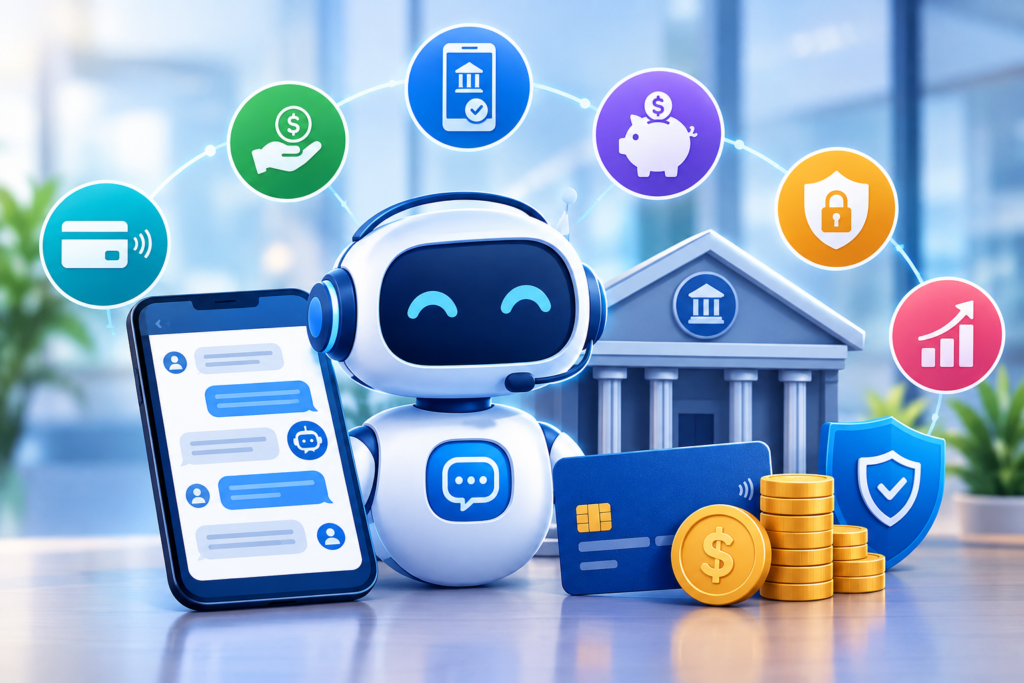
A bank and finance chatbot can support multiple customer journeys, from discovering financial products to receiving assistance with an existing service. For retail banking, common use cases include explaining current account features, providing information about savings products, describing card application procedures, and guiding customers through digital banking registration. A chatbot may also explain how to report a lost card or where to find transaction information. These functions should be designed around the institution’s actual capabilities and policies. If a chatbot cannot access a customer’s account, it should explain how to use the secure banking application rather than implying that it can inspect private account information.
Lending and financial advisory businesses can use chatbots to answer preliminary questions about borrowing, explain documentation requirements, and help visitors understand application stages. A mortgage chatbot, for example, might explain the difference between a fixed and variable interest rate, identify the documents commonly requested during an application, and direct a prospective applicant to an approved eligibility assessment. It should clearly distinguish general educational information from a formal lending decision. Similarly, an investment-related assistant may explain publicly available product information and general financial terminology, but personalized investment recommendations may require additional authorization, suitability checks, disclosures, and qualified human involvement. The permitted scope depends on the institution, jurisdiction, product, and applicable regulations.
Business banking offers another important area for conversational automation. Small businesses may need information about merchant accounts, payment processing, business loans, cash management, international transfers, and documentation for opening a corporate account. A chatbot can help business owners locate the correct product information and identify the next step in a process. Insurance providers, payment companies, credit unions, and financial technology businesses can also use conversational assistants for product inquiries, service navigation, and support requests. To choose suitable use cases, organizations should evaluate inquiry volume, customer demand, operational complexity, data sensitivity, and the consequences of a wrong answer. Starting with high-volume, low-risk questions allows the institution to establish reliable performance before expanding into more sensitive workflows.
Security, Privacy, and Regulatory Compliance for Financial Chatbots
Security and privacy must be fundamental design requirements for any chatbot operating in financial services. Customer conversations can contain names, contact details, account information, transaction references, and other sensitive data. An institution should determine which information the chatbot genuinely needs, where that information will be processed, how long it will be retained, and which employees or service providers can access it. Data minimization is an important principle: if a general product inquiry can be answered without collecting an account number, the chatbot should not request one. Organizations should also explain relevant data practices in accessible language and avoid encouraging customers to share passwords, personal identification numbers, or full payment card security codes in ordinary chat messages.
Authentication and authorization are separate but related controls. Authentication establishes that a user has successfully verified their identity, while authorization determines which actions that user is permitted to perform. A chatbot should not reveal private account information merely because a conversation includes a customer’s name or email address. Sensitive functions must rely on appropriate identity verification, session management, access controls, and secure connections to trusted systems. The institution should also consider encryption, logging, secrets management, vendor access, incident response, and the risk of unauthorized data exposure through AI prompts or conversation histories. The OWASP Top 10 provides a useful overview of common web application security risks, while the NIST Cybersecurity Framework can help organizations structure cybersecurity risk management.
Regulatory obligations vary by country and by the services being provided. Requirements may cover customer identification, anti-money-laundering controls, consumer disclosures, data protection, record retention, accessibility, complaints, lending decisions, and financial promotions. A chatbot does not remove these responsibilities simply because a conversation is automated. Before deployment, compliance and legal teams should determine which rules apply to each workflow and document how the chatbot meets them. High-impact decisions should receive appropriate scrutiny, and customers should have a way to challenge an outcome or reach a qualified employee. Institutions should also test how the chatbot responds to requests for confidential information, misleading instructions, and attempts to bypass safeguards. Regular security assessments, controlled updates, and a documented incident-response process help ensure that the assistant remains trustworthy after launch.
Integrating a Banking Chatbot With Existing Financial Systems
Integration determines whether a chatbot remains an information assistant or becomes part of a broader digital banking workflow. A basic implementation may rely on an approved knowledge base and direct customers to existing account portals, product pages, application forms, or support channels. A more advanced solution may connect to a customer relationship management platform, help desk, appointment system, or secure banking API. These integrations can reduce repeated data entry, help support teams understand customer requests, and provide more relevant guidance. However, each connection introduces technical dependencies and potential security risks, so institutions should establish a clear purpose and permission model before linking the chatbot to any internal system.
A secure integration architecture should separate the conversational interface from systems responsible for authoritative financial records and transactions. The chatbot should not be allowed to change account details, initiate transfers, or make lending decisions through unrestricted database access. Instead, sensitive actions should pass through approved APIs, server-side authorization checks, validation rules, transaction limits, and any required customer confirmation. The system should also handle timeouts, failed requests, duplicate submissions, and unexpected responses without misleading the customer. For example, if a payment-status service is unavailable, the chatbot should state that it cannot verify the status and provide a safe alternative rather than inventing a successful result.
Testing and operational monitoring are essential to reliable integration. Before launch, technical teams should verify that each workflow works as intended under normal conditions and during failures. They should test authentication expiry, insufficient permissions, API errors, network interruptions, repeated requests, and attempts to access another customer’s information. Logs should capture enough information for troubleshooting and auditing while avoiding unnecessary exposure of sensitive content. Version control, staged deployment, rollback procedures, and documented ownership help reduce the risk of a software update disrupting customer service. For organizations with legacy banking platforms, a phased approach may be more practical than attempting a full integration immediately. Begin with dependable informational features, establish performance and security controls, and expand to more advanced functions only after the necessary systems and governance processes are ready.
Personalization and Customer Engagement in Digital Banking
Personalization helps a bank and finance chatbot provide more relevant assistance by adapting its responses to the customer’s question, selected service, and authorized context. Instead of presenting every visitor with the same list of banking products, the chatbot can ask whether the person needs information about savings, borrowing, payments, business accounts, or digital banking access. Based on the answer, it can guide the customer through a focused conversation and provide the most relevant approved information. This approach reduces unnecessary navigation and helps customers reach useful answers with fewer steps. Effective personalization begins with understanding the customer’s immediate goal rather than collecting as much personal information as possible.
More advanced personalization may use information from authenticated customer profiles or previous support interactions, provided that the institution has an appropriate legal basis, valid permissions, and suitable security controls. For example, an authenticated customer who has started a loan application might receive guidance about the next documented step, while a business customer could be directed toward the support process for merchant payments. The chatbot should use only the information needed for the requested task and should not reveal confidential details before the required verification has been completed. Institutions should also avoid making unsupported assumptions about a customer’s income, financial knowledge, creditworthiness, or personal circumstances based on limited conversational data.
Customer engagement improves when interactions are useful, transparent, and easy to continue. A chatbot can offer clear follow-up options, explain unfamiliar terminology, summarize the next steps, and provide relevant links to official documentation. It can also invite feedback after resolving an inquiry or offer a human representative when the customer needs more detailed help. These interactions should not become intrusive sales conversations or pressure customers into purchasing financial products. To assess whether personalization creates genuine value, organizations can measure task completion, customer satisfaction, repeat contacts, abandonment rates, and the frequency of unnecessary data requests. The objective is to create a more convenient and respectful banking experience, not simply to increase the number of messages exchanged.
Lead Generation and Conversion Optimization for Financial Businesses
A bank and finance chatbot can support lead generation by helping website visitors understand a financial product and identify the appropriate next step. Visitors researching business accounts, mortgages, personal loans, payment processing, or financial consulting may have questions before they are ready to complete a formal application. A chatbot can explain the service, describe the general requirements, and guide interested visitors toward an application form, consultation request, or contact page. This makes the website more interactive while helping the organization identify which services attract customer interest. However, lead generation should be based on clear communication and genuine customer needs rather than aggressive sales tactics.
An effective lead qualification workflow asks only relevant questions. For example, a business financing assistant might ask whether the visitor represents a new or established business, what type of financing information they need, and how they would prefer to be contacted. It should explain why information is requested, provide appropriate privacy information, and obtain consent where required. The chatbot must not request passwords, complete payment credentials, or unnecessary sensitive financial details to generate a sales lead. It should also distinguish preliminary interest from formal eligibility. A visitor who answers a few questions has not necessarily qualified for a loan, and the chatbot should never suggest that an approval is guaranteed before the institution completes its official assessment.
Conversion optimization requires more than counting how many people start a conversation. Financial businesses should evaluate the proportion of visitors who complete a meaningful action, such as submitting a valid inquiry, scheduling a consultation, or beginning an application. They should also measure lead quality, duplicate submissions, consent compliance, customer satisfaction, and the number of visitors who abandon the process because it is confusing. Testing different introductory messages, question sequences, and calls to action can reveal where customers encounter friction. Changes should be assessed against reliable baseline data and monitored for unintended consequences. A successful financial chatbot helps the right customers find relevant services and take informed next steps while preserving transparency, privacy, and freedom of choice.
Mobile Banking Chatbots and Omnichannel Support
Mobile devices are a major part of modern banking, and customers increasingly expect digital support to work smoothly on smaller screens. A mobile banking chatbot can provide quick access to product explanations, application instructions, card support procedures, branch details, and common account-access guidance. Its interface should be designed for touch interaction, readable text, short conversational steps, and reliable performance across different screen sizes. Customers should not have to scroll through long paragraphs or repeatedly re-enter information simply because they are using a phone. A responsive website chatbot can provide an accessible starting point, while an in-app assistant may offer additional features when the institution has securely integrated it with its mobile banking environment.
Omnichannel support means customers can interact with an organization through several connected channels, such as its website, mobile application, email, telephone support, and approved messaging platforms. A chatbot can help connect these channels by directing customers to the correct support route and, where appropriate, passing a concise summary of the conversation to a human representative. For example, if a customer begins asking about a disputed transaction on the website and needs to speak with a specialist, the handoff should preserve the relevant context without exposing unnecessary personal information. The organization should clearly explain when a conversation moves to another channel and which information will be shared.
Consistency across channels is critical. Product descriptions, service availability, fees, eligibility requirements, and complaint instructions should not conflict between the website chatbot and the official banking application. Institutions should maintain central content sources where practical and assign responsibility for keeping information current. They should also consider customers with limited connectivity, older devices, disabilities, or low confidence using digital technology. A chatbot must not become the only way to access essential support. Customers should retain suitable alternatives, including human assistance and accessible contact methods. Performance monitoring should examine response speed, mobile usability, failed sessions, channel handoffs, and customer feedback. By treating the chatbot as one part of a connected service strategy, financial institutions can improve convenience without creating another disconnected customer support channel.
Measuring Banking Chatbot Performance and Return on Investment
A bank and finance chatbot should be evaluated against measurable business and customer outcomes. Before deployment, the organization should record baseline information about inquiry volumes, average response times, resolution rates, customer satisfaction, support costs, and the frequency of repeated contacts. These measurements establish a comparison point for determining whether the chatbot has improved the service experience. The institution should also identify its primary objectives. A chatbot designed to answer product questions may need different success measures from one designed to guide authenticated users through a secure support workflow. Without clear objectives, teams may focus on superficial activity metrics rather than meaningful results.
Useful performance indicators include the following:
- Containment rate: The proportion of conversations completed without a human handoff. This should be interpreted alongside resolution quality because preventing an escalation is not beneficial if the customer remains confused.
- Task completion rate: The percentage of users who successfully complete the intended journey, such as locating application requirements or submitting a support request.
- First-contact resolution: The proportion of eligible inquiries resolved during the initial interaction without unnecessary follow-up.
- Customer satisfaction: Feedback gathered through appropriately designed surveys or other customer experience measures.
- Escalation rate: The percentage of conversations transferred to a human representative, segmented by issue type and reason.
- Accuracy and safety: The frequency of incorrect answers, unsupported claims, privacy incidents, and failures to follow approved procedures.
- Operational efficiency: Changes in support workload, average handling time, and cost per successfully resolved inquiry.
- Conversion quality: The number and quality of completed inquiries or applications, where lead generation is an approved objective.
Return on investment should include both benefits and the full cost of implementation. Potential benefits include reduced repetitive support work, improved customer self-service, and more efficient handling of inquiries. Costs may include software licensing, development, integration, security reviews, compliance work, staff training, monitoring, and ongoing content maintenance. A simplified calculation is: ROI = (measured financial benefits − total implementation and operating costs) ÷ total costs × 100. The calculation should use defensible estimates and a clearly defined measurement period. Organizations should also review results by customer segment and inquiry type because an acceptable average can conceal serious problems affecting a particular group. Regular evaluation allows teams to improve weak workflows, retire features that do not provide value, and expand successful capabilities based on evidence rather than assumptions.
Common Mistakes When Implementing a Bank and Finance Chatbot
One frequent mistake is launching a chatbot without clearly defining what it is allowed to do. If the assistant attempts to answer every financial question, it may produce unreliable explanations or move into areas requiring specialist judgment. Another common mistake is relying on outdated product documentation. Banking rates, fees, eligibility criteria, application procedures, and service policies can change, so a chatbot that uses old information may mislead customers even when its language sounds confident. Financial institutions should define supported use cases, identify authoritative information sources, assign content owners, and create a clear procedure for reviewing and updating responses. They should also establish a safe fallback when the chatbot cannot provide a verified answer.
A second category of mistakes involves security and privacy. Organizations may request excessive customer information, connect the chatbot to internal systems without adequate access controls, or retain conversation histories for longer than necessary. Some teams may assume that an external chatbot provider automatically handles all security and regulatory requirements. In reality, the institution must understand its responsibilities, evaluate suppliers, establish appropriate contractual protections, and verify that the implementation matches its risk requirements. Sensitive actions should be protected by the appropriate authentication and authorization mechanisms, while testing should include attempts to extract private information or bypass the assistant’s restrictions. A chatbot should never be treated as a trusted authority simply because it operates within an official website.
The third mistake is measuring success by the number of conversations rather than by their outcomes. A high conversation count does not prove that customers are receiving accurate answers or completing tasks successfully. If users repeatedly ask the same question because the first response was confusing, engagement metrics may increase while service quality declines. Similarly, automatically deflecting customers from human support can create frustration and increase complaints. Institutions should provide visible escalation options, test realistic customer journeys, and monitor negative feedback alongside efficiency measures. They should also avoid deploying advanced AI features before establishing appropriate governance, evaluation, and incident-response procedures. A staged rollout with a limited set of well-tested capabilities generally provides a stronger foundation than a rushed launch with an unnecessarily broad scope.
Best Practices for Building a Secure and Helpful Finance Chatbot
The most effective financial chatbots are built around specific customer needs and carefully defined operational boundaries. Start by identifying common inquiries through support records, customer feedback, website searches, and employee observations. Group those inquiries into practical journeys, such as product discovery, application guidance, payment support, or account-access assistance. Select an initial group of low-risk tasks that can be answered accurately using approved information. For each journey, define the expected answer, the relevant source, the conditions under which clarification is required, and the point at which the chatbot should escalate to a human. This preparation helps prevent the common problem of creating a conversational interface without a clear service strategy.
Security and governance should be incorporated throughout the design and deployment process. Apply data minimization, secure authentication, least-privilege access, controlled integrations, and appropriate retention rules. Test the chatbot for inaccurate answers, ambiguous requests, prompt injection, unauthorized information disclosure, and failures in connected systems. Maintain records of important configuration changes, establish an incident-response plan, and determine who is responsible for reviewing performance and approving updates. Where AI generates answers from institutional documentation, evaluate whether the responses faithfully reflect the source and whether the system appropriately acknowledges uncertainty. For relevant privacy and security requirements, organizations can consult official guidance such as the FTC’s data security resources and the NIST Cybersecurity Framework, while obtaining jurisdiction-specific legal and compliance advice.
Finally, improve the chatbot continuously using evidence from real customer interactions. Review unresolved questions, identify inaccurate or incomplete answers, and prioritize fixes based on customer impact and risk. Provide employees with appropriate training so that they understand the chatbot’s limitations and can handle escalated conversations effectively. Maintain clear disclosures about automated assistance, make human support easy to access, and use plain language for important financial explanations. Test the interface with users who have different levels of digital confidence and accessibility needs. Before expanding into account-specific actions, lending decisions, or investment-related interactions, conduct a separate risk assessment and confirm that the necessary controls are in place. Sustainable success comes from treating the chatbot as an ongoing financial service capability that requires ownership, monitoring, and improvement—not as a one-time software installation.
The Future of AI Banking Assistants and Financial Automation

The next generation of banking chatbots is likely to combine conversational AI with more integrated digital workflows. Rather than simply answering questions, an assistant may help customers navigate multiple steps of an approved process, such as preparing an application, locating the relevant documents, checking the status of a request, and arranging follow-up support. These capabilities can make financial services easier to navigate, particularly when customers face complicated procedures or unfamiliar terminology. However, more advanced automation also increases the importance of permissions, transaction controls, verification, and accountability. Each additional capability should be introduced only when the institution can demonstrate that it operates safely and reliably.
Advances in language models may also improve multilingual communication, document summarization, conversational search, and the ability to explain complex financial concepts in accessible language. AI systems may help support employees by summarizing conversations, suggesting relevant approved articles, and organizing customer inquiries by topic. These applications can improve productivity without giving the model unrestricted authority over financial decisions. Institutions should still evaluate accuracy across languages, dialects, customer groups, and types of financial questions. They must also consider the risks associated with biased outputs, fabricated explanations, excessive reliance on automation, and the use of sensitive information in external AI services. Human oversight remains particularly important when a decision may significantly affect a customer’s finances or legal rights.
Another likely development is the closer integration of conversational assistants with fraud reporting, financial education, accessibility tools, and personalized service navigation. These functions could help customers understand unfamiliar transactions, locate official reporting procedures, and learn about common financial risks. Nevertheless, a chatbot should not claim to detect fraud with certainty unless the institution has implemented and validated an appropriate detection process. It should also direct suspected fraud, account compromise, and urgent payment issues to the institution’s established reporting channels. Financial organizations that prepare for these developments now—by improving data quality, strengthening governance, documenting workflows, and establishing reliable evaluation processes—will be better positioned to adopt future capabilities responsibly. The long-term objective is not to remove human involvement from banking, but to combine convenient automation with the security, expertise, and accountability customers expect from financial institutions.
Frequently Asked Questions
1. What is a bank and finance chatbot, and how does it work?
A bank and finance chatbot is a digital assistant that responds to customer questions and guides users through supported financial service workflows. It may use predefined rules, natural language processing, or generative AI to interpret questions and retrieve relevant information. A simple chatbot can answer frequently asked questions, explain product features, and direct customers to official forms. A more advanced system may connect to authorized business applications or secure banking APIs. Its capabilities depend on the implementation, and access to private financial information requires appropriate authentication, authorization, and security controls.
2. Can a banking chatbot provide account balances and transaction details?
Yes, a properly designed banking chatbot may provide account-specific information when the institution has implemented a secure integration and the customer has completed the required authentication. The chatbot must verify permissions before retrieving or displaying confidential information. It should not request passwords or other authentication secrets through ordinary chat messages. If the necessary integration is unavailable, the assistant should direct customers to the institution’s secure mobile application or online banking portal instead of suggesting that it can access their accounts.
3. Are AI banking chatbots secure?
A banking chatbot can be designed with strong security controls, but security is not guaranteed simply because the system uses AI or operates on a bank’s website. Appropriate protections may include encryption, access controls, authentication, data minimization, secure API integrations, vendor assessments, monitoring, and incident-response procedures. AI-specific testing should also cover inaccurate responses, prompt injection, and attempts to reveal confidential information. Financial institutions should assess the complete system, including third-party providers and connected applications, before deployment and throughout its operation.
4. How can a finance chatbot improve customer service?
A finance chatbot can help customers find information faster, receive assistance outside standard support hours, understand application procedures, and navigate common service requests. It can also collect relevant information before a conversation is transferred to an employee, reducing repetitive explanations. Its impact depends on the accuracy of its answers and the usefulness of its workflows. Organizations should measure customer satisfaction, resolution quality, task completion, and escalation outcomes rather than assuming that automation automatically improves service.
5. Can a chatbot help generate leads for banks and financial businesses?
Yes. A financial chatbot can explain products, answer preliminary questions, and guide interested visitors toward consultation requests, application forms, or other appropriate next steps. It can ask a limited number of relevant qualification questions when there is a valid purpose and the necessary privacy safeguards are in place. However, it should not promise loan approval, misrepresent eligibility, or pressure customers into financial commitments. Lead quality, consent compliance, and completed customer journeys are more useful indicators than the number of conversations alone.
6. What is the difference between a rule-based banking chatbot and an AI chatbot?
A rule-based chatbot follows predefined conversation paths and responds to recognized options or keywords. It can be suitable for predictable inquiries and carefully controlled workflows. An AI chatbot can interpret a wider variety of natural-language questions and may retrieve information or generate responses based on approved sources. AI systems offer greater flexibility but introduce additional risks, including fabricated information and inconsistent answers. Many financial institutions can benefit from a hybrid approach that combines AI-based language understanding with controlled workflows for sensitive operations.
7. How long does it take to implement a bank and finance chatbot?
Implementation time depends on the scope, available documentation, security requirements, integration complexity, and approval process. A basic informational chatbot using a prepared knowledge base may be introduced more quickly than a system connected to customer records, payment services, or lending workflows. Organizations should account for requirements gathering, content preparation, development, integration, security testing, compliance review, employee training, and ongoing monitoring. A phased rollout often makes it easier to identify problems before introducing more complex capabilities.
8. How can an organization measure the ROI of a banking chatbot?
Organizations can evaluate ROI by comparing measurable financial benefits with implementation and operating costs over a defined period. Benefits may include lower handling costs for routine inquiries, reduced repeat contacts, and improved completion of appropriate customer journeys. Costs can include software, development, integration, compliance reviews, security testing, and maintenance. The calculation should use actual operational data wherever possible. Customer satisfaction, accuracy, privacy incidents, and escalation quality should also be considered so that financial gains do not conceal declining service quality.
Common Mistakes to Avoid When Deploying a Banking Chatbot
Financial institutions should pay particular attention to the following practical mistakes during implementation and ongoing operation.
- Launching without a defined scope: Trying to automate every financial inquiry increases complexity and creates avoidable risks. Start with clearly defined, lower-risk customer needs.
- Using outdated product information: Assign content owners and establish a review process for rates, fees, eligibility requirements, and service procedures.
- Collecting excessive personal data: Ask only for information required to complete the requested task, and explain relevant data practices.
- Ignoring authentication and authorization: Never expose confidential account information or perform sensitive actions without the appropriate access controls.
- Allowing AI to invent answers: Ground responses in approved sources, test factual accuracy, and provide safe fallbacks when reliable information is unavailable.
- Making human support difficult to access: Offer clear escalation options for complaints, complex financial questions, suspected fraud, and unresolved requests.
- Connecting systems without sufficient testing: Validate API permissions, error handling, session management, and transaction workflows before deployment.
- Measuring conversations instead of outcomes: Monitor successful resolution, task completion, customer satisfaction, accuracy, and avoidable repeat contacts.
- Overlooking compliance responsibilities: Review the laws, regulatory requirements, disclosures, and recordkeeping obligations applicable to each use case.
- Failing to monitor performance after launch: Review customer feedback, investigate incidents, update content, and retest important workflows whenever the system changes.
Avoiding these mistakes requires cooperation between customer service, IT, cybersecurity, compliance, legal, and product teams. Each group should understand its responsibilities, and significant changes should follow an established review and approval process.
Best Practices Summary
A successful bank and finance chatbot should make financial services easier to navigate while protecting customers and supporting reliable business operations.
1. Begin with customer needs
Identify frequent inquiries and prioritize workflows that provide clear value without introducing unnecessary financial risk.
2. Build security into the design
Apply appropriate authentication, authorization, data minimization, secure integrations, monitoring, and incident-response procedures.
3. Use approved information sources
Keep product documentation current, evaluate answer accuracy, and ensure the chatbot acknowledges uncertainty instead of inventing facts.
4. Preserve human oversight
Make escalation easy and route sensitive complaints, complex financial questions, and high-impact decisions to appropriate personnel.
5. Integrate systems carefully
Use approved APIs, least-privilege access, robust error handling, and staged testing before enabling account-specific functions.
6. Measure meaningful outcomes
Track resolution quality, task completion, customer satisfaction, operational costs, and safety incidents instead of relying only on engagement figures.
7. Improve continuously
Review feedback, update information, investigate failures, and reassess risks whenever features, models, integrations, or regulations change.
The central principle is to use automation where it can deliver dependable assistance and retain human judgment where it is needed. Financial institutions that combine clear communication, reliable information, strong security, and measurable outcomes can create more useful digital experiences without compromising customer trust.
Conclusion
A bank and finance chatbot can help financial institutions improve digital customer support, simplify product discovery, guide customers through common procedures, and reduce repetitive service work. When properly implemented, it provides a convenient way to answer routine questions and connect customers with relevant services across digital channels. Advanced AI capabilities can make these interactions more natural, but they must be supported by approved information sources, secure integrations, appropriate permissions, and clear boundaries around financial decisions.
The best approach is to begin with well-defined customer needs, test a limited set of workflows, establish meaningful performance measurements, and expand only when the necessary security and governance controls are in place. Institutions should also ensure that customers can reach human representatives, understand how their information is used, and receive clear explanations when the chatbot cannot complete a request.
For organizations exploring conversational automation, Engagerbot is a place to start evaluating chatbot possibilities for customer engagement and digital service delivery. A carefully planned implementation can support better customer experiences and more efficient operations while keeping accuracy, privacy, transparency, and responsible financial service at the center of the strategy.
Want to Implement This Easily?
AI Implementation Prompt
You are an expert consultant. Based on the blog post titled “(Bank & Finance Chatbot)”, provide a step-by-step, practical implementation guide. Include tools, best practices, common mistakes to avoid, and advanced tips. Assume the reader wants to implement everything discussed in this article effectively.
Implementation requirements:
- Define the business objectives, target audience, and most important customer service problems.
- Identify the initial chatbot use cases and separate general information from authenticated account services and regulated financial activities.
- Recommend suitable chatbot platforms, AI models, knowledge base tools, integration methods, and analytics solutions based on the organization’s size, budget, and technical requirements.
- Explain how to prepare and maintain an approved financial knowledge base, including product documentation, FAQs, policies, and application instructions.
- Design conversational workflows with clear responses, clarifying questions, fallback behavior, and human escalation.
- Establish appropriate security, privacy, authentication, authorization, data retention, and vendor assessment controls.
- Explain how to integrate the chatbot with existing websites, customer relationship management systems, help desks, and authorized banking APIs.
- Create a testing plan covering response accuracy, accessibility, mobile usability, security, privacy, system failures, and AI-specific risks.
- Describe the deployment process, employee training, staged rollout, monitoring, and incident response.
- Define measurable KPIs for customer satisfaction, task completion, resolution quality, operational efficiency, lead quality, and return on investment.
- Identify common implementation mistakes and provide practical solutions.
- Include advanced recommendations for responsible AI, continuous improvement, scalability, and long-term maintenance.
Provide a realistic implementation timeline, an indicative budget framework, clear team responsibilities, and a prioritized action plan. Distinguish general guidance from requirements that depend on the organization’s jurisdiction, regulatory status, and specific financial products. Do not invent compliance certifications, guarantee business results, or recommend exposing sensitive customer data to unauthorized systems.
Call to Action:
Want our help implementing this? Just reach out to us via our website contact form: https://www.engagerbot.com/contact-us/