

An Automotive Chatbot helps dealerships and automotive businesses answer customer questions, recommend vehicles, qualify leads, support test-drive requests, improve response times, and create a more convenient buying journey through intelligent conversational automation.
Introduction
The automotive buying journey has changed dramatically. Customers no longer depend entirely on sales representatives, printed brochures, or showroom visits to begin researching a vehicle. A potential buyer may discover a model through search, compare specifications from a smartphone, explore inventory during the evening, ask questions about financing, investigate trade-in possibilities, and decide whether to schedule a test drive without ever speaking to a dealership employee during the initial stages of research.
This shift creates an important challenge for automotive businesses: customers expect answers when they are ready to ask questions. A dealership may have excellent vehicles, experienced sales representatives, competitive offers, and a professional website, yet still lose opportunities when a visitor cannot quickly find the information they need. An Automotive Chatbot can address this gap by providing immediate conversational assistance while guiding visitors toward useful information and meaningful actions.
The purpose of an automotive chatbot is not simply to place an automated chat window on a website. A properly planned system can become part of the complete customer journey. It can help visitors explore vehicle categories, understand features, find relevant inventory, request a test drive, submit an inquiry, provide information for sales follow-up, and obtain answers to common questions. For service departments, it can also support appointment-related conversations and direct customers toward appropriate assistance.
For businesses using conversational technology, trust is particularly important. Purchasing or maintaining a vehicle can involve significant financial decisions, personal information, technical questions, and expectations about availability. The chatbot therefore needs to provide accurate information, clearly communicate limitations, protect customer information, and transfer conversations to qualified people when automation is not appropriate.
That is why the strongest automotive chatbot strategy combines automation, accurate information, thoughtful conversation design, reliable integrations, human support, security, and continuous improvement. Instead of treating conversational technology as a standalone marketing feature, automotive organizations can use it as a practical communication layer connecting customers with the information and people they need.
What Is an Automotive Chatbot?
An Automotive Chatbot is a conversational software solution designed to communicate with customers and prospects through natural-language interactions. It can be deployed on an automotive website, landing page, customer portal, messaging channel, or another digital environment where customers need assistance. Depending on its architecture, the chatbot can answer questions from a controlled knowledge base, guide users through predefined workflows, connect with business systems, collect lead information, or transfer conversations to human representatives.
A basic automotive chatbot may handle straightforward questions such as dealership opening hours, contact details, general vehicle information, or test-drive requests. A more advanced system can support personalized conversations around vehicle preferences, inventory discovery, appointment requests, customer qualification, service inquiries, and sales follow-up. The difference is usually determined by the quality of the underlying information, conversation design, integrations, and business processes.
For example, imagine a visitor arriving on a dealership website and typing, “I need a family SUV with enough space for five people and good fuel economy.” A traditional website may require the visitor to navigate through multiple vehicle categories and filters. A conversational system can begin by asking useful questions about seating, budget, fuel preference, new or used inventory, and important features. The chatbot can then guide the visitor toward relevant vehicles or pages.
This does not mean that every chatbot should make autonomous purchasing recommendations. Automotive decisions are highly individual, and some questions require professional judgment. A responsible chatbot should distinguish between providing information and making decisions on behalf of the customer. It can explain specifications, identify available options, and facilitate the next step without pretending to replace an experienced sales professional, financial advisor, or qualified technician.
The concept is therefore broader than a website pop-up. An effective automotive chatbot acts as a conversational navigation system. It helps customers move from a question to information, from information to interest, and from interest to an appropriate next action.
The system may contain several components, including a conversational interface, intent recognition, knowledge sources, business rules, integration layers, analytics, security controls, and human escalation. Each component contributes to the final experience. If the chatbot understands questions but has outdated inventory information, customers may receive incorrect answers. If it has accurate information but cannot connect customers with employees, high-value opportunities may be lost.
A successful implementation focuses on the complete process rather than simply selecting a chatbot technology. The business must decide what customers should be able to accomplish, which information the chatbot can provide, which systems it needs to access, what information it should collect, and when a human should take over.
Why Automotive Businesses Need Conversational Customer Engagement
Automotive customers often research vehicles at unpredictable times. Someone may compare SUVs after work, investigate electric vehicles during the weekend, check a used vehicle listing late at night, or look for service information while preparing for an upcoming appointment. Traditional business-hour communication does not always match these customer behaviors.
This creates a response-time problem. If a visitor has an important question and cannot find the answer, they may leave the website and investigate another dealership or automotive business. The competitor does not necessarily need to offer a better vehicle. It may simply make the digital buying experience easier.
An Automotive Chatbot can provide an immediate first layer of assistance. It can acknowledge a question, provide relevant information, ask a useful follow-up question, or guide the visitor toward a human representative. This can reduce friction during moments when customer interest is active.
Consider a visitor who wants to know whether a specific vehicle is available. If the website provides only a generic contact form, the customer must submit information and wait. If the chatbot has an appropriate inventory integration, the visitor may be able to receive a current availability response or be guided toward the correct next step. Even when real-time availability cannot be confirmed, the chatbot can collect the customer’s preferred vehicle and contact details for follow-up.
Conversational engagement can also reduce repetitive work for automotive employees. Sales representatives frequently receive similar questions about models, features, financing processes, dealership hours, test drives, trade-ins, and appointments. A chatbot can handle suitable routine questions and allow employees to focus on conversations that require experience, negotiation, emotional intelligence, or professional judgment.
Another advantage is consistency. Human employees may provide different explanations depending on workload, experience, or communication style. A carefully maintained chatbot can provide standardized information based on approved sources. This is particularly valuable for basic factual questions where consistency matters.
However, automation should never become a barrier to human support. Customers should be able to request human assistance when appropriate. A person who has already decided to speak with a sales representative should not be forced through unnecessary automated steps.
The best model is therefore automation before escalation, not automation instead of people. Routine questions can be handled efficiently, while complex or high-value conversations can move quickly to qualified employees.
This approach can improve both sides of the customer relationship. Customers receive faster assistance, while automotive teams receive better context and fewer repetitive inquiries.
Automotive Chatbot Use Cases Throughout the Customer Journey
An automotive chatbot can support customers at multiple stages of the buying and ownership journey. The most effective implementations do not attempt to automate everything immediately. Instead, they identify the points where customers repeatedly need information or where delays create unnecessary friction.
At the vehicle discovery stage, the chatbot can help visitors identify suitable vehicle categories. A customer may know they need a vehicle for commuting, family transportation, towing, long-distance travel, or city driving but may not know which models to consider. The chatbot can ask relevant questions and guide the visitor toward appropriate categories or educational resources.
At the research stage, customers may ask about seating capacity, cargo space, drivetrain options, technology features, fuel type, charging capabilities, safety technologies, trim levels, warranties, or other specifications. The chatbot can answer questions using approved information and direct users to detailed vehicle pages when more information is available.
At the inventory stage, customers may want to know whether a particular vehicle is available, whether similar alternatives exist, or whether a different configuration should be considered. This is where inventory integration can provide significant value. However, availability information should come from a reliable source and should clearly indicate whether the information is current or requires confirmation.
At the lead-generation stage, the chatbot can help visitors request a quote, ask for a representative, submit an inquiry, or provide contact information. Instead of presenting a long form immediately, the chatbot can collect information progressively.
At the appointment stage, the system can guide customers toward test drives, sales consultations, service appointments, or other relevant bookings when the underlying systems support those workflows.
After the sale, the chatbot can continue supporting the customer. Ownership questions, service information, maintenance scheduling, warranty-related navigation, accessory inquiries, and dealership contact information can become part of the post-purchase experience.
This broader perspective is important because automotive businesses should not evaluate a chatbot solely as a lead-generation tool. It can potentially support the complete relationship between customer and business.
The conversation can begin with “Which vehicle should I consider?” and eventually become “How do I schedule my service appointment?” The technology remains useful because the customer’s needs change over time.
How an Automotive Chatbot Generates and Qualifies Better Leads
Traditional lead forms can create friction because they often ask customers for personal information before providing enough value. A visitor who simply wants to know whether a particular SUV has a feature may not be willing to complete a form containing multiple required fields.
A chatbot can change the sequence. Instead of asking for contact details immediately, it can begin by understanding the customer’s objective. Once the customer receives useful information and demonstrates stronger interest, the chatbot can request the information needed for follow-up.
For example, a conversation might establish that the customer is looking for a midsize SUV, prefers a particular fuel type, wants to purchase within the next three months, and would like to schedule a test drive. That information is much more useful to a sales representative than an anonymous form submission containing only a name and phone number.
Qualification can also be gradual. The chatbot might first identify the customer’s preferred vehicle type, then ask about the intended timeline, then determine whether the visitor wants a test drive or more information. Only when appropriate should it request contact details.
This approach can improve lead quality, not merely lead quantity.
A useful automotive lead should provide enough context for the sales team to understand the customer’s needs. If a representative receives a lead with vehicle preference, intended action, and conversation context, the follow-up can be more relevant.
CRM integration can make this even more effective. When appropriate and securely implemented, information gathered during the conversation can be transferred to the business’s lead-management system. Employees can then see the context surrounding the inquiry instead of starting the conversation from scratch.
However, businesses should avoid measuring chatbot success only by the number of contact details collected. A chatbot that captures hundreds of low-intent leads may create more work without producing better outcomes.
Better measurements include qualified inquiries, test-drive requests, appointment completion, sales opportunities, lead-to-appointment rates, and eventually revenue where attribution can be measured reliably.
The principle is straightforward: a chatbot should help identify genuine customer intent rather than simply maximize form submissions.
Personalizing Vehicle Discovery With Conversational Questions
One of the strongest advantages of conversational technology is its ability to understand customers who do not know the exact terminology used by an automotive website.
A customer may say, “I want something comfortable for my daily commute, but I also need enough room for my family.” That statement contains valuable information even though it does not specify a vehicle category, model, trim, or technical specification.
A conversational system can turn that broad requirement into a structured discovery process. It can ask about the number of passengers, typical driving conditions, budget, preferred fuel type, cargo requirements, important technology features, and purchase timeframe.
The questions should be purposeful. Asking too many questions at once can make the interaction feel like a survey. Asking one relevant question at a time allows the customer to explain their needs naturally.
Personalization can also include negative preferences. A customer may specifically avoid certain vehicle types, fuel systems, transmission options, or features. Capturing these preferences can prevent irrelevant recommendations.
However, recommendations must remain grounded in real information. If the chatbot suggests a vehicle, it should have a clear basis for that suggestion. It should not invent specifications, claim unavailable inventory is available, or present a subjective recommendation as objective truth.
The system should also recognize uncertainty. If two vehicles appear suitable but the available information is insufficient to determine which one better fits the customer’s needs, the chatbot can explain the relevant differences and encourage the customer to explore further or speak with a representative.
This creates a more trustworthy experience than pretending every conversation has one perfect answer.
Personalization should ultimately help the customer narrow choices, not pressure the customer into a purchase.
Integrating Automotive Chatbots With Inventory and CRM Systems
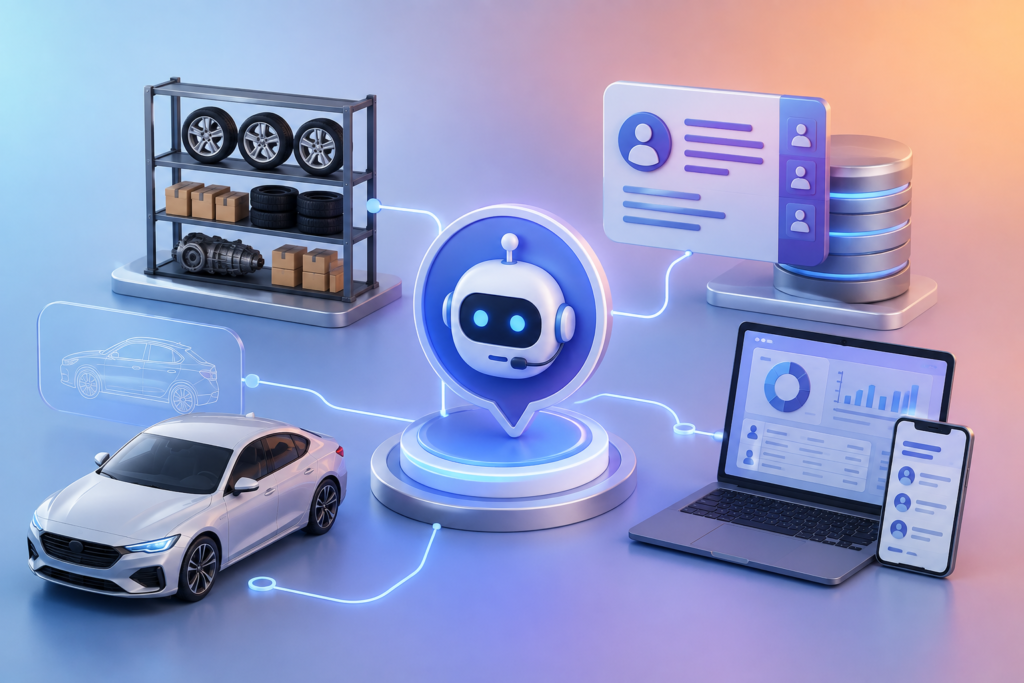
A chatbot becomes considerably more useful when it can work with reliable business data. Without integration, the system may be limited to static information. With appropriate integrations, it can potentially support real-world workflows.
Inventory is one of the most valuable integration opportunities. Automotive customers frequently ask whether a particular model or vehicle is available. If the chatbot can securely access an approved inventory source, it can provide more relevant responses.
The architecture should establish which system is the authoritative source for inventory information. The chatbot should not maintain a separate manual copy of frequently changing vehicle data if that creates a risk of inconsistency.
CRM integration provides another opportunity. Customer inquiries can potentially be transferred into existing sales workflows, along with relevant conversation context.
Appointment systems can support test-drive and service scheduling. When real-time appointment availability is available, the chatbot can guide customers toward available options. When it is not, the chatbot should clearly describe the request process rather than implying that an appointment is already confirmed.
Integrations must also be designed carefully. APIs can expose sensitive information and business functionality, so authentication, authorization, validation, rate controls, logging, and failure handling should be considered.
A practical implementation should begin with a system-of-record map. For every piece of information the chatbot uses, identify where that information originates, who owns it, how frequently it changes, and what happens if the system becomes unavailable.
This prevents a common mistake: connecting multiple systems without defining responsibility for data accuracy.
The chatbot should also have fallback behavior. If an inventory API is temporarily unavailable, it should not invent a result. It can explain that availability needs confirmation and offer a human follow-up instead.
Reliable integrations are therefore not about connecting as many systems as possible. They are about connecting the right systems in a controlled and measurable way.
Designing Automotive Chatbot Conversations for Trust and Conversion
A successful chatbot conversation should feel useful rather than manipulative. Customers should understand what the system can do, what information it needs, and what will happen after they provide it.
The first principle is relevance. If a customer asks about a test drive, the chatbot should focus on the test-drive process instead of forcing the customer through unrelated promotional content.
The second principle is progressive questioning. A chatbot should collect information gradually rather than displaying a long sequence of questions immediately.
The third principle is transparency. If the chatbot is automated, businesses should not create confusion about whether the customer is speaking with a person. The system can be friendly without pretending to be human.
The fourth principle is accurate confirmation. When a customer requests an appointment or submits information, the chatbot should confirm what has actually happened. It should distinguish between “request received,” “request submitted,” and “appointment confirmed.”
The fifth principle is human escalation.
Customers should have a clear route to a person when they need one. Escalation can be triggered when a customer explicitly asks for assistance, when the chatbot cannot answer a question reliably, or when the situation requires professional judgment.
A well-designed handoff should preserve context. If the customer has already explained their preferred vehicle, timeline, and request, the human representative should ideally receive that information so the customer does not need to repeat it.
Conversation design should also include recovery from misunderstandings. Customers may use abbreviations, spelling variations, incomplete sentences, or informal descriptions. The chatbot should ask clarifying questions rather than repeatedly giving irrelevant responses.
Ultimately, conversion should be a consequence of usefulness. If the chatbot provides the right information and makes the next step easier, customers are more likely to continue. Aggressive sales prompts may increase short-term interactions while damaging trust.
The objective is not to force a conversion. It is to remove unnecessary friction between customer intent and customer action.
Automotive Chatbot SEO, Website Experience, and Google Best Practices
A chatbot can support the customer experience, but it should not replace the website’s core informational content. Important automotive information should remain accessible through normal pages that users and search engines can discover.
Businesses should follow official Google Search Central guidance when planning their SEO strategy. Google explains that SEO helps search engines understand content and helps users discover websites and make decisions about visiting them. Google Search Central
The SEO Starter Guide also emphasizes useful fundamentals such as making content understandable, using descriptive link text, creating crawlable links, and focusing on the user experience. SEO Starter Guide
For an automotive business, this means the chatbot should complement high-quality website content rather than hiding important information inside an interface that search engines or users may not be able to access easily.
For example, a dealership might publish comprehensive pages covering vehicle comparisons, model specifications, maintenance information, buying guidance, financing explanations, and common customer questions. The chatbot can then help visitors find and understand those resources.
This creates a useful relationship between SEO content and conversational assistance.
The chatbot can also reveal content opportunities. If customers repeatedly ask questions that the website does not answer clearly, those conversations can identify topics worth addressing through new pages or improved existing content.
However, businesses should avoid creating large volumes of low-value pages simply because automated technology makes production easy. Google’s Google Search Essentials emphasizes helpful, reliable, people-first content and warns against practices designed primarily to manipulate search visibility. Google Search Essentials
Google’s Google Search spam policies specifically address tactics such as keyword stuffing, link spam, and scaled content abuse. Google Search spam policies
This is especially relevant when AI and automation are involved. The goal should not be to generate thousands of repetitive automotive pages or conversations for search engines. The goal should be to create genuinely useful information for customers.
Website performance should also be considered. The chatbot should load efficiently, behave properly on mobile devices, and avoid blocking important content or navigation.
A conversational experience is successful when it enhances the website rather than making the website harder to use.
Using Automotive Chatbot Data to Improve Customer Experience
Every conversation can provide insight into what customers want to know, where they experience friction, and which parts of the website or sales process may need improvement.
For example, if hundreds of visitors ask whether a particular model has a certain feature, that may indicate that the feature is not clearly explained on the vehicle page. If many customers ask whether a test drive requires an appointment, the business may need to make its appointment policy more visible.
Conversation analytics can therefore become a source of customer-experience intelligence.
Useful metrics include conversation starts, completed conversations, abandoned conversations, frequently asked questions, unresolved questions, escalation rates, appointment requests, qualified leads, and conversion outcomes.
Businesses should avoid treating every metric as equally important. A large number of conversations is not automatically positive. If most conversations end because customers cannot find useful answers, high conversation volume may actually indicate a problem.
Instead, organizations should identify metrics that correspond to business objectives.
For sales teams, qualified leads and completed appointments may be more important than total conversations. For service departments, successful appointment requests may be more meaningful than chat duration. For customer support, resolution rate and successful escalation may matter most.
Qualitative analysis is equally valuable. Reviewing representative conversation patterns can uncover problems that numerical dashboards miss.
A chatbot may technically recognize a question while still providing an unhelpful answer. Customers may repeatedly phrase the same request in different ways, revealing gaps in intent recognition or knowledge architecture.
The improvement cycle should therefore be continuous:
Observe → Analyze → Improve → Test → Measure again.
This process allows the chatbot to evolve based on real customer behavior rather than assumptions.
Organizations should also establish governance around analytics and customer information. Data used for improvement should be handled responsibly, with appropriate access controls and retention practices.
When handled correctly, chatbot data becomes more than a reporting tool. It becomes a source of practical insight into customer expectations.
Best Practices for Automotive Chatbot Implementation
The foundation of a successful implementation is a clearly defined scope. Start by identifying the customer problems that create the greatest friction. These might include vehicle discovery, frequently asked questions, lead qualification, test-drive requests, inventory inquiries, or service scheduling.
Do not attempt to automate every process on the first launch.
A focused first release makes it easier to test the customer experience and identify weaknesses.
The next priority is information quality. Establish authoritative sources for vehicle specifications, inventory, dealership information, appointments, policies, and other important facts. Define who is responsible for maintaining each source.
Conversation design should then be built around customer intent.
Instead of designing dozens of isolated responses, create logical paths that help customers accomplish specific goals. Each path should include normal conversations, clarifying questions, failure states, and human escalation.
Integration planning should happen before development is finalized. Identify the systems the chatbot needs to access and determine what information can safely be read or written.
Security should be part of this process from the beginning.
Access should be limited to what the chatbot actually requires. Authentication and authorization should be carefully configured, and integrations should be monitored for failures or unusual behavior.
The business should also define what information the chatbot should never provide without verification.
This is particularly important for pricing, financing, inventory availability, trade-in valuations, warranty interpretations, and mechanical concerns.
Testing should involve realistic customer questions. Use short messages, long explanations, spelling errors, vague requests, comparisons, follow-up questions, and contradictory information.
Finally, establish measurable goals before launch.
A chatbot should have a clear reason for existing and a clear method for evaluating whether it is helping.
When these principles are combined, the implementation becomes easier to manage and more likely to create sustainable value.
The most successful automotive chatbot is not necessarily the one with the greatest number of features. It is the one that solves meaningful customer problems accurately, securely, and efficiently.
Common Mistakes When Implementing an Automotive Chatbot
One of the most common mistakes automotive businesses make is launching a chatbot without first identifying the specific customer problems it is supposed to solve. A chatbot that appears on every page with a generic greeting may create the impression of automation without delivering meaningful value. Before implementation, businesses should examine actual customer questions, sales-team conversations, support requests, appointment problems, and website behavior. This research can reveal where automation would genuinely reduce friction. If customers repeatedly ask about vehicle availability, test drives, financing processes, service appointments, or model differences, those areas may be stronger starting points than attempting to automate every possible conversation. A focused implementation is easier to test, maintain, and improve.
Another major mistake is allowing the chatbot to operate with inaccurate or outdated information. Automotive data changes frequently. Inventory can be sold, appointments can become unavailable, model specifications can vary by year and trim, promotions can expire, and dealership policies can change. If information is manually copied into a chatbot and rarely reviewed, customers can receive answers that sound confident but are no longer correct. This creates a serious trust problem. Businesses should establish authoritative information sources and determine who is responsible for keeping them accurate. Where information changes frequently, appropriate integrations should be considered rather than relying entirely on static chatbot content. The chatbot should also distinguish between confirmed information and information that requires human verification.
A third mistake is creating an aggressive sales experience. Some businesses configure automated systems to ask for a phone number or email address almost immediately, repeatedly promote offers, or push visitors toward a sales representative before understanding what they need. This can make the experience feel transactional rather than helpful. Customers should be allowed to ask questions and receive useful information before being asked for unnecessary personal details. Lead qualification should be progressive, relevant, and proportionate to the customer’s intent. The chatbot should also provide an easy path to human support without forcing customers through unnecessary loops. When automation is designed around customer needs instead of lead volume alone, the resulting conversations are usually more useful and more trustworthy.
Security and integration mistakes are equally important. A chatbot connected to inventory, CRM, scheduling, analytics, or other systems becomes part of a larger technical environment. Excessive permissions, weak access controls, poorly protected APIs, inadequate monitoring, and insecure data handling can create avoidable risks. Businesses should evaluate the complete data flow rather than focusing only on the visible chat interface. They should understand what information enters the system, where it is stored, which applications receive it, who can access it, and how long it is retained. Security should be considered during planning and implementation, not treated as a final inspection after the chatbot is already operational.
Another common error is failing to test realistic customer behavior. Developers may test carefully written questions that are easy for the system to understand, while actual customers use abbreviations, incomplete sentences, spelling mistakes, informal language, follow-up questions, and vague descriptions. A strong testing program should reflect this reality. It should also test failure conditions, such as unavailable inventory data, failed APIs, conflicting information, incomplete lead details, and requests that require human expertise. The chatbot should have a predictable recovery process for each situation. A system that works perfectly under ideal conditions but fails badly when something unexpected happens is not ready for production.
Finally, many automotive businesses measure the wrong outcomes. Counting conversations, clicks, or collected email addresses can create an attractive dashboard without proving that the chatbot is helping the business. A better measurement strategy connects conversations with meaningful outcomes such as qualified leads, completed test drives, appointments, customer satisfaction, successful human handoffs, and eventual sales opportunities where attribution is practical. The objective should be to understand whether the chatbot is making the customer journey easier and the business process more effective.
Best Practices Summary for Long-Term Automotive Chatbot Success
Long-term chatbot success begins with a clearly defined business purpose. The system should have a small number of measurable objectives that connect directly to customer and operational needs. Examples might include reducing response time, increasing qualified vehicle inquiries, improving test-drive requests, supporting service appointment workflows, or reducing repetitive questions handled manually by employees. These objectives should guide the chatbot’s design, integrations, analytics, and ongoing improvements. Without clear goals, businesses often continue adding features without knowing whether those features are creating value.
Information quality should be treated as an ongoing responsibility. Automotive businesses should maintain a structured knowledge-management process covering vehicle information, dealership policies, contact details, appointment processes, service information, and other frequently requested facts. Dynamic information should come from authoritative systems whenever practical. Static information should have clear ownership and review schedules. The chatbot should never be encouraged to fill gaps by guessing. When information is unavailable, it is better to acknowledge the limitation and offer an appropriate next step than provide an uncertain answer that could damage customer trust.
Conversation design should remain simple, helpful, and adaptable. Customers should be able to express their needs naturally while still receiving clear guidance. The chatbot should use progressive questions, provide concise answers, confirm important actions, and avoid repetitive prompts. It should recognize when a customer has changed topics and should not force the conversation to continue along an outdated path. Human escalation should be built into the experience rather than treated as an emergency feature. Customers who need expert assistance should be able to reach an appropriate employee without unnecessary frustration.
Businesses should also maintain a disciplined approach to search optimization. Google Search Essentials identifies helpful, reliable, people-first content as a key best practice and explains that technical requirements, spam policies, and content practices all contribute to eligibility in Google Search. Google Search Essentials The chatbot should therefore complement the website’s SEO strategy rather than replace important indexable content. Vehicle pages, buying guides, service information, comparisons, and educational resources should remain accessible to users through normal website navigation.
This is particularly important because Google continues to emphasize original, useful information. Its guidance on creating helpful, reliable, people-first content encourages creators to provide substantial value, demonstrate appropriate expertise, and focus on satisfying visitors rather than producing content primarily for search engines. creating helpful, reliable, people-first content Automotive businesses should apply the same principle to their chatbot-supported content strategy. If customers repeatedly ask a question, the answer should not necessarily exist only inside the chatbot. The question may indicate an opportunity to improve a public website page as well.
Security and privacy should remain part of the long-term maintenance process. Changes to APIs, CRM platforms, inventory systems, authentication mechanisms, third-party tools, and chatbot platforms can introduce new risks. Periodic reviews can help ensure that permissions remain appropriate and that integrations continue working as intended. Access should be limited according to business requirements, and sensitive information should not be collected merely because the chatbot can collect it.
Finally, continuous optimization should be based on evidence. Businesses should review unresolved conversations, frequently requested information, abandoned workflows, successful conversions, human escalations, and integration failures. Improvements should be tested rather than assumed to work. This creates a sustainable cycle in which the chatbot becomes increasingly aligned with customer behavior.
Advanced Automotive Chatbot Strategies for Dealership Growth
Once the fundamental chatbot experience is working reliably, automotive businesses can explore more advanced strategies. One opportunity is intelligent segmentation. Instead of treating every visitor identically, the system can adapt the conversation based on the customer’s apparent objective. Someone researching vehicles for the first time may need educational guidance, while someone who already knows the exact model they want may prefer inventory and appointment information. The chatbot can create different conversational paths without requiring every customer to complete the same sequence.
Another advanced strategy is conversational comparison. Customers often compare multiple vehicles before making a decision. A chatbot can help organize the comparison by asking which characteristics matter most, such as passenger capacity, cargo space, technology, drivetrain, efficiency, towing capability, or other relevant specifications. The system should present factual distinctions using verified information and avoid exaggerated claims. Comparison conversations can also lead naturally toward detailed vehicle pages or a human consultation when the customer wants personalized assistance.
The chatbot can also support lead prioritization. Not every lead requires the same urgency. A visitor who wants to schedule a test drive this week may have a different level of intent from someone who is simply exploring vehicle categories. When the business has appropriate data and governance, conversations can be classified according to useful signals such as requested action, timeframe, preferred vehicle, and contact preference. This can help sales teams organize follow-up more effectively.
Another advanced use case involves customer re-engagement. If a visitor previously requested information and returns later, the experience can potentially become more contextual, subject to appropriate privacy and consent practices. Instead of forcing the customer to restart the entire journey, the system may be able to help them continue from their previous objective. However, businesses should be careful about storing and displaying personal information. Personalization should improve convenience without creating an uncomfortable feeling that the system knows more about the visitor than expected.
Automotive businesses can also connect chatbot analytics with broader customer-experience analysis. If conversations reveal repeated confusion about a vehicle page, financing explanation, appointment process, or service policy, the business can improve the underlying customer journey rather than simply adding another chatbot response. This is an important distinction: the chatbot should not become a permanent patch over a poorly designed website or process.
Advanced automation should therefore be introduced only after the fundamentals are reliable. More sophisticated technology cannot compensate for inaccurate data, weak conversation design, poor escalation, or unclear business ownership. The strongest advanced strategy is to use automation to improve an already well-structured customer experience.
Automotive Chatbot Security and Data Protection Considerations
Security becomes increasingly important as an automotive chatbot moves beyond basic questions and begins interacting with business systems. A chatbot that can access inventory may require different permissions from one that can create appointments. A chatbot connected to a CRM may process personal information that should not be exposed to unauthorized users. The security architecture should therefore be based on the chatbot’s actual capabilities rather than a one-size-fits-all approach.
Access control is one of the most important considerations. Each integration should receive only the permissions it requires. If the chatbot only needs to read inventory information, it should not automatically receive permission to modify unrelated customer or administrative data. Separating read and write capabilities can reduce unnecessary exposure if an integration is compromised.
Authentication and authorization should also be evaluated independently. Authentication determines who or what is accessing a system, while authorization determines what that authenticated entity is allowed to do. Both matter when a chatbot interacts with external systems. API credentials should be managed appropriately, and sensitive secrets should not be embedded in client-side code.
Input validation is another important consideration. Customers can enter unexpected information, including unusual characters, links, instructions, or data that the application did not anticipate. Systems should validate and handle inputs appropriately before passing them to downstream applications.
Logging can also help identify problems. Businesses should monitor relevant technical events, failed integrations, unusual access patterns, and important workflow failures while being careful not to expose unnecessary personal information in logs.
The OWASP Top 10 is a useful reference for understanding major web application security risks, while the OWASP API Security Top 10 focuses specifically on security risks associated with APIs. OWASP Top 10 OWASP API Security Top 10
Automotive organizations should also consider broader cybersecurity governance. The NIST Cybersecurity Framework 2.0 provides a structured approach for organizations to manage cybersecurity risks and communicate them across business and technical teams. NIST Cybersecurity Framework 2.0
Security should not stop when the chatbot launches. Integrations change, software is updated, employees change roles, and business processes evolve. Periodic reviews can identify outdated permissions, unused integrations, configuration problems, and new risks.
A secure chatbot is therefore the result of continuous governance, not simply the purchase of a secure platform.
How to Improve Automotive Chatbot Conversion Rates Without Being Pushy
Conversion optimization in automotive chatbot design should focus on reducing friction rather than increasing pressure. Customers are more likely to take action when the next step is clear, relevant, and proportionate to their intent.
One effective approach is to match calls to action with the customer’s current stage. A visitor asking general questions may be better served by a vehicle guide or comparison resource. Someone asking about a specific vehicle may be ready to view inventory. A customer asking about a test drive may be ready for appointment scheduling. The chatbot should not present the same sales prompt to everyone.
The timing of contact-information requests also matters. Asking for a phone number before answering a simple question can create unnecessary resistance. Instead, the chatbot can provide useful information first and then explain why contact information would help with the next requested action.
Clarity is equally important. A button labeled “Continue” is less informative than one that clearly describes what will happen, such as requesting a test drive or contacting a representative. Clear labels reduce uncertainty.
The chatbot should also minimize unnecessary fields. If the business only needs a customer’s name and preferred contact method to begin a follow-up, asking for many additional details may reduce completion.
Trust signals can improve the experience as well. Customers should understand whether information is current, whether an appointment is confirmed, and whether a human representative will follow up. Clear expectations can prevent disappointment.
Another useful strategy is to offer alternatives. A customer who does not want to provide a phone number may prefer email. Someone who does not want to schedule immediately may want to save a vehicle or continue researching. Providing reasonable choices respects customer autonomy.
Conversion should also be evaluated after the initial chatbot interaction. A lead submission is not necessarily a successful conversion if the customer never responds to follow-up. Businesses should examine the downstream journey where reliable tracking is possible.
The goal is not to make the chatbot more aggressive. It is to make the desired customer action easier.
Automotive Chatbot Integration With Service and After-Sales Support
The automotive relationship does not end when a vehicle is purchased. Customers continue to need information about maintenance, service appointments, warranty processes, accessories, dealership contact details, and ownership-related questions. This creates a valuable opportunity for conversational support beyond sales.
A service chatbot can help customers understand how to request an appointment, what information they may need, where the service department is located, or how to contact the appropriate team. It can also direct customers toward approved service information.
However, service conversations require careful boundaries. A chatbot should not attempt to diagnose potentially dangerous mechanical problems based solely on a customer’s text description. If someone reports symptoms that could indicate a safety issue, the system should encourage appropriate professional assistance and avoid presenting an automated guess as a technical diagnosis.
Appointment support can be especially useful. If integrated with an appropriate scheduling system, the chatbot can guide customers through available service options. It should clearly communicate whether the appointment has been requested or confirmed.
The chatbot can also help reduce service-department phone volume by answering routine administrative questions. Customers may ask about opening hours, appointment preparation, contact information, or general maintenance processes. Handling suitable questions conversationally can allow service employees to focus on customers who need direct assistance.
After-sales support also provides an opportunity for proactive communication. Businesses may use approved workflows to remind customers about relevant maintenance or appointment information, provided that such communication follows applicable privacy and consent requirements.
The quality of the experience depends heavily on data accuracy. Service hours, appointment availability, warranty information, and dealership policies should be maintained carefully.
A useful post-sale chatbot should therefore behave more like a customer assistance layer than a technical diagnostic tool.
When designed responsibly, it can strengthen the ownership experience while reducing unnecessary administrative workload.
Automotive Chatbot Accessibility and Mobile Experience
Automotive customers do not interact with websites only from desktop computers. Many vehicle searches happen on smartphones, particularly when customers are comparing listings, checking dealership information, or researching a vehicle while away from home. The chatbot therefore needs to work effectively on smaller screens.
The interface should not cover the entire page unnecessarily. Customers should be able to close, minimize, or ignore the chatbot when they want to continue browsing. A conversational tool should support website navigation rather than interfere with it.
Text should remain readable without requiring excessive zooming or horizontal scrolling. Buttons should be large enough to interact with comfortably on touch devices, and conversational responses should avoid unnecessarily long blocks of text.
Keyboard accessibility should also be considered. Users who navigate without a mouse should be able to access the chatbot controls, enter messages, move through interactive elements, and close the interface using appropriate keyboard interactions.
The experience should also consider users with assistive technologies. Clear labels, sensible focus behavior, accessible controls, and appropriate semantic structure can make the interface easier to use.
Error messages should be understandable. If an action fails, the customer should know what happened and what they can do next. Technical messages should not be exposed unnecessarily.
Performance is another consideration. A chatbot that adds excessive scripts or delays page rendering can create a poor experience. Businesses should evaluate the chatbot’s impact on page performance rather than assuming that a small visual widget has no technical effect.
This matters for SEO as well as usability. Google’s guidance on page experience emphasizes the importance of providing a good overall experience across devices and ensuring that visitors can easily find and interact with the main content. page experience
Mobile testing should therefore be part of the normal chatbot quality-assurance process. Test common screen sizes, browsers, connection conditions, keyboard interactions, and accessibility scenarios.
A chatbot that works beautifully on a developer’s desktop but poorly on a customer’s phone is not a successful implementation.
Using Google-Friendly Content Strategy With an Automotive Chatbot
An automotive chatbot should operate alongside a strong content strategy. It should not be used as a replacement for useful public information. Customers and search engines should be able to access important content through normal website pages.
Automotive businesses can create valuable resources around vehicle comparisons, buying considerations, maintenance guidance, ownership questions, model differences, technology explanations, and frequently asked questions. The chatbot can then help visitors discover those resources when relevant.
Google’s current guidance emphasizes that useful content should be created primarily for people and should provide original value. Its Google Search guidance about AI-generated content explains that automation itself is not automatically against Google’s policies, but using automation primarily to manipulate search rankings violates its spam policies. Google Search guidance about AI-generated content
This distinction is important for automotive businesses using AI-assisted content production. A business should not create hundreds of nearly identical pages for different vehicle keywords simply because automation makes it easy. Instead, content should answer real customer questions and contain useful information that helps people make informed decisions.
Google’s current documentation on AI-generated content also warns that generating many pages without adding value can fall under scaled content abuse. AI-generated content
The chatbot can actually help improve this strategy by identifying genuine customer questions. If customers repeatedly ask about charging times, towing capacity, vehicle dimensions, warranty processes, or service requirements, those topics may deserve dedicated content.
The result is a feedback loop between customer conversations and content development.
The business learns what customers need to know, creates useful resources, and then uses the chatbot to guide visitors toward those resources.
This approach supports both user experience and sustainable SEO because the content exists to answer real questions rather than simply target keywords.
Future Trends Shaping Automotive Chatbots

Automotive conversational technology is likely to become increasingly connected to broader digital customer journeys. Instead of operating as an isolated chat window, future systems may coordinate information across inventory, CRM, scheduling, service, website content, and customer-support workflows.
One important direction is more contextual conversation. Customers increasingly expect digital systems to understand the conversation’s history and respond appropriately to follow-up questions. A visitor may ask about a vehicle, then immediately ask about its cargo space, then ask whether a similar model is available. A mature system should understand that these questions are connected rather than treating each one as a separate request.
Another trend is multimodal interaction. Future automotive experiences may combine text, images, structured vehicle information, and other digital interfaces. A customer might identify a vehicle from an image, ask questions about its features, and then move directly into an appointment workflow. Businesses will need to ensure that these capabilities remain accurate and transparent.
AI-assisted customer support may also become more integrated with human teams. Rather than simply transferring a conversation to an employee, future systems may provide the representative with a concise summary of the customer’s needs, previous questions, selected vehicle, and requested action.
This could make human follow-up faster and more relevant.
However, more powerful automation will also increase the importance of governance. As systems gain access to more business functions, organizations will need stronger controls around permissions, data handling, reliability, and human oversight.
Search is evolving as well. Google has expanded AI experiences in Search while continuing to emphasize foundational SEO practices. Its guidance for AI features states that the same core principles remain important: pages should meet technical requirements, follow Search policies, and provide helpful, reliable, people-first content. AI features and your website
This suggests that automotive businesses should focus less on trying to optimize for a specific interface and more on creating useful, authoritative information that can serve customers across changing search experiences.
The future of automotive chatbots will therefore not simply be about making bots more conversational. It will be about making them more useful, more connected, more accurate, and more responsibly integrated into the customer journey.
Measuring ROI From an Automotive Chatbot
Return on investment should be considered from both revenue and operational perspectives. A chatbot can potentially create value by generating more qualified opportunities, improving appointment completion, reducing repetitive workload, and helping customers find information faster.
The first step is establishing a baseline. Businesses should understand existing lead volumes, response times, appointment requests, conversion rates, and customer-support workloads before launching the chatbot. Without a baseline, it becomes difficult to determine whether the system has created measurable improvement.
Lead metrics may include qualified inquiries, test-drive requests, appointment requests, contact requests, and opportunities that progress into later sales stages. Businesses should avoid counting every conversation as a lead.
Operational savings can also matter. If the chatbot handles routine questions that previously required employee time, the organization can estimate the value of that reduced workload. However, automation should not simply be judged by the number of employee interactions eliminated. The quality of the customer experience remains important.
Appointment metrics can be especially useful for dealerships. A chatbot that makes test-drive requests easier may create value even if the total number of conversations remains unchanged.
Customer-experience metrics can provide another perspective. Successful resolution, reduced abandonment, faster responses, and appropriate human escalation can indicate whether the chatbot is actually helping visitors.
Businesses should also account for implementation and maintenance costs. These may include platform costs, integration work, development, analytics, content maintenance, security reviews, employee training, and ongoing optimization.
ROI should therefore be evaluated as a complete business equation rather than a single metric.
A useful reporting framework might compare:
Qualified opportunities + completed appointments + operational efficiency + customer-experience improvements − implementation and maintenance costs.
The exact financial model will differ between businesses.
The important point is to measure outcomes that matter to the organization.
A chatbot is not successful because it is technically impressive. It is successful when the investment produces measurable improvements in customer communication and business performance.
Final Checklist for Launching an Automotive Chatbot
Before launching an Automotive Chatbot, the business should confirm that its primary use cases are clearly defined. The team should know whether the initial goal is lead generation, inventory assistance, test-drive requests, customer support, service scheduling, or another specific objective. Each use case should have measurable success criteria.
The next step is information validation. All important chatbot answers should be reviewed against authoritative sources. Vehicle specifications, dealership details, appointment policies, service information, and other important facts should have clear ownership.
The conversation flows should then be tested from beginning to end. Test normal questions as well as unexpected inputs, incomplete information, misunderstandings, and requests that require human intervention.
Human escalation should be verified. Customers should have a reliable path to an employee when the chatbot cannot help or when the customer explicitly requests human assistance.
Integrations should be tested for both success and failure. Inventory APIs, CRM connections, appointment systems, analytics tools, and other dependencies should have defined fallback behavior.
Security should be reviewed before launch. Confirm authentication, authorization, data protection, API permissions, logging, administrative access, and third-party dependencies.
The mobile and accessibility experience should also be tested across appropriate devices and interaction methods.
Analytics should be configured before the chatbot begins collecting meaningful business data. The team should know which events represent conversations, qualified leads, appointments, escalations, failures, and other important outcomes.
Content should also be reviewed from a people-first perspective. Google’s helpful content guidance recommends evaluating whether content provides substantial, original value and demonstrates appropriate expertise and trustworthiness. helpful, reliable, people-first content
Finally, establish an improvement schedule. A chatbot should not be launched and forgotten. Review unresolved conversations, customer feedback, conversion data, integration failures, and new business requirements regularly.
A launch checklist can be summarized as:
Purpose → Data → Conversation → Integration → Security → Accessibility → Analytics → Human Handoff → Testing → Continuous Improvement.
Following this sequence gives automotive businesses a stronger foundation for creating a chatbot that is useful, reliable, and sustainable.
Frequently Asked Questions
What is the main purpose of an Automotive Chatbot?
The primary purpose is to make automotive customer communication faster and easier. Depending on the business, the chatbot can answer questions, help visitors discover vehicles, qualify leads, support test-drive requests, assist with service workflows, provide dealership information, and connect customers with human representatives.
Can an Automotive Chatbot help sell more vehicles?
It can support the sales process by reducing friction and helping customers take meaningful actions. For example, it can help visitors find relevant vehicles, answer questions, qualify inquiries, and support test-drive requests. Actual sales results depend on many factors, including inventory, pricing, sales processes, customer intent, follow-up quality, and market conditions.
Can an Automotive Chatbot provide real-time inventory information?
Yes, if it is appropriately integrated with a reliable inventory system. The chatbot should use an authoritative source and clearly communicate whether information is current or requires confirmation. It should never claim that a specific vehicle is available without an appropriate source confirming that information.
Can an Automotive Chatbot qualify leads before sending them to sales?
Yes. It can ask relevant questions about vehicle preferences, purchase timing, desired actions, and contact preferences. The qualification process should remain concise and conversational. Businesses should focus on collecting information that genuinely helps sales representatives rather than maximizing the amount of data collected.
Can an Automotive Chatbot schedule test drives and service appointments?
It can support scheduling when connected to an appropriate appointment system. The exact capability depends on the available integration. The chatbot should distinguish clearly between an appointment request and a confirmed appointment.
Should an automotive chatbot give financing advice?
A chatbot can provide general information about an organization’s financing process if that information is accurate and approved for publication. It should be careful with personalized financial guidance, eligibility decisions, approvals, or promises. Where a question requires professional or case-specific evaluation, the conversation should be transferred to an appropriate human representative.
Can a chatbot replace a dealership sales team?
No. Automation is most effective when it handles suitable routine interactions and supports employees with useful context. Sales professionals remain important for complex questions, negotiations, relationship building, high-value conversations, and situations requiring human judgment.
How can an automotive business improve chatbot accuracy?
Accuracy depends on reliable information sources, appropriate integrations, regular content reviews, testing, monitoring, and clear escalation rules. Businesses should identify which systems are authoritative and prevent the chatbot from guessing when information is unavailable or uncertain.
Conclusion
An Automotive Chatbot can become a powerful component of the modern automotive customer journey when it is built around genuine customer needs. From the first vehicle question to inventory discovery, lead qualification, test-drive requests, appointment support, and post-sale assistance, conversational automation can help businesses respond faster while making customer interactions more convenient.
The technology itself, however, is only one part of the solution. Successful implementation requires accurate information, thoughtful conversation design, secure integrations, appropriate data practices, accessible interfaces, meaningful analytics, and reliable human escalation. Businesses that focus only on installing a chatbot may miss the larger opportunity.
The strongest strategy is to view conversational automation as a customer-experience system. It should connect customers with useful information, reduce unnecessary friction, and help employees spend more time on interactions where their expertise matters most.
Search strategy should follow the same principle. Google’s current guidance emphasizes helpful, reliable, people-first content and warns against creating content primarily to manipulate search rankings. Creating helpful, reliable, people-first content Automotive businesses should therefore use conversational technology to improve genuine customer value rather than simply produce more automated pages or keyword-focused interactions.
When implemented thoughtfully, an Automotive Chatbot can support more than lead generation. It can improve discovery, communication, service, customer support, and operational efficiency while creating a more connected digital experience.
For businesses looking to turn these principles into a practical conversational strategy, Engagerbot can be considered as part of the implementation process. The objective should always remain the same: make it easier for customers to get useful answers, take the right next step, and connect with a qualified person when automation is not enough.
Want to Implement This Easily?
Prompt Text:
You are an expert consultant. Based on the blog post titled “Automotive Chatbot”, provide a step-by-step, practical implementation guide. Include tools, best practices, common mistakes to avoid, and advanced tips. Assume the reader wants to implement everything discussed in this article effectively.
Call to Action: Want our help implementing this? Just reach out to us via our website contact form: contact form