
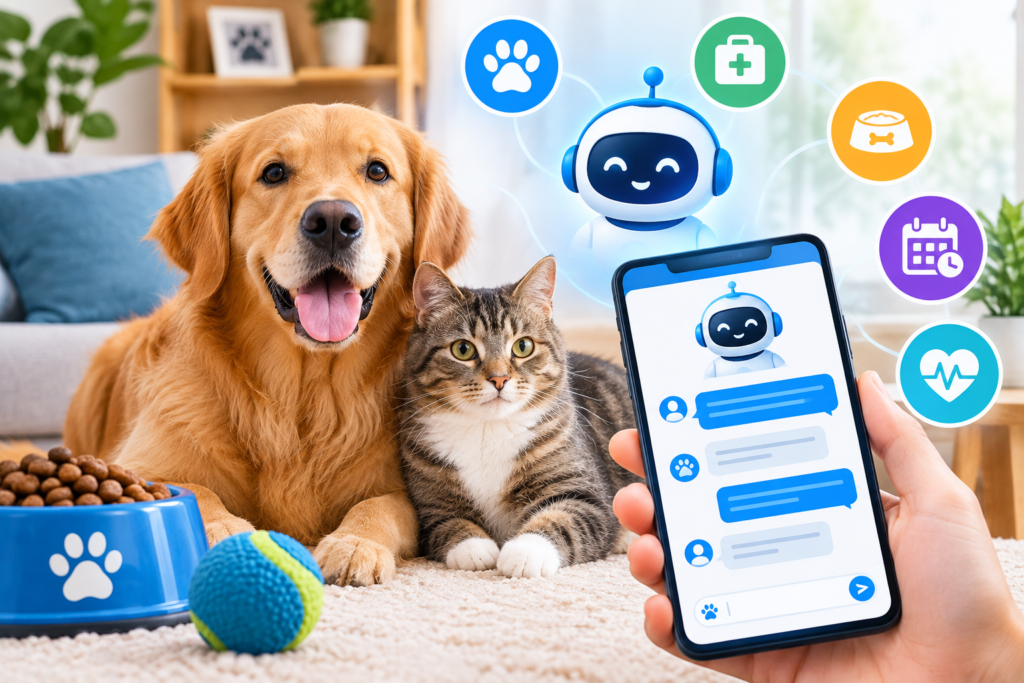
A Pet Care Chatbot helps veterinary clinics, pet stores, groomers, shelters, trainers, and pet service businesses provide faster answers, appointment support, pet-care information, and personalized customer experiences around the clock.
Introduction
Pet owners expect convenient, fast, and reliable communication when they need information about their animals. A customer may want to book a veterinary appointment, ask about grooming requirements, find out whether a boarding facility accepts a particular type of pet, check a business’s opening hours, explore pet products, or understand how a service works. If every question requires a phone call or a delayed email response, customers may experience unnecessary friction before they ever become clients.
A Pet Care Chatbot provides a conversational layer that can help businesses respond to common questions and guide visitors toward the appropriate next step. Instead of forcing a visitor to search through multiple pages, a chatbot can understand natural-language questions and provide relevant information through a simple conversation. When implemented correctly, it can support customer service, appointment requests, lead qualification, product discovery, FAQs, and human handoffs.
Engagerbot can be used as part of a broader conversational engagement strategy for pet-related organizations that want to make their websites more interactive and accessible. However, pet care requires a responsible approach because conversations can sometimes involve animal health and safety. A chatbot should never create the impression that artificial intelligence can replace professional veterinary assessment. Instead, it should provide appropriate general information, identify situations requiring professional attention, and make human support easy to access.
The SEO strategy surrounding a Pet Care Chatbot should follow the same people-first philosophy. Google’s guidance on helpful content emphasizes creating original, useful information for people rather than producing content primarily to manipulate search rankings. That principle is particularly important for pet-care topics because readers need accurate information they can understand and trust.
What Is a Pet Care Chatbot?
A Pet Care Chatbot is a conversational software system designed to communicate with pet owners, customers, and prospective clients through natural-language interactions. Rather than relying entirely on traditional menus, forms, and FAQ pages, a chatbot allows visitors to ask questions in their own words. Someone might type, “Do you groom large dogs?” or “I need to schedule a checkup for my cat,” and the system can identify the purpose of the conversation and guide the user toward relevant information or an appropriate action.
The underlying technology may include conversational artificial intelligence, natural-language processing, intent recognition, knowledge bases, business rules, appointment integrations, product databases, and human escalation workflows. Not every pet business needs the same level of sophistication. A small grooming salon might primarily need automated FAQs and appointment inquiries, while a veterinary practice may need carefully controlled administrative automation and strict boundaries around medical conversations.
The most important principle is that a chatbot should support professionals rather than pretend to replace them. A veterinary chatbot can help explain clinic procedures or collect appointment information, but it should not claim to diagnose an animal based on a few messages. A grooming chatbot can collect information about a pet’s coat and requested service, but professional staff may still need to evaluate the pet before confirming what can safely be provided.
For SEO and content quality, the supporting website should explain these capabilities accurately. Google’s SEO Starter Guide encourages site owners to create useful, understandable content and organize websites in ways that help users and search engines understand the information. A Pet Care Chatbot page should therefore explain genuine functionality, limitations, use cases, and implementation considerations rather than making exaggerated promises.
Why Pet Businesses Are Adopting Conversational AI
Pet businesses handle a surprisingly large number of repetitive customer questions. Groomers may repeatedly explain pricing, preparation requirements, coat-care services, cancellation policies, and appointment availability. Boarding businesses may receive questions about check-in times, vaccination requirements, feeding instructions, accommodation options, and medication procedures. Veterinary clinics often receive administrative questions about appointments, clinic hours, services, locations, and new-client procedures.
A chatbot can organize these recurring questions into a conversational experience that is available whenever visitors need it. This can be especially useful outside normal business hours. A potential customer visiting a website in the evening may not want to wait until the following morning to find basic information. The chatbot can answer approved questions immediately and collect an inquiry when the customer needs assistance from a member of staff.
Conversational automation can also improve internal efficiency. Instead of receiving a vague message such as “I need to book my dog,” staff can receive a structured inquiry containing the pet type, requested service, preferred date, and contact details. The employee can then continue from information that has already been collected. This reduces repetitive back-and-forth communication and can make the customer journey more organized.
However, automation should solve a real problem rather than being added simply because artificial intelligence is popular. The same principle applies to SEO content. Google’s Search Essentials provide guidance on technical requirements, spam policies, and practices that help websites appear appropriately in Google Search. A useful chatbot should similarly focus on genuine customer value instead of artificial complexity.
How a Pet Care Chatbot Improves the Pet Owner Experience
The pet-owner journey contains many small questions that can create friction. A visitor may want to know whether a grooming business accepts puppies, whether a boarding facility provides food, whether a veterinary clinic accepts new patients, or what information is needed before an appointment. A chatbot can provide immediate guidance without requiring the visitor to locate every answer manually.
Personalization can make the experience more relevant when it is based on information that the visitor voluntarily provides. For example, the chatbot may ask whether the visitor is asking about a dog, cat, rabbit, bird, or another animal. It can then focus the conversation on relevant services. If the visitor says they are interested in puppy grooming, the chatbot can maintain that context during the conversation instead of repeatedly asking the same question.
Another advantage is that customers do not necessarily need to understand a company’s internal terminology. A website may call a service “full coat maintenance,” while a customer simply asks, “Can you groom my long-haired dog?” A well-designed conversational system can recognize the intent behind natural language and guide the customer toward the appropriate service.
The experience should always include an appropriate human option. A visitor with a complicated complaint, a sensitive question, an unusual booking request, or a professional-care concern should not be forced through endless automated responses. Good conversational design recognizes when automation has reached its limit. A clear human handoff can therefore be considered an essential feature rather than a failure of the technology.
Essential Features of a Pet Care Chatbot
A practical Pet Care Chatbot should be designed around actual customer needs. Common capabilities include frequently asked questions, service explanations, business hours, location information, appointment assistance, contact collection, product discovery, pricing guidance, policy explanations, and human escalation.
Appointment support can be particularly useful. The chatbot can ask what type of service the customer needs, collect relevant pet information, identify preferred dates, and then direct the user toward the appropriate booking process. If a real scheduling integration is available, the chatbot may be able to help the visitor select from genuine availability. If no such integration exists, it should collect an appointment request without falsely claiming that a booking has been confirmed.
A controlled knowledge base is another important feature. Businesses can provide approved information about services, policies, preparation requirements, opening hours, locations, and common customer questions. This reduces the need for the system to improvise answers. For sensitive pet-health questions, businesses should establish particularly strict boundaries and use professionally reviewed information.
Advanced implementations can also include analytics, CRM integration, ecommerce connections, multilingual support, automated lead qualification, conversation history, staff notifications, and feedback collection. These features should be introduced according to actual business requirements rather than simply because they are available.
The chatbot should also have a reliable fallback strategy. If it cannot understand a question, it should explain what it can help with and offer relevant options. If a customer asks for a human, the system should provide that route rather than repeatedly attempting to automate the interaction.
Pet Health Questions: Where Chatbots Need Strong Boundaries
Pet health is one of the most sensitive areas for conversational AI. A short message such as “My dog is vomiting” can represent many different situations, and the chatbot may not have the information necessary to determine the seriousness of the problem. Age, frequency, duration, possible toxin exposure, existing conditions, hydration, behavior, and other factors may all matter.
A responsible Pet Care Chatbot should therefore clearly distinguish between general educational information and professional veterinary care. It can explain general concepts, help customers prepare questions for a veterinarian, provide information about clinic procedures, or direct users toward appropriate professional assistance. It should not present a diagnosis as fact based solely on a conversational exchange.
Businesses can establish escalation rules for potentially urgent situations. Language involving severe breathing difficulty, collapse, serious trauma, uncontrolled bleeding, suspected poisoning, seizures, or other potentially life-threatening circumstances can trigger a response encouraging the user to seek urgent veterinary assistance. The exact wording should be reviewed by appropriate professionals and adapted to the business’s location and available emergency resources.
This is also an important E-E-A-T consideration. Google’s creating helpful, reliable, people-first content guidance emphasizes trust and expertise, particularly when content can affect users’ well-being. Pet-care websites should therefore distinguish professional advice from general educational material, identify qualified reviewers when appropriate, and avoid presenting AI-generated information as professional veterinary judgment.
Using a Pet Care Chatbot for Veterinary Appointment Booking
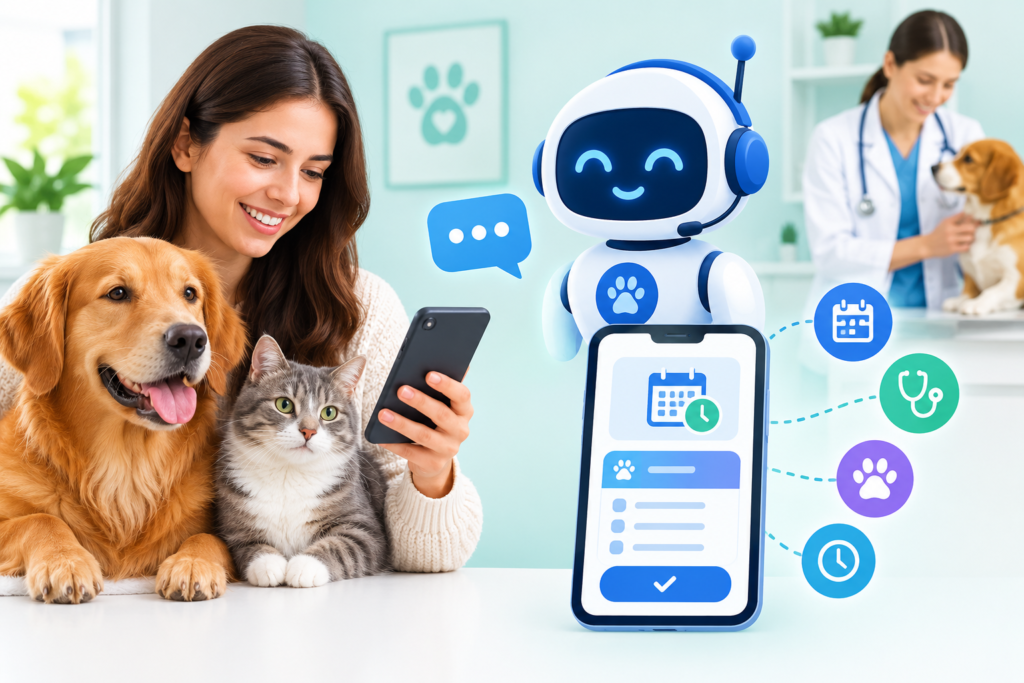
Appointment scheduling is one of the most practical applications of conversational technology for veterinary practices. Traditional forms can feel impersonal and may require customers to understand exactly which service or appointment type they need before beginning. A chatbot can guide them through the process using straightforward questions.
A veterinary appointment conversation might begin by asking what the visitor needs help with. Options could include routine appointments, vaccinations, new-patient inquiries, follow-up visits, or general administrative questions. Once the customer selects an option, the chatbot can request the information required for the next step.
The system should clearly distinguish between a booking request and a confirmed appointment. If it is not connected to live scheduling data, it should never claim that a specific appointment time is reserved. Instead, the customer can be told that their request has been received and will be confirmed by the clinic. This distinction prevents confusion and protects the credibility of the business.
Where live scheduling is available, the chatbot can make the booking journey more conversational. It may collect the customer’s preferred date and service, check actual availability, and direct the visitor through the appropriate confirmation process. Any technical failure should trigger a fallback rather than fabricated availability.
Pet Product Discovery and Personalized Recommendations
Pet retailers often have extensive product catalogs that can overwhelm customers. A visitor may know the problem they want to solve but not know which product category is appropriate. They may ask for a harness for a particular dog size, grooming equipment for a long-haired animal, bedding for a particular environment, or enrichment products for an indoor pet.
A chatbot can narrow the selection by asking useful questions. Depending on the product category, these may include animal type, approximate size, intended use, material preferences, budget, age range, or other meaningful product attributes. The chatbot can then explain why certain categories or products may match the customer’s stated requirements.
Recommendations should be based on real product information rather than unsupported assumptions. If an ecommerce system is integrated, the chatbot may be able to direct customers toward current products and product pages. It should avoid claiming that a product is available if inventory information has not been verified.
Health-related products require additional caution. A chatbot should not casually present a product as a treatment for a medical condition. If the customer is seeking advice about a health issue, the safer approach is to provide general information and encourage appropriate professional consultation.
Pet Grooming, Boarding, Training, and Other Service Support
The value of a Pet Care Chatbot extends well beyond veterinary practices. Grooming businesses can use conversational automation to explain services, preparation instructions, appointment policies, coat-care options, and aftercare information.
A grooming chatbot can collect information such as the animal’s type, breed, approximate size, coat characteristics, requested service, previous grooming experience, and preferred appointment date. This can help staff understand the customer’s needs before the appointment. However, the information collected through the chatbot should support professional decision-making rather than replace it.
Boarding and daycare businesses can automate common questions about check-in and pickup times, required documentation, feeding arrangements, medication policies, accommodation options, and cancellation procedures. Keeping these answers in a controlled knowledge base can also help ensure that customers receive consistent information.
Pet trainers can use conversational intake flows to understand a customer’s goals. The chatbot might ask about the animal’s approximate age, training history, behavior concerns, and preferred training format before directing the customer toward the appropriate consultation or service.
Across all these industries, the strongest implementation is not the one that automates every possible interaction. It is the one that automates repetitive communication while making professional assistance easier to access when needed.
Building a Reliable Knowledge Base for Pet Care Conversations
A successful pet care chatbot depends heavily on the quality of the information behind every conversation. Pet owners may ask questions about feeding schedules, grooming routines, vaccination reminders, boarding requirements, training appointments, product availability, service policies, or general pet-care guidance. If the chatbot relies on outdated, incomplete, or inconsistent information, even a technically advanced conversational system can create frustration. A reliable knowledge base should therefore be treated as an ongoing business asset rather than a document that is created once and forgotten. Information should be organized around the real questions customers ask and should be written in clear language that a conversational system can retrieve and explain naturally. Businesses can also organize content according to pet type, service category, customer intent, and frequently asked questions so the chatbot can identify relevant information efficiently.
For general pet-care information, the knowledge base should distinguish between educational guidance and professional veterinary advice. This distinction is especially important because questions about symptoms, medications, injuries, poisoning, or serious behavioral changes can require professional evaluation. The chatbot can provide general educational information while clearly directing customers toward appropriate veterinary care when a situation may require professional attention. Content should also identify the date or version of policies that may change, such as grooming requirements, boarding documentation, cancellation policies, appointment availability, and product information. A structured content-management process makes it easier for staff to review and update information without rebuilding the entire conversational experience. This approach also supports the principles behind helpful, reliable, people-first content, where information should genuinely serve users rather than simply being produced to attract search traffic.
The knowledge base should also reflect the organization’s actual operations. If a grooming business accepts certain breeds only at particular times, that information needs to be represented accurately. If a boarding facility requires vaccination records, customers should receive the same requirements whether they ask through a chatbot or a staff member. Product-related responses should similarly reflect current inventory systems where integrations are available. Businesses can create dedicated knowledge categories for services, policies, products, locations, hours, pricing, care guidance, emergency escalation, and customer support. Regular reviews should then identify outdated entries, duplicated information, missing answers, and questions that repeatedly require human intervention. Over time, unanswered customer questions become valuable signals for improving both the knowledge base and the chatbot experience.
Designing Natural Pet Owner Conversations
Pet owners generally do not communicate with businesses using carefully structured search queries. They may type messages such as “My puppy keeps chewing everything,” “Do you have grooming appointments Saturday?”, “What food is suitable for my senior dog?”, or “Can I bring vaccination records later?” A useful pet care chatbot must therefore be designed around conversational intent rather than isolated keywords. Natural-language understanding allows the system to interpret variations in wording and identify the underlying purpose of the request. Instead of requiring users to select from long menus, the chatbot can acknowledge the question, clarify missing information, and guide the conversation toward an appropriate response or action.
Conversation design should also account for the emotional context surrounding pet care. Owners may contact a business because they are excited about adopting a new pet, worried about an animal’s behavior, looking for urgent assistance, or simply trying to arrange a routine appointment. The chatbot should use calm, respectful, and transparent language in every situation. It should avoid pretending to understand information that it does not actually have. When a question is ambiguous, asking one useful clarification question is generally better than providing a confident but irrelevant answer. For example, if a customer asks about “vaccines,” the chatbot may need to determine whether they are asking about a boarding requirement, a general information question, or an appointment with a veterinarian. This conversational approach helps reduce unnecessary back-and-forth while keeping the user in control.
A well-designed conversation should also have clear transitions between information and action. A customer might begin by asking about grooming and eventually want to book an appointment. The chatbot can move from answering service questions to presenting relevant booking options without forcing the user to restart the conversation. Similarly, someone asking about a product can move toward product discovery, availability, or customer support. Businesses should create conversation paths for common intents while still allowing flexible natural-language input. Analytics can then reveal where customers abandon conversations, repeat questions, request human assistance, or encounter confusion. These insights can be used to refine prompts, content, routing logic, and escalation paths over time.
Privacy, Security, and Responsible Pet Data Handling
Pet-care businesses may collect more customer information than they initially realize. A chatbot conversation can contain a customer’s name, email address, telephone number, appointment details, pet names, pet ages, service preferences, location information, purchase history, or other information shared voluntarily during support conversations. Although a pet’s information is not itself equivalent to human medical information, conversations may still contain personal data belonging to the customer. A responsible implementation should therefore minimize unnecessary collection and retain only information required for the specific business purpose. Clear privacy practices can help customers understand what information is collected, why it is needed, and how it is handled.
Security should be considered throughout the chatbot architecture rather than added after deployment. Businesses should use appropriate access controls, secure connections, strong authentication for administrative systems, and sensible retention practices. Integrations should also be reviewed carefully because a chatbot connected to booking, CRM, ecommerce, email, or customer-support systems may create additional pathways through which information moves. Sensitive administrative functions should not be exposed simply because a conversational interface can technically access them. Access should follow the principle of least privilege, meaning the system receives only the permissions necessary for the tasks it is expected to perform.
Responsible data handling also requires clear boundaries around automated responses. If a customer asks the chatbot to reveal another customer’s booking information, private account details, or other restricted information, the system should not provide it merely because the request is phrased conversationally. Authentication and authorization should remain separate from the chatbot’s natural-language interpretation. Businesses should also monitor integrations and logs for unusual behavior. Where search visibility is concerned, organizations should follow established Google Search spam policies and avoid generating large quantities of low-value, repetitive content simply because AI makes content production easier. A trustworthy pet care chatbot should prioritize customer service, accuracy, privacy, and responsible automation rather than automation for its own sake.
Integrating the Pet Care Chatbot With Business Systems
A chatbot becomes significantly more useful when it can work with the systems that already support a pet-care business. A standalone chatbot may answer frequently asked questions, but an integrated system can help customers complete practical tasks. Depending on the business model, integrations may include appointment scheduling, ecommerce platforms, CRM systems, customer support software, payment systems, inventory databases, calendars, email platforms, and internal knowledge repositories. The goal is not to connect every possible tool. Instead, businesses should identify the repetitive customer journeys that consume the most staff time and determine which integrations can improve those journeys.
Appointment management is one of the most obvious examples. A customer could ask about grooming availability, provide a preferred date, choose a service, and move toward booking without leaving the conversation. A boarding business could similarly collect information about requested dates, pet type, required documentation, and service preferences before routing the customer into the appropriate booking workflow. Ecommerce businesses can use conversational interfaces to help customers locate products, understand product attributes, check availability, and obtain support. The chatbot should not invent inventory information or claim that an action has been completed when the connected system has not confirmed it. Transactional responses should be based on actual system results whenever possible.
Integration architecture should also include failure handling. If an appointment system becomes unavailable, the chatbot should explain the limitation and provide an alternative route rather than repeatedly attempting the same failed operation. If an API returns incomplete information, the system should avoid presenting uncertain results as confirmed facts. Human staff should also have a clear way to take over conversations when automated support is insufficient. Good integration design therefore combines automation with controlled escalation. For websites that rely on organic visibility, businesses should also ensure that the chatbot experience complements rather than replaces useful website content. Google’s guidance around page experience emphasizes the broader quality of the page experience, including usability, security, mobile considerations, and Core Web Vitals.
Measuring Pet Care Chatbot Performance
A pet care chatbot should be measured according to business and customer outcomes rather than simply counting how many conversations occurred. Useful metrics can include conversation completion rate, appointment conversion rate, product-assistance conversion, customer-support resolution rate, human handoff rate, abandoned conversations, response accuracy, average interaction length, repeat questions, and customer satisfaction. Each metric should be connected to a specific business objective. For example, a veterinary practice may care primarily about qualified appointment requests, while a grooming business may focus on successful bookings and fewer repetitive phone inquiries. An ecommerce pet retailer may instead prioritize product discovery and purchase assistance.
Quality measurement should also examine the conversations themselves. Quantitative metrics can show that users are dropping out of a particular flow, but they may not explain why. Conversation reviews can identify recurring problems such as confusing questions, irrelevant responses, missing information, incorrect assumptions, or unnecessary steps. Businesses can categorize failed conversations by intent and then prioritize improvements according to frequency and business impact. A chatbot that resolves 80 percent of simple questions but consistently fails on one high-value customer journey may need improvement even if its overall statistics appear positive.
Search performance should be evaluated separately from chatbot performance. A conversational interface can improve customer support without directly changing organic rankings, and strong search visibility cannot automatically prove that a chatbot is useful. Businesses should therefore measure both experiences independently while looking for areas where they complement each other. Search Console can provide information about how website content performs in Google Search, while chatbot analytics can reveal what customers ask after reaching the website. Combining these insights can identify content gaps. If visitors repeatedly ask questions that are not answered clearly on important website pages, the business can improve those pages using principles from the SEO Starter Guide and then update the chatbot knowledge base with the same accurate information.
Common Mistakes When Implementing a Pet Care Chatbot
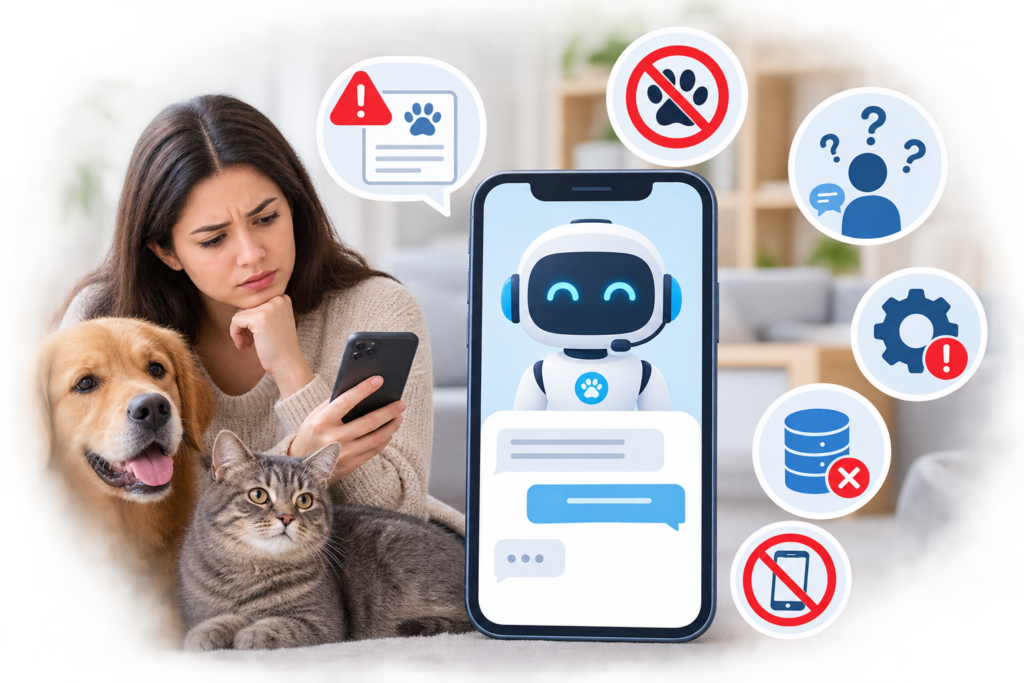
One common mistake is trying to automate every customer interaction immediately. Pet care businesses have many different customer needs, and not all of them are suitable for automated handling. Attempting to automate complex cases before understanding the most common customer journeys can result in confusing conversations and unnecessary escalations. A better implementation begins with a limited set of high-volume, well-defined use cases such as service questions, opening hours, appointment preparation, product discovery, basic policies, and booking assistance. Once those flows perform reliably, the business can expand the chatbot’s responsibilities based on real customer data.
Another mistake is allowing the chatbot to provide overly confident answers about health-related situations. Pet owners may ask about symptoms, medication, injuries, toxic substances, or behavioral changes. A conversational system should not present itself as a veterinarian or create the impression that an automated answer replaces professional assessment. Health-related flows should use carefully reviewed educational content, appropriate disclaimers where necessary, and clear escalation paths. When a situation may be urgent, the chatbot should direct the customer toward appropriate professional or emergency resources rather than prolonging a lengthy automated conversation.
A third mistake is neglecting maintenance after launch. Business information changes constantly. Prices change, appointment schedules change, staff availability changes, products become unavailable, policies are updated, and new services are introduced. A chatbot containing outdated information can become a source of customer frustration. Another mistake is measuring only conversation volume. High traffic does not necessarily indicate successful customer support. Businesses should review resolution, conversion, satisfaction, escalation, and error patterns. Finally, organizations should avoid using automated content generation as a shortcut for producing large amounts of low-value website content. Google’s documentation identifies practices such as keyword stuffing and scaled content abuse as areas that can violate spam policies. Automation should support useful customer experiences, not replace quality and editorial responsibility.
Best Practices Summary for a High-Quality Pet Care Chatbot
A strong pet care chatbot begins with a clearly defined purpose. Businesses should identify which customer problems the chatbot is expected to solve and which situations require human involvement. The system should use accurate, regularly reviewed information and communicate in a friendly, straightforward manner. Important service details should come from authoritative business sources rather than assumptions. Where live information is required, integrations should retrieve current data from the appropriate system. This approach helps keep conversational responses aligned with the actual customer experience.
Another important practice is to build safety and escalation into the design from the beginning. The chatbot should know when to answer, when to ask a clarification question, when to provide general educational information, and when to transfer the conversation to a human or recommend professional assistance. Pet health questions deserve particularly careful handling because users may interpret conversational confidence as professional certainty. The chatbot should therefore be transparent about its role and limitations. Privacy controls, authentication, authorization, secure integrations, and sensible data retention should also be considered before the system is launched rather than after problems occur.
Finally, successful chatbot management is an ongoing improvement process. Businesses should monitor conversations, identify unanswered questions, update knowledge, test important workflows, review integration failures, and measure meaningful customer outcomes. Website content should remain useful and accessible independently of the chatbot. Technical quality also matters: pages should remain secure, mobile-friendly, and usable, while unnecessary scripts and interface complexity should be controlled. Google’s Search Essentials provide a useful foundation for understanding technical and content considerations for search visibility. When these practices are combined with thoughtful conversation design and responsible automation, a pet care chatbot can become a practical support channel rather than simply another website feature.
Frequently Asked Questions
1. What is a pet care chatbot?
A pet care chatbot is a conversational software system designed to help pet owners interact with a pet-care business through natural-language conversations. Depending on its configuration, it can answer frequently asked questions, explain services, assist with appointment requests, help customers discover products, provide general educational information, and route complex requests to human staff.
The exact capabilities depend on the information available to the chatbot and the systems connected to it. A simple implementation may focus on frequently asked questions, while a more advanced system can connect with appointment scheduling, ecommerce, CRM, customer-support, or inventory platforms.
2. Can a pet care chatbot provide veterinary advice?
A chatbot can provide general educational information about pet care, but it should not present automated responses as a substitute for professional veterinary assessment. Questions involving serious symptoms, injuries, poisoning, medication, or potentially urgent conditions should be handled carefully and may require referral to a veterinarian or emergency service.
Businesses should establish clear boundaries around health-related conversations and create escalation pathways for situations that exceed the chatbot’s intended role.
3. Can a pet care chatbot book appointments?
Yes, a chatbot can support appointment booking when it is connected to a suitable scheduling system. It can collect information such as the requested service, preferred date, and other relevant details before checking available options through the connected system.
The important distinction is between requesting a booking and confirming one. The chatbot should only tell a customer that an appointment is confirmed when the underlying booking system has successfully confirmed the appointment.
4. Can a pet care chatbot recommend pet products?
A chatbot can help customers discover products by using information such as product category, pet type, size, age group, use case, or other relevant attributes. For example, it could help a customer locate grooming supplies or identify products suitable for a particular shopping need.
Recommendations should be based on accurate product information. Businesses should avoid allowing the chatbot to invent product specifications, availability, pricing, or safety claims.
5. How does a pet care chatbot help customer service teams?
The chatbot can handle repetitive questions that would otherwise require staff time. Customers may use it to ask about opening hours, services, appointment preparation, policies, product information, or basic support.
This can allow human staff to focus on more complicated conversations that require judgment, empathy, professional expertise, or access to information that should not be automated.
6. What information should a pet care chatbot know?
The knowledge base can include business hours, services, pricing information, policies, appointment requirements, grooming information, boarding rules, training services, product information, frequently asked questions, contact information, and escalation procedures.
The exact information should depend on the business. Content should be reviewed regularly so customers do not receive outdated policies or incorrect operational information.
7. How can businesses measure whether their chatbot is successful?
Useful measurements include conversation completion, appointment requests, successful bookings, customer-support resolution, human handoffs, abandoned conversations, customer satisfaction, repeated questions, and response accuracy.
Businesses should combine quantitative metrics with conversation reviews. A chatbot may have a high conversation volume while still failing to solve important customer problems, so measurement should focus on meaningful outcomes rather than traffic alone.
8. Is a pet care chatbot suitable for every pet business?
The technology can be adapted to many types of pet-related organizations, including veterinary practices, grooming businesses, boarding facilities, trainers, pet retailers, shelters, breeders, and other pet-service organizations. However, the appropriate implementation depends on the organization’s customer journeys, information systems, staff workflows, and risk requirements.
The most effective approach is usually to start with clearly defined, repetitive use cases and expand automation after the business has evidence that the initial workflows are reliable.
Final Takeaway
A pet care chatbot can become a valuable customer-experience tool when it is designed around real pet-owner needs rather than treated as a simple automated messaging box. Its strongest applications include answering routine questions, guiding customers through services, supporting appointment workflows, assisting with product discovery, improving customer support, and directing complex requests to the appropriate human professional.
The quality of the underlying knowledge, conversation design, integrations, privacy controls, escalation paths, and ongoing maintenance determines how useful the system becomes. Businesses should also keep a clear distinction between general pet-care education and professional veterinary advice. Responsible automation means knowing both what the chatbot can do and where it should stop.
For organizations considering conversational AI, the practical objective should be straightforward: make it easier for customers to find reliable information, complete appropriate tasks, and reach a human when automation is not enough. When implemented thoughtfully, a pet care chatbot can support customers while helping staff spend more time on the interactions that genuinely require human expertise and attention.
Want to Implement This Easily?
Prompt Text:
You are an expert consultant. Based on the blog post titled “Pet Care Chatbot”, provide a step-by-step, practical implementation guide. Include tools, best practices, common mistakes to avoid, and advanced tips. Assume the reader wants to implement everything discussed in this article effectively.
CTA:
Want our help implementing this? Just reach out to us via our website contact form: contact form