
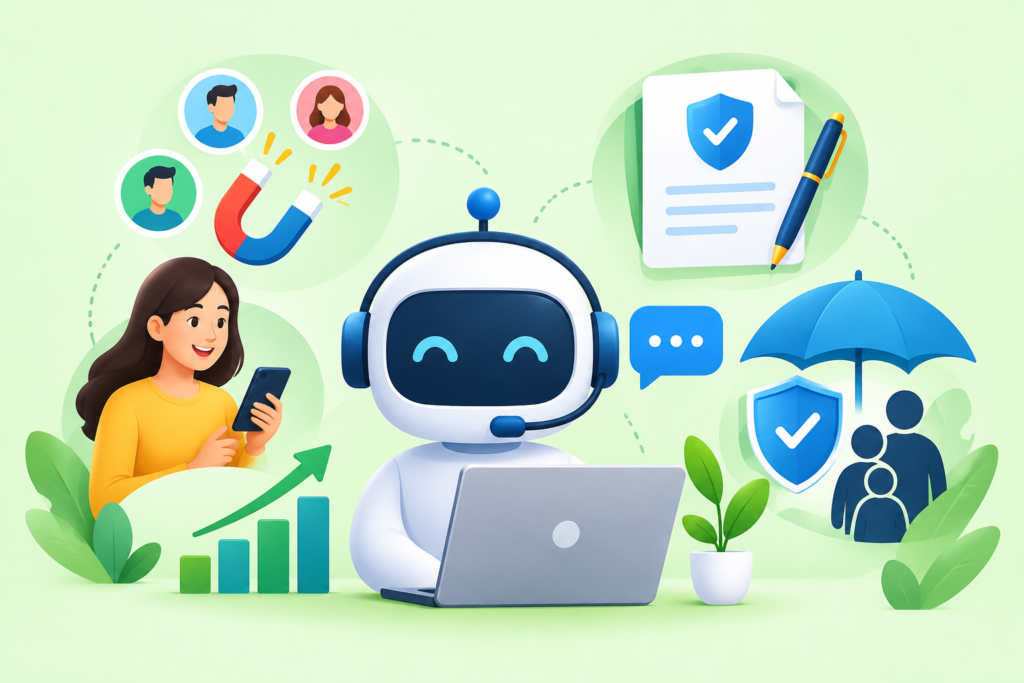
Discover how an Insurance Chatbot can improve customer engagement, lead generation, policy support, claims assistance, customer service, and insurance automation while creating a faster and more trustworthy digital experience.
Introduction
The insurance industry has changed significantly as customers increasingly expect fast, convenient, and clear digital experiences. People researching insurance may want to understand coverage, compare products, request a quotation, check policy information, ask about renewals, understand claims procedures, or speak with an appropriate representative. Traditionally, many of these interactions have depended on phone calls, emails, contact forms, and business-hour support. Although these channels remain important, they can create unnecessary delays when customers simply need straightforward information or guidance.
An Insurance Chatbot provides a conversational way to support these customers throughout their digital journey. Instead of forcing visitors to search through multiple pages or wait for an employee to become available, a chatbot can answer common questions, guide visitors toward relevant resources, collect preliminary information, qualify potential leads, explain processes, and connect customers with human representatives when a situation requires professional judgment. The goal is not to eliminate human interaction. Instead, the goal is to make routine interactions more efficient while allowing insurance professionals to focus on conversations that genuinely require their expertise.
Insurance is also a sector where trust matters enormously. Customers may share personal information, financial details, property information, vehicle information, business information, or other sensitive data. The National Association of Insurance Commissioners explains that insurance regulators continue to monitor the effects of technology, artificial intelligence, machine learning, and consumer data use within the insurance sector. Its resources on data privacy and insurance highlight the importance of privacy considerations as technology becomes increasingly integrated into insurance operations. data privacy and insurance
For this reason, a successful Insurance Chatbot should be designed around more than conversational technology. It should combine accurate information, appropriate security controls, responsible data handling, useful customer journeys, transparent limitations, human escalation, and continuous monitoring. From an SEO perspective, the supporting content should also focus on genuinely useful information rather than producing repetitive pages simply to target search queries. Google’s guidance on helpful, reliable, people-first content emphasizes original value, expertise, accuracy, and satisfying the user’s purpose. helpful, reliable, people-first content
This comprehensive guide explores how an Insurance Chatbot works, where it can create value, how it can support customers and insurance teams, and what organizations should consider before implementing conversational automation.
What Is an Insurance Chatbot and How Does It Work?
An Insurance Chatbot is a conversational software solution designed to communicate with customers and prospects through natural-language interactions. It can be integrated into an insurance website, customer portal, messaging platform, or other digital environment to answer questions and guide users through predefined or dynamically generated conversational journeys. Depending on its architecture, it can perform simple FAQ functions or connect with business systems to support more sophisticated workflows.
At the most basic level, an insurance chatbot recognizes what a visitor is asking and provides an appropriate response. For example, someone might ask, “How can I request a car insurance quote?” The chatbot can recognize the intent, explain the general process, ask relevant preliminary questions, and direct the visitor toward the next step. Another customer might ask, “What documents are needed for a claim?” The chatbot can provide approved procedural information and explain where the customer should submit the required documentation. These interactions can save time for both the customer and the support team.
More advanced implementations can combine natural language processing, conversational AI, knowledge retrieval, workflow automation, CRM integrations, authentication systems, analytics, and human handoff capabilities. This allows the chatbot to operate as a structured digital assistant rather than simply a question-and-answer widget. However, greater technical capability also creates greater responsibility. The system should have clearly defined boundaries around what it can answer, what information it can access, and which actions require human approval.
A particularly important distinction is the difference between providing information and making decisions. A chatbot may explain what a deductible generally means without deciding whether a particular claim is covered. It may explain how customers normally begin a claims process without independently approving a claim. It may collect information from a prospect without making an unauthorized underwriting decision.
This distinction should be established during the planning stage rather than added later. Insurance organizations should classify chatbot activities into categories such as informational support, lead qualification, customer-service assistance, authenticated account support, workflow initiation, and human-only decisions.
The architecture should also include a controlled knowledge source. Important answers should ideally be grounded in approved and maintained information rather than generated without boundaries. This reduces the possibility of outdated or unsupported responses.
Responsible AI principles can also help guide the design. The NIST AI Risk Management Framework provides a structured approach for managing AI risks and emphasizes characteristics including reliability, security, transparency, explainability, privacy, and fairness. NIST AI Risk Management Framework These principles are particularly relevant when conversational systems are used in industries where customers may rely on the information provided.
The most effective Insurance Chatbot is therefore not necessarily the one with the most sophisticated AI model. It is the one that provides the right information, through the right workflow, with appropriate safeguards and clear escalation options.
Why Insurance Companies Are Adopting Chatbots for Customer Support
Insurance customer support includes a large number of repetitive questions. Customers frequently need information about policy documents, payments, renewals, coverage terminology, claim procedures, documentation requirements, contact information, and product differences. Although each individual question may be relatively simple, answering thousands of similar questions manually can place considerable pressure on customer-service teams.
An Insurance Chatbot can handle many of these repetitive interactions immediately. A visitor who wants to understand a common insurance term does not necessarily need to wait for an agent. Someone looking for general information about the claims process may be able to receive guidance within seconds. A prospective customer researching a product outside normal office hours can also receive an initial response instead of encountering a dead end.
This creates a more efficient division of responsibilities. The chatbot can handle predictable and frequently repeated questions while human employees focus on complex cases, complaints, sensitive conversations, unusual circumstances, and decisions that require professional expertise. This does not mean that every customer interaction should be automated. Instead, automation should remove unnecessary repetitive work from the customer-service process.
Another advantage is consistency. When different employees answer the same question, the wording and level of detail can vary. A carefully maintained chatbot can provide a standardized response based on approved information. This is particularly valuable when organizations want customers to receive consistent explanations of general processes and terminology.
However, a chatbot should never be introduced simply because competitors are using one. The technology needs to solve a real customer problem. Organizations should first identify where customers experience delays, which questions consume the greatest amount of support time, where website visitors commonly abandon their journeys, and which requests could be handled through structured automation.
For example, if customers frequently ask where they can submit a claim, a chatbot could provide the appropriate route immediately. If visitors regularly abandon a lengthy quotation form, a conversational qualification flow could make the first interaction easier. If customer-service agents repeatedly answer the same ten questions, those questions may represent a strong initial chatbot use case.
The quality of the underlying content is equally important. Google recommends creating content that is useful, reliable, original, and primarily intended to help people rather than manipulate search rankings. Google Search Essentials The same principle should influence chatbot design. A chatbot should exist because it makes the customer experience better, not because adding “AI” to a website sounds innovative.
Organizations should also establish measurable goals before launch. These might include reducing repetitive support requests, increasing qualified leads, improving response times, increasing successful journey completion, reducing abandonment, or improving customer satisfaction.
When the objectives are clear, the chatbot becomes easier to evaluate. Instead of asking whether the technology “works,” the organization can determine whether it is actually improving a specific part of the insurance customer journey.
The Most Valuable Insurance Chatbot Use Cases
An Insurance Chatbot can support many different parts of the insurance customer journey, but the strongest implementations usually begin with practical use cases where the organization can provide accurate information and define a clear outcome. These use cases can include customer support, lead generation, product education, quotation assistance, claims guidance, policy servicing, appointment scheduling, and human-agent escalation.
One of the most straightforward applications is insurance FAQ automation. Customers may ask questions about deductibles, coverage terminology, renewal procedures, required documents, payment methods, claim reporting, or contact information. Instead of searching through a large FAQ page, the visitor can ask a question naturally and receive an appropriate response. This can make information easier to access while reducing repetitive questions reaching human agents.
Lead generation is another valuable application. A chatbot can ask what type of insurance the visitor is interested in, identify whether they are exploring personal or commercial coverage, collect appropriate preliminary information, and determine what should happen next. Rather than presenting a visitor with a large static form immediately, the chatbot can break the process into smaller conversational steps.
Claims support can also be useful when carefully controlled. The chatbot can explain how customers generally begin a claim, identify the appropriate claims channel, explain what documentation may be needed, and provide general procedural information. It should not falsely imply that it has independently evaluated coverage or approved a claim unless it is specifically connected to an authorized system capable of performing that function.
Policy servicing is another strong opportunity. Customers may need help finding policy documents, understanding renewal procedures, locating payment information, or determining which department should handle a request. Authenticated chatbot experiences can potentially provide additional functionality when securely integrated with internal systems.
Customer education should not be overlooked. Insurance terminology can be difficult for people who are purchasing coverage for the first time. A conversational assistant can explain complex concepts in plain language and direct customers toward more detailed resources. This can help people understand what they are researching before they speak with an agent.
Appointment scheduling can also be incorporated. A visitor who wants to discuss a product with an insurance professional can potentially use the chatbot to identify the appropriate department and select an available appointment slot.
The strongest approach is usually phased implementation. Rather than attempting to automate every insurance interaction from the beginning, organizations can start with high-volume, lower-risk journeys and expand after collecting real-world performance data.
Important metrics can include:
- Conversation completion rate
- Qualified lead rate
- Human escalation rate
- Customer satisfaction
- Unanswered-question rate
- Average response time
- Appointment conversion
- Form abandonment
- Repeat-contact rate
- Successful self-service rate
The purpose of these metrics is not merely to prove that the chatbot is being used. They should reveal whether the system is creating a measurable improvement for customers and employees.
How an Insurance Chatbot Improves Customer Experience
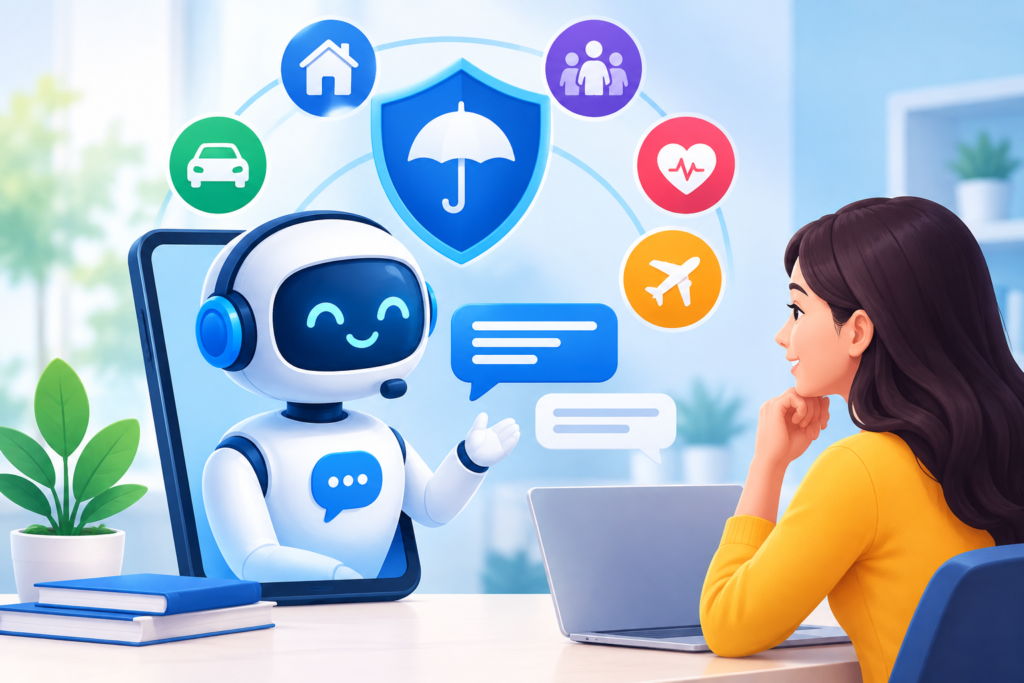
Customer experience has become an important differentiator in digital insurance. Customers increasingly expect businesses to make information easy to find, processes easy to understand, and support accessible across convenient digital channels. An Insurance Chatbot can contribute to this experience by reducing friction at several points in the customer journey.
One of the most important benefits is conversational navigation. Many insurance websites contain a large amount of information, but visitors may not know where to begin. A customer might understand the problem they want to solve without knowing which website section contains the answer. Instead of navigating through menus, the customer can describe their objective in ordinary language.
For example, a visitor might say, “I need insurance for a new business.” The chatbot can ask appropriate follow-up questions and direct the visitor toward commercial insurance information or a suitable consultation pathway. Another visitor might say, “I need to understand what happens after an accident.” The chatbot can provide general claims-related guidance and identify the next appropriate step.
Speed is another important factor. A customer who receives an immediate answer is less likely to abandon the website simply because the information was difficult to find. Faster responses can be especially valuable when visitors are comparing multiple insurance providers.
A chatbot can also help reduce unnecessary repetition. If a visitor explains the reason for their inquiry, the system should use that context rather than asking the same question repeatedly. This makes the interaction more efficient and creates a smoother experience.
However, personalization needs to be handled responsibly. Insurance organizations may deal with sensitive personal and financial information, and customers should not be surprised by how their data is being used. The NAIC notes that regulators continue to monitor data privacy issues and the use of AI and other technologies in insurance. Artificial Intelligence in insurance
Another important experience principle is transparency. Customers should know that they are interacting with an automated system and should understand when an answer is general information rather than individualized professional advice. If the chatbot cannot confidently answer a question, it should provide an appropriate escalation instead of guessing.
A useful chatbot should therefore reduce friction without creating false confidence.
The best customer experience is not necessarily the one with the fewest human interactions. It is the one where customers reach the right information or the right person with the least unnecessary effort.
Using an Insurance Chatbot for Lead Generation and Qualification
Lead generation is one of the strongest commercial applications of conversational technology in insurance. Customers often have questions before they are willing to complete a quotation form or speak directly with an agent. A chatbot can create a bridge between initial interest and a qualified business opportunity.
Traditional forms frequently ask visitors to provide several details at once. This can create friction, particularly when the visitor is still researching options. A conversational approach can divide the process into smaller steps. The chatbot might first ask what type of insurance the visitor needs, then establish whether the inquiry relates to personal or commercial coverage, followed by a small number of relevant qualification questions.
This approach can also help the organization understand customer intent earlier. A visitor asking for a quote is different from someone simply learning what a particular type of coverage means. The chatbot can identify this distinction and provide the appropriate next step.
A well-designed qualification flow should avoid collecting unnecessary information. Every question should have a purpose. It might determine the appropriate product category, establish whether a lead is commercially relevant, route the customer to the correct team, or prepare an agent for the next conversation.
The chatbot can then pass structured information to a CRM or customer-management system. This means an agent may receive context such as the visitor’s requested insurance type, general objective, preferred contact method, and other information that the visitor intentionally provided.
This can make follow-up more efficient because the customer does not have to repeat the entire conversation.
Lead scoring can also be introduced where appropriate. A business could distinguish between informational visitors, early-stage prospects, quotation-ready prospects, and customers requesting immediate assistance. The scoring methodology should be transparent internally and should not result in unfair or inappropriate treatment.
Importantly, a chatbot should never promise a quotation, eligibility decision, coverage outcome, or price that it is not actually authorized to provide. The language used during qualification should make the difference between a preliminary inquiry and an official insurance decision clear.
Google’s guidance emphasizes that high-quality content should provide genuine value rather than being created primarily to attract search traffic. Google’s SEO Starter Guide This principle is relevant to chatbot-driven lead generation as well. A conversational experience should help visitors make progress, not simply push them toward submitting contact information.
The most valuable result is therefore not simply more leads. It is more relevant and better-qualified leads, combined with a customer experience that makes the person feel informed rather than pressured.
Building Trust and Transparency Into an Insurance Chatbot
Trust should be treated as a fundamental requirement when designing an Insurance Chatbot. Customers may use the system while making decisions involving significant financial consequences, personal circumstances, property, businesses, or family protection. A chatbot that provides overly confident or misleading answers can therefore create more harm than value.
The first step is to make the chatbot’s identity and purpose clear. Customers should understand that they are interacting with an automated assistant. The chatbot should not create the impression that every response has been personally reviewed by a licensed insurance professional.
The system should also clearly distinguish between general education and individualized advice. Explaining the general meaning of a deductible is one task. Determining whether a specific customer’s claim falls within their contractual coverage is another. Explaining how a customer can begin a claims process is different from deciding the outcome of that claim.
These distinctions should be reflected in the chatbot’s conversation logic.
Trust also depends on the quality of the information being provided. A chatbot should preferably operate using approved and maintained sources. Product information, claims procedures, customer-service instructions, and policy explanations should have clear ownership and review processes.
This becomes even more important when generative AI is involved. A generative model can produce fluent language even when it lacks the correct information. Fluency should never be treated as proof of accuracy.
The NIST AI Risk Management Framework identifies trustworthy AI characteristics such as validity and reliability, safety, security and resilience, accountability and transparency, explainability, privacy enhancement, and fairness. trustworthy AI characteristics These concepts provide a useful framework for thinking about conversational systems that interact directly with customers.
Transparency should also extend to limitations. If the chatbot cannot answer a question, it should explain what it can do next. A statement such as “I can provide general information, but this situation should be reviewed by an insurance professional” is more responsible than generating an uncertain answer.
Human escalation is therefore an important component of trust. Customers should have a clear way to reach an appropriate representative when their issue is complex, sensitive, disputed, urgent, or outside the chatbot’s scope.
Organizations should also establish internal governance. Someone should be responsible for reviewing chatbot responses, updating the knowledge base, monitoring failures, investigating complaints, and approving changes.
A trustworthy Insurance Chatbot is not one that tries to appear completely human.
It is one that makes its capabilities, limitations, information sources, privacy expectations, and human-support options clear to the customer.
Insurance Chatbot Security, Privacy, and Data Protection
Security and privacy should be considered before an Insurance Chatbot collects or accesses customer information. Insurance organizations may process personal, financial, health-related, property, vehicle, business, and claims information. A conversational interface can become a sensitive entry point into business systems if access controls are not designed correctly.
The first principle should be data minimization. Organizations should identify the information genuinely required for each chatbot journey and avoid collecting unnecessary details. If a customer is asking a general question about insurance terminology, there may be no reason to request personally identifiable information.
Authentication becomes important when the chatbot moves from public information into private account functionality. A visitor asking, “What is a deductible?” does not normally need authentication. A customer asking for private policy information is different. Before revealing protected account information, the system should verify that the person is authorized to access it.
Authorization is equally important. Even if a user has authenticated successfully, the chatbot should only expose information and functions that the user’s permissions allow.
Third-party integrations require careful consideration as well. A chatbot may connect with a CRM, help-desk platform, analytics service, identity system, policy-management platform, payment system, or AI provider. Each integration introduces additional security and governance considerations.
Organizations should evaluate what information is transmitted, where it is stored, who can access it, how long it is retained, and whether the third party uses the information for any additional purposes.
The NAIC’s insurance privacy resources identify several model frameworks related to consumer information, including the Insurance Data Security Model Law, privacy protection models, and safeguards for consumer information. NAIC insurance privacy resources The exact legal requirements applicable to an organization depend on its jurisdiction and circumstances, so technical implementation should be reviewed alongside appropriate legal and compliance guidance.
Security should also include monitoring and incident response. Organizations should know how chatbot activity is logged, how suspicious behavior is detected, how credentials are protected, and how an incident would be investigated.
AI-specific risks should also be considered. NIST’s guidance emphasizes that AI systems need attention to security, resilience, privacy, accountability, and other trustworthiness characteristics throughout their lifecycle. NIST AI Risk Management Framework Playbook
A secure Insurance Chatbot therefore requires more than a secure chat interface. It requires a secure ecosystem of data, integrations, authentication, permissions, models, knowledge sources, logs, and operational processes.
Designing Effective Insurance Chatbot Conversations
A successful Insurance Chatbot conversation should begin with the customer’s objective rather than the organization’s internal structure. Customers generally do not think in terms of departments. They think in terms of problems they want to solve.
Someone might say, “I want to insure my new car.” Another person might say, “I need help after an accident.” A business owner might say, “What type of insurance does my company need?” Each statement expresses an objective, and the chatbot should interpret that objective before determining the appropriate workflow.
Conversation design should therefore begin with intent mapping. Organizations should identify the most common reasons people contact them and build appropriate conversation paths around those reasons.
Each path should have a defined purpose and completion point. A quotation journey might end when the customer is transferred to a quotation process. A claims-support journey might end when the customer receives the correct submission instructions. A general question may end when the visitor receives a useful explanation.
Questions should be short and purposeful. Asking one focused question at a time generally creates less friction than presenting a long questionnaire. Where appropriate, selectable options can reduce ambiguity, while free-text input should remain available for more complex questions.
Error recovery is particularly important. No chatbot will understand every message perfectly. If the system misunderstands the customer, it should provide a useful alternative rather than repeatedly returning an identical fallback response.
For example, instead of repeatedly saying “I did not understand,” the chatbot could offer several possible interpretations:
Are you asking about:
- Getting a new quote
- An existing policy
- Making a claim
- Renewing coverage
- Speaking with an agent
This gives the customer a way forward.
Context should also be preserved where appropriate. If a visitor has already stated that they are asking about a vehicle claim, the chatbot should not repeatedly ask what type of insurance they mean unless the information is genuinely necessary.
The conversation should also provide clear control. Customers should be able to restart the conversation, return to the main menu, request human assistance, or leave the conversation.
Another important consideration is mobile usability. Many insurance customers will interact with a chatbot on smartphones. Long blocks of text, complicated menus, tiny controls, and excessive questioning can make the experience frustrating.
Google’s SEO guidance also emphasizes readable, well-organized content and clear page structure. Google SEO guidance Although this guidance is primarily about web content, the same usability principle applies to conversational experiences.
The objective of conversation design is not to create a chatbot that talks endlessly.
The objective is to create the shortest clear and trustworthy path between a customer’s question and a useful outcome.
Building an Insurance Chatbot Knowledge Base That Customers Can Trust
The quality of an Insurance Chatbot depends heavily on the quality of its knowledge base. Even an advanced conversational model cannot compensate for inaccurate, outdated, incomplete, or poorly organized source information.
An effective knowledge base should contain approved information that customers genuinely need. This might include general product explanations, insurance terminology, frequently asked questions, claims procedures, customer-service instructions, documentation requirements, renewal information, payment guidance, and contact details.
Every important knowledge-base resource should ideally have an owner. Someone should know who is responsible for reviewing it, when it was last updated, and what process should be followed when information changes.
This is especially important in insurance because product details and procedures can change. Contact information may change. Claims processes may change. Digital forms may change. Legal requirements may change. If an outdated chatbot answer remains active, the organization may distribute incorrect information repeatedly.
Content governance should therefore be built into the chatbot operation.
A useful approach is to separate information according to risk and access level.
Public information may include general insurance education and basic service instructions.
Authenticated information may include customer-specific policy details.
Restricted information may include internal procedures, sensitive operational data, or information that should never be exposed through a public chatbot.
This separation reduces the possibility of accidental disclosure.
Knowledge retrieval should also be tested with realistic customer questions. Customers may misspell terms, use informal language, ask incomplete questions, combine multiple topics, or change their intent halfway through a conversation.
Testing should therefore include both common and unusual phrasing.
The organization should also establish a process for identifying questions the chatbot cannot answer. Those unanswered questions can become valuable signals for improving the knowledge base.
For example, if customers repeatedly ask about a specific coverage term and the chatbot cannot provide a useful answer, the organization has identified a content gap.
The knowledge base should also support human agents. When an interaction is escalated, the representative should have access to relevant context and approved information rather than starting from zero.
Google’s Search Essentials emphasizes helpful, reliable, people-first content and warns against tactics intended to manipulate search visibility. Search Essentials The same philosophy can be applied to an insurance knowledge base: create information because customers need it, maintain it because accuracy matters, and structure it so both people and systems can understand it.
A trustworthy knowledge base is therefore not simply a database of answers.
It is a continuously maintained information system with ownership, review, version control, testing, and clear boundaries.
Integrating an Insurance Chatbot With Business Systems
An Insurance Chatbot becomes considerably more useful when it is connected to the systems that already support customer and operational workflows. A standalone chatbot can answer questions, but integrations can allow it to guide customers toward quotations, appointments, support tickets, policy information, or other authorized processes. The objective should not be to connect every available system simply because an integration exists. Each connection should solve a specific customer or operational problem.
A CRM integration can be particularly valuable for lead-generation workflows. When a prospective customer completes a conversational qualification process, relevant information can be transferred to the CRM so that a sales or insurance representative has useful context before making contact. Similarly, a customer-service integration can allow conversations requiring human intervention to be routed to the appropriate team. The handoff should preserve useful context so that customers do not have to repeat information unnecessarily.
Other integrations may include quotation platforms, appointment scheduling systems, knowledge bases, ticketing platforms, authentication services, customer portals, analytics tools, and policy-management systems. However, integrations involving customer-specific information should be subject to stronger security controls than public informational workflows. The system should verify permissions before retrieving or exposing private information.
API design also matters. Each integration should use appropriate authentication, authorization, error handling, logging, and rate controls. Sensitive credentials should never be exposed within front-end chatbot code. Organizations should also define what happens when an integrated system is unavailable. A chatbot should not falsely tell a customer that an action has been completed if the connected service failed.
A practical architecture often separates conversational logic from business-system access. The chatbot determines the user’s intent and the appropriate workflow, while controlled backend services determine whether the requested action is authorized and technically possible.
This separation improves governance and makes the system easier to maintain. It also helps prevent a conversational model from gaining unnecessary direct access to sensitive systems.
Organizations should document every integration, including its purpose, data exchanged, authentication mechanism, owner, failure behavior, and review schedule. This creates a clearer operational picture as the chatbot grows.
The goal is simple: connect the chatbot to systems that improve the customer journey while minimizing unnecessary access to business data.
Using an Insurance Chatbot for Claims Assistance and Policy Support
Claims are among the most important moments in the insurance customer journey. A person contacting an insurer after an accident, property incident, loss, or other event may be stressed and uncertain about what to do next. An Insurance Chatbot can provide useful procedural guidance at this stage by making information easier to access and helping customers understand the next step.
The chatbot can explain how to initiate a claim, where to submit documentation, what information may generally be requested, and how customers can contact the appropriate claims department. It can also answer common procedural questions and direct customers toward official forms or authenticated portals.
However, claims assistance requires particularly careful boundaries. A chatbot should not imply that a claim has been approved, rejected, or fully assessed unless the underlying system is specifically authorized and designed to perform that function. It should also avoid making definitive statements about coverage based solely on a customer’s short description of an incident.
Policy support can be broader. Customers may want to understand general terminology, locate policy documents, learn about renewal processes, or determine how to update certain information. Authenticated systems can potentially provide customer-specific information when appropriate security and authorization controls are in place.
The chatbot should also recognize when a conversation requires human involvement. Situations involving disputes, complaints, complex claims, urgent circumstances, or unclear policy interpretation should have a straightforward escalation route.
The customer experience can be improved further by providing contextual guidance. Instead of simply saying, “Contact claims,” the chatbot can explain what department the customer needs, what information they should have available, and what the next step is.
This approach reduces uncertainty without pretending that automation can replace professional claims handling.
The Consumer Financial Protection Bureau has also emphasized the importance of accuracy and consumer protection when automated technologies are used in financial contexts. consumer financial protection While regulatory requirements differ across insurance and financial services, the broader principle is relevant: automated systems should not create misleading outcomes or prevent consumers from accessing appropriate assistance.
A claims chatbot should therefore be designed as a support and navigation layer, not as an unrestricted decision-maker.
Personalization Without Creating Unnecessary Risk
Personalization can make an Insurance Chatbot more useful because customers do not all have the same needs. A visitor researching travel insurance has different questions from a business owner exploring commercial coverage. A policyholder asking about renewal also has a different objective from a first-time visitor requesting general information.
The simplest form of personalization comes from information the customer intentionally provides during the conversation. If someone says they are looking for business insurance, the chatbot can adjust the next questions and resources accordingly. This type of contextual personalization can improve relevance without requiring extensive personal data.
More advanced personalization can use authenticated account information. For example, a customer portal chatbot might recognize that the user has an existing policy and provide appropriate account-related options. However, this should only happen after suitable authentication and authorization.
Organizations should avoid collecting sensitive information simply because personalization is technically possible. More data does not automatically mean a better customer experience. Excessive data collection can increase privacy, security, governance, and compliance risks.
The Federal Trade Commission has repeatedly emphasized that organizations should be transparent about data practices and should take reasonable measures to protect consumer information. data security Insurance organizations should consider these principles alongside applicable insurance regulations and professional legal guidance.
Personalization should also avoid creating unfair or unexplained experiences. If the chatbot changes its treatment of customers based on automated classifications, organizations should understand how those classifications work and whether they could produce inappropriate outcomes.
A practical personalization strategy can therefore be divided into levels.
Level one: use conversational context.
Level two: use customer-provided preferences.
Level three: use authenticated account information when necessary.
Level four: use carefully governed business rules or approved customer data.
Each level should introduce additional controls as the sensitivity of the information increases.
The best personalization is not necessarily the most sophisticated. It is the personalization that makes the interaction more relevant without making the customer feel monitored, manipulated, or exposed.
Measuring Insurance Chatbot Performance and Customer Satisfaction
Launching an Insurance Chatbot is only the beginning. Organizations need reliable measurements to determine whether the chatbot is actually improving customer service, generating valuable leads, and reducing unnecessary operational work.
A useful measurement framework should include both business metrics and experience metrics. Business metrics may include qualified leads, quotation requests, appointment bookings, successful self-service journeys, and support-cost reductions. Experience metrics may include customer satisfaction, conversation abandonment, escalation rates, response quality, and the percentage of questions that receive useful answers.
The completion rate is particularly valuable. It measures how often customers successfully reach the intended outcome of a conversation. A chatbot may receive thousands of conversations but still perform poorly if most users abandon the interaction before achieving their objective.
The fallback rate is another important indicator. If a large percentage of customer questions result in “I don’t understand” responses, the organization likely has problems with intent recognition, knowledge coverage, conversation design, or content quality.
The human escalation rate should not automatically be treated as a failure. Some conversations should be escalated. A complex insurance claim may appropriately require a professional representative. The more useful question is whether escalation occurs at the right point.
Organizations should also measure the quality of escalated conversations. If agents receive useful context from the chatbot, the handoff may still represent a successful automation outcome.
Customer feedback can provide another layer of insight. Short surveys can ask whether the customer found the answer useful, whether the process was easy to understand, and whether they were able to accomplish what they wanted.
Analytics should also identify recurring unanswered questions. These questions can reveal content gaps and opportunities for new chatbot flows.
Testing should continue after launch. Organizations can compare different conversation structures, prompts, knowledge sources, escalation messages, and calls to action. However, experimentation should be controlled carefully when customer outcomes or sensitive information are involved.
Google’s Search Console provides website owners with tools for monitoring search performance and understanding how pages appear in Google Search. Search Console While Search Console does not measure chatbot performance directly, it can be useful when evaluating the surrounding content strategy.
A mature measurement framework ultimately asks three questions:
Did the customer achieve the intended outcome?
Did the organization achieve its business objective?
Was the interaction accurate, safe, and trustworthy?
All three matter.
How to Implement an Insurance Chatbot Successfully
A successful Insurance Chatbot implementation should begin with planning rather than technology selection. Organizations should first identify customer problems, repetitive support requests, lead-generation opportunities, and service processes that are suitable for conversational assistance.
The first stage is use-case discovery. Review customer-service tickets, website searches, contact forms, sales inquiries, frequently asked questions, and agent feedback. Look for recurring questions that have reliable answers and clear workflows.
The second stage is risk classification. Separate low-risk informational requests from high-risk interactions involving personalized decisions, sensitive data, claims outcomes, or regulated processes. This helps determine where automation can be used confidently and where human review is required.
The third stage is knowledge preparation. Gather authoritative content and remove outdated or contradictory information. Assign ownership to important resources and establish a review process.
The fourth stage is conversation design. Build clear journeys for the highest-priority use cases. Define entry points, questions, responses, fallback behavior, escalation rules, and completion criteria.
The fifth stage is technical integration. Connect only the systems required to complete the selected workflows. Apply authentication and authorization controls appropriate to the data being accessed.
The sixth stage is testing. Test ordinary questions, unusual wording, spelling errors, ambiguous requests, incomplete information, malicious inputs, privacy boundaries, system failures, and escalation scenarios.
Security testing should be included before public launch. The OWASP Top 10 provides a widely used awareness framework for common web application security risks. OWASP Top 10 Organizations should also consider AI-specific security risks when conversational systems use generative models or external AI services.
The seventh stage is controlled deployment. Rather than immediately making every capability available, organizations can launch selected use cases, monitor performance, collect feedback, and expand gradually.
The eighth stage is continuous improvement. Analyze failed conversations, update knowledge, refine flows, review security controls, and monitor changes in customer behavior.
A successful implementation is therefore not a single development project.
It is an ongoing process of design, testing, governance, measurement, optimization, and human oversight.
Common Mistakes When Implementing an Insurance Chatbot
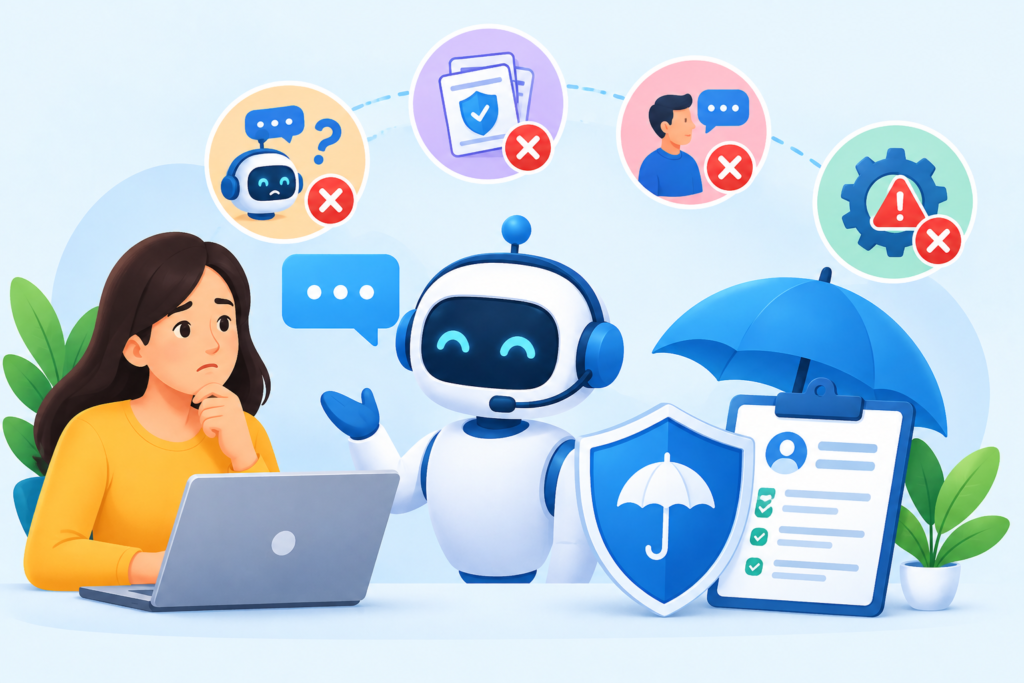
Many chatbot projects fail not because the underlying technology is incapable, but because the organization implements it without sufficiently understanding the customer journey. One common mistake is trying to automate everything immediately. Insurance contains many processes that require professional judgment, contextual understanding, and appropriate human oversight. Attempting to automate these processes without proper controls can create customer frustration and operational risk.
Another mistake is building the chatbot around the organization’s internal terminology rather than customer language. Customers may not know technical insurance terms or internal department names. If the chatbot expects exact terminology, it may fail to understand otherwise reasonable questions.
A third mistake is creating overly long conversations. Customers should not have to answer ten questions when two would be sufficient to determine the next step. Every question should have a purpose.
Other common mistakes include:
- Collecting unnecessary personal information
- Failing to provide human escalation
- Using outdated policy information
- Allowing unrestricted AI-generated answers
- Ignoring mobile usability
- Connecting too many internal systems
- Failing to test unusual customer questions
- Treating every escalation as a chatbot failure
- Measuring conversations instead of outcomes
- Hiding the fact that customers are interacting with automation
- Making unsupported promises about coverage or pricing
- Failing to assign ownership of chatbot content
- Launching without security testing
- Ignoring customer feedback
- Never reviewing failed conversations
Another serious mistake is confusing fluent language with accurate information. A chatbot can sound extremely confident while still producing an incorrect response. This is especially dangerous in insurance because customers may rely on explanations when making consequential decisions.
Organizations should therefore establish clear answer boundaries and approved knowledge sources. Where the system lacks sufficient information, it should acknowledge the limitation and route the customer appropriately.
Finally, organizations should avoid using search-engine optimization as the primary reason for creating chatbot-related content. Google states that content should be created primarily to help people and should demonstrate genuine value. people-first content
The same principle applies to conversational automation.
Build the chatbot because customers need better assistance—not simply because AI is currently popular.
Best Practices Summary for Insurance Chatbots
The most reliable Insurance Chatbot strategies combine customer experience, technical quality, security, governance, and measurable business objectives. The chatbot should be designed around real customer problems and supported by accurate, maintained information.
A strong implementation should:
- Start with clearly defined use cases
- Prioritize high-volume, repeatable customer questions
- Use accurate and approved knowledge sources
- Keep conversations concise and purposeful
- Provide context-aware responses
- Clearly identify automation
- Explain limitations where appropriate
- Provide human escalation
- Minimize unnecessary data collection
- Apply appropriate authentication and authorization
- Protect sensitive customer information
- Secure third-party integrations
- Test chatbot behavior extensively
- Monitor failed and unanswered questions
- Measure customer outcomes rather than conversation volume alone
- Review knowledge regularly
- Assign clear ownership for chatbot governance
- Maintain a documented change process
- Monitor security and privacy risks
- Improve conversations using real customer feedback
For AI-enabled systems, organizations should also consider recognized risk-management frameworks. The NIST AI Risk Management Framework can help organizations structure their approach to identifying and managing AI-related risks. NIST AI Risk Management Framework
For website and digital content quality, organizations should follow Google Search Essentials and focus on creating useful information for people rather than manipulating search rankings. Google Search Essentials
Security should be integrated throughout the lifecycle rather than treated as a final checklist. The OWASP Top 10 is useful for understanding common application-security risks, while insurance-specific privacy and security requirements should be evaluated according to the organization’s jurisdiction and business activities. OWASP Top 10
The most important principle is to balance automation with human expertise.
An Insurance Chatbot should make straightforward customer interactions faster while ensuring complex, sensitive, uncertain, or high-impact situations can reach an appropriately qualified person.
Frequently Asked Questions
1. What is an Insurance Chatbot?
An Insurance Chatbot is a conversational digital assistant designed to help insurance customers and prospects obtain information, navigate services, qualify for assistance, and complete selected workflows. Depending on its configuration, it can answer frequently asked questions, explain general insurance concepts, collect preliminary lead information, provide claims guidance, support policy-service journeys, and transfer complex conversations to human representatives.
The most effective systems operate within clearly defined boundaries. A chatbot can provide general information without necessarily being authorized to make individualized coverage decisions or claims determinations. Its capabilities should therefore be designed around the organization’s actual business processes, security requirements, and regulatory obligations.
2. Can an Insurance Chatbot Generate Leads?
Yes. An Insurance Chatbot can qualify visitors by asking relevant questions about their insurance needs and then directing suitable prospects toward quotation requests, consultations, appointments, or other approved next steps.
Conversational lead generation can also reduce friction compared with long forms. Instead of asking for many details at once, the chatbot can gather information progressively. The information can then be transferred to an appropriate CRM or sales workflow when the technical integration and privacy requirements permit it.
3. Can an Insurance Chatbot Handle Claims?
An Insurance Chatbot can support parts of the claims journey, particularly procedural guidance. It may explain how to begin a claim, what information may generally be required, where documentation should be submitted, and how to reach the appropriate claims team.
However, organizations should establish clear boundaries. A chatbot should not claim to approve, reject, or determine coverage for a claim unless it is specifically designed and authorized to perform that function. Complex or sensitive claims should have an appropriate human escalation path.
4. Is an Insurance Chatbot Secure?
An Insurance Chatbot can be designed with strong security controls, but security depends on the entire architecture rather than the chatbot interface alone. Organizations should consider authentication, authorization, data minimization, encryption, secure integrations, access controls, logging, monitoring, third-party providers, and incident-response procedures.
Security should also be reviewed continuously. New integrations, model changes, software updates, and changes to data flows can introduce new risks.
5. Can an Insurance Chatbot Work 24/7?
Yes. A chatbot can provide automated assistance outside normal business hours as long as the underlying website or platform is available. This can be particularly useful for customers researching insurance at night, during weekends, or at other times when human representatives may not be immediately available.
Twenty-four-hour availability does not mean that every issue must be resolved automatically. The chatbot can provide useful information, collect preliminary details, and explain when a human representative will need to become involved.
6. Can an Insurance Chatbot Integrate With a CRM?
Yes. CRM integration is a common way to connect conversational lead generation with sales and customer-management workflows. Relevant information collected during a conversation can potentially be transferred to the CRM so that representatives have context when following up.
The integration should be designed around data minimization, security, appropriate permissions, and the organization’s data-governance requirements.
7. How Much Does an Insurance Chatbot Cost?
The cost varies significantly depending on the chatbot’s capabilities, integrations, AI technology, security requirements, number of users, maintenance requirements, and level of customization.
A basic FAQ chatbot can be considerably simpler than an enterprise system connected to CRM, customer portals, quotation systems, authentication services, analytics platforms, and policy-management infrastructure.
Organizations should therefore evaluate the total implementation and operating requirements rather than choosing a chatbot based solely on an initial software price.
8. Should an Insurance Chatbot Replace Human Agents?
No. The strongest strategy is generally to use automation and human expertise together. Chatbots are well suited to repetitive questions, basic navigation, information retrieval, preliminary qualification, and predictable workflows.
Human representatives remain important for complex claims, complaints, sensitive situations, unusual cases, professional judgment, and circumstances where customers specifically need personal assistance.
The objective should be to remove unnecessary friction—not remove human expertise.
Conclusion
An Insurance Chatbot can become a valuable part of a modern insurance customer-experience strategy when it is implemented with clear objectives, accurate information, responsible data practices, thoughtful conversation design, and appropriate human oversight. It can help customers find information faster, support lead generation, guide policy-service journeys, provide claims assistance, answer repetitive questions, and connect people with the right representative when automation reaches its limits.
The technology itself, however, is not the complete solution. Successful implementation requires a reliable knowledge base, carefully designed workflows, secure integrations, meaningful analytics, continuous testing, and governance. Organizations should understand what the chatbot is allowed to do, what it should never do, and when a conversation must move to a qualified human.
Trust should remain at the center of every decision. Customers should know when they are communicating with an automated system, understand the nature of the information being provided, and have access to appropriate human assistance when necessary. Security and privacy should be incorporated into the architecture from the beginning rather than added after deployment.
From an SEO and content perspective, the same philosophy applies. Useful insurance resources should answer real customer questions, demonstrate expertise, remain accurate, and provide genuine value. Following Google’s people-first content principles helps ensure that content serves users rather than being produced primarily for search-engine manipulation. people-first content
When conversational automation is combined with trustworthy information, responsible technology, strong security, and human expertise, an Insurance Chatbot can become much more than a website feature. It can become an important digital layer connecting customers with information, services, and people at the moments when they need assistance most.
For organizations ready to move beyond basic FAQ automation, the next step is to identify the highest-value customer journeys, establish appropriate governance, select suitable technology, and introduce automation gradually. The result should be a system that improves both customer experience and operational efficiency while maintaining the trust that insurance customers expect.
Want to Implement This Easily?
Prompt Text:
You are an expert consultant. Based on the blog post titled “(Insurance Chatbot)”, provide a step-by-step, practical implementation guide. Include tools, best practices, common mistakes to avoid, and advanced tips. Assume the reader wants to implement everything discussed in this article effectively.
Call to Action: Want our help implementing this? Just reach out to us via our website contact form: contact form