
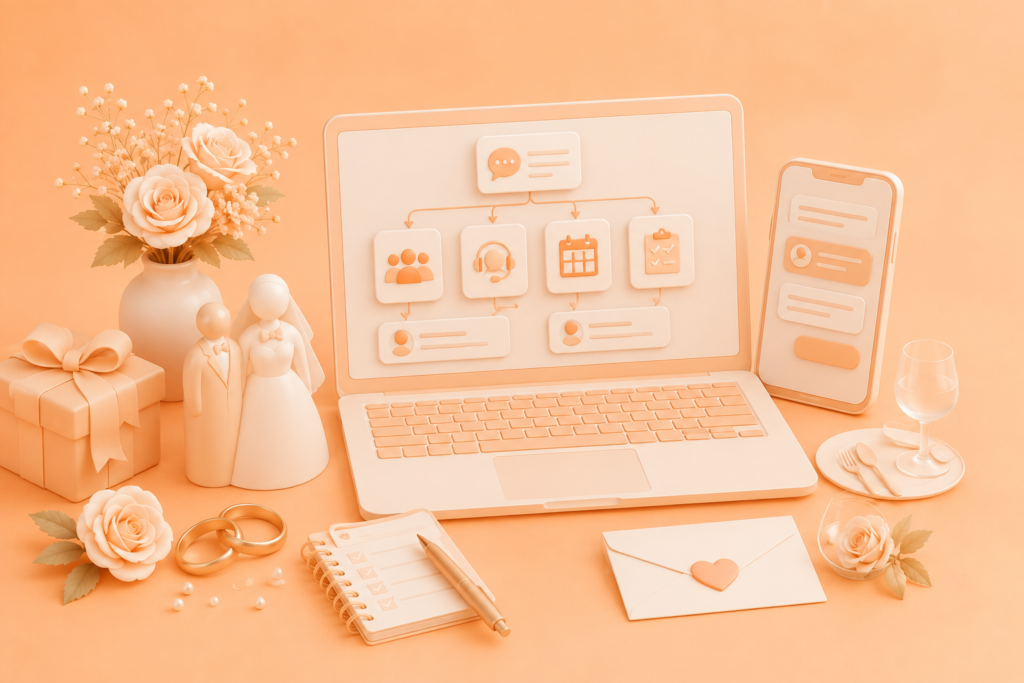
Discover how a Wedding Planning Chatbot can simplify wedding coordination, automate inquiries, support couples and guests, generate leads, manage bookings, and improve the digital wedding planning experience.
Introduction
Planning a wedding involves hundreds of small decisions, conversations, appointments, confirmations, and last-minute questions. Couples may need help choosing a venue, comparing packages, checking availability, scheduling consultations, understanding pricing, finding vendors, managing guest information, or simply getting answers to questions that arise outside normal business hours. For wedding planners, venues, photographers, caterers, decorators, florists, and other wedding businesses, responding to all these requests manually can become time-consuming very quickly.
This is where a Wedding Planning Chatbot can make a meaningful difference. Instead of forcing potential clients to search through multiple pages or wait for an email response, a chatbot can provide immediate assistance through a conversational interface. It can answer common questions, collect event requirements, qualify potential clients, recommend relevant options, schedule consultations, and guide users toward the next step. When implemented correctly, it becomes more than a simple automated support widget—it becomes a digital assistant throughout the wedding planning journey.
For businesses looking to turn website visitors into qualified inquiries, Engagerbot can help create a more responsive digital experience around these conversations. The goal is not to replace wedding professionals or remove the human element from such an important occasion. Rather, the goal is to automate repetitive interactions while allowing planners and sales teams to spend more time on conversations that require creativity, judgment, empathy, and personal attention.
This guide explains how a Wedding Planning Chatbot works, where it can create the greatest value, what features businesses should consider, how it can support lead generation, and how to implement it responsibly. The article also explores common mistakes, practical best practices, future opportunities, and measurable performance indicators so businesses can approach chatbot implementation strategically rather than simply adding automation for its own sake.
What Is a Wedding Planning Chatbot?
A Wedding Planning Chatbot is an AI-powered conversational system designed to help couples, families, guests, and potential customers obtain information and complete common wedding-related tasks through an interactive chat experience. Instead of navigating menus or waiting for a human representative to respond, visitors can type questions naturally and receive automated answers based on the information, services, and workflows configured by the business.
For example, a couple visiting a wedding venue website might ask, “Do you have availability for October?” The chatbot can respond by asking for the preferred date, estimated guest count, and event type. It can then collect those details and potentially route the inquiry to the appropriate sales or event team. A wedding planner could use the same system to answer questions about planning packages, consultation availability, payment processes, vendor coordination, and event timelines. The important point is that the chatbot should be designed around real customer journeys, rather than simply providing a list of generic answers.
A capable chatbot can also act as an information layer connecting different parts of the customer experience. It might direct visitors toward a wedding package, collect contact information, provide venue details, answer frequently asked questions, recommend relevant services, or help users schedule a consultation. Depending on the business model and available integrations, it may also support appointment scheduling, lead qualification, CRM workflows, notifications, and follow-up processes. The exact capabilities should depend on the organization’s operational needs rather than adding features simply because they are technically available.
The most effective implementations therefore combine automation with human escalation. A chatbot should know when a question can be answered immediately and when a human should become involved. Complex pricing negotiations, unusual venue requests, emotional concerns, contract questions, special accessibility requirements, or highly customized wedding arrangements may require professional judgment. Designing those handoff points from the beginning creates a more trustworthy experience and prevents automation from becoming frustrating.
Why Wedding Businesses Need Conversational Automation
Wedding businesses operate in an environment where customer expectations are often immediate. Couples researching venues or vendors may compare several businesses during the same planning session. If one website answers their questions instantly while another requires them to complete a long form and wait for a response, the faster experience can become more attractive—even when the underlying service quality is similar.
This creates a major opportunity for conversational automation. A wedding chatbot can engage visitors while their interest is active. Instead of allowing a potential customer to leave the website because they cannot find an answer, the chatbot can ask what they need and guide them toward useful information. It can also reduce friction during the early research stage by allowing visitors to explain their requirements in their own words. That can make the experience feel more natural than forcing every visitor through the same navigation path.
Another important advantage is availability. Wedding research does not necessarily happen during business hours. Couples may browse venues after work, compare photographers during weekends, or research destination wedding options late at night. A chatbot can remain available when staff members are offline, answering approved questions and collecting information for follow-up. This does not mean every inquiry needs to be fully automated. In many cases, the most valuable function is simply capturing enough information so that the business can respond intelligently later.
Automation can also reduce repetitive workload. Wedding professionals frequently answer similar questions about availability, packages, locations, guest capacity, consultation processes, cancellation policies, photography coverage, catering options, and planning timelines. A well-maintained knowledge base can allow the chatbot to handle these routine questions consistently. Staff can then focus on consultations, creative planning, vendor relationships, negotiations, and client relationships.
The key is to treat conversational automation as an experience improvement strategy, not merely a cost-cutting tool. A wedding is highly personal, and customers often want reassurance as much as information. A chatbot should therefore be helpful, respectful, transparent, and easy to hand over to a human whenever the situation requires personal attention.
How a Wedding Planning Chatbot Supports the Customer Journey
The wedding planning journey usually develops through several stages. A couple may begin with general inspiration, move into research, compare vendors, request pricing, schedule consultations, make bookings, coordinate details, and eventually manage guest-related questions. Each stage creates different conversational needs, which means a chatbot should not be designed around a single interaction.
During the discovery stage, the chatbot can help visitors understand what the business offers. For example, it can explain wedding planning packages, venue capacities, photography styles, catering options, destination wedding support, or available event formats. The chatbot can also ask simple qualifying questions such as the wedding date, approximate guest count, location, preferred service, and planning stage. These questions help both the visitor and the business understand whether the service is appropriate.
During the consideration stage, conversations become more specific. Visitors may ask about prices, availability, inclusions, customization, timelines, and consultation options. Instead of providing vague responses, the chatbot should use structured information and clearly explain when a human needs to confirm something. For instance, if availability changes frequently, the chatbot should not invent an answer. It can collect the date and tell the visitor that the event team will confirm availability.
During the decision stage, the chatbot can help users take action. It may offer a consultation booking, collect contact information, direct users to a relevant inquiry form, or explain the next step. After booking, conversational automation can continue supporting the customer with reminders, FAQs, preparation instructions, and other approved information.
This journey-based approach is important because not every visitor wants the same thing. A person researching wedding venues needs different information from someone who has already booked a venue and wants to ask about setup times. A chatbot that understands these different intents can create a much more useful experience than a generic “How can I help?” window.
Google’s guidance also emphasizes creating content primarily for people and ensuring visitors receive a satisfying experience. A chatbot should follow the same principle: its purpose should be to make the customer’s task easier, not to manipulate engagement or force users into unnecessary conversations.
Key Features of a Wedding Planning Chatbot
A successful Wedding Planning Chatbot should combine conversational intelligence with practical business functions. One of the most important capabilities is FAQ automation. The chatbot can answer frequently asked questions about services, packages, venue information, event capacity, consultation processes, policies, timelines, and other information that can be maintained accurately. This gives visitors immediate access to useful information without requiring staff to answer every repetitive question.
Another valuable feature is lead qualification. Instead of simply asking visitors to “contact us,” the chatbot can collect information relevant to the business. Depending on the service, this could include the wedding date, event location, estimated guest count, budget range, type of service required, preferred package, and contact details. These questions should be limited to information that genuinely helps the business respond. Asking for excessive information at the beginning can create unnecessary friction.
Appointment scheduling can also turn the chatbot into a practical conversion tool. Once a visitor demonstrates buying intent, the chatbot can offer a consultation or meeting. If connected to an appropriate scheduling system, the process can be streamlined from conversation to appointment. This can be particularly useful for wedding planners, venues, photographers, caterers, decorators, and other businesses where a consultation is an important part of the sales process.
Additional features may include:
- Wedding package recommendations
- Venue information
- Date and availability inquiries
- Vendor discovery
- Guest-related FAQs
- Event timeline guidance
- Consultation booking
- Lead capture
- Human-agent handoff
- Automated follow-up
- CRM integration
- Multichannel support
- Post-booking customer assistance
However, businesses should avoid adding features simply to make the chatbot appear sophisticated. Every feature should have a clear customer or operational purpose. A smaller chatbot that gives accurate answers and smoothly captures qualified leads is usually more valuable than a complicated system that frequently provides incorrect or irrelevant responses.
Using a Wedding Chatbot for Lead Generation
For many wedding businesses, one of the strongest reasons to deploy a chatbot is lead generation. Wedding customers often research several providers before making a decision, so businesses need an effective way to capture interest while visitors are actively exploring their options.
A chatbot can turn passive website browsing into a conversation. Instead of hoping a visitor finds the contact page, the chatbot can ask a relevant question based on the visitor’s intent. For example: “Are you looking for a wedding planner, venue, photography, catering, or another service?” The visitor’s response can determine what information appears next. This creates a more personalized path and can reduce the amount of irrelevant information a potential customer needs to navigate.
Lead qualification is particularly valuable because not every inquiry has the same commercial value. A wedding planner may want to know whether someone is planning a local wedding or destination event, the approximate wedding date, guest count, and planning requirements. A venue may prioritize date availability and expected attendance. A photographer may want to know the event date, location, coverage requirements, and preferred style. The chatbot can collect these details before the lead reaches the sales team.
A useful lead-generation flow might look like this:
Visitor arrives → chatbot starts conversation → service identified → event details collected → lead qualified → relevant information provided → consultation offered → contact details captured → sales team notified.
The quality of this process depends heavily on what happens after lead capture. A chatbot should not collect information into a database that nobody reviews. Leads should be routed to the appropriate team, prioritized when possible, and followed up within a reasonable timeframe.
Businesses should also measure the entire funnel rather than celebrating chatbot conversation volume alone. Useful metrics include qualified leads, consultation bookings, lead-to-booking rate, conversion rate, abandonment rate, human handoff rate, and response completion rate. These measurements reveal whether the chatbot is actually helping the business generate opportunities rather than simply producing large numbers of conversations.
Personalizing Wedding Conversations Without Losing Trust
Personalization can make a chatbot feel considerably more useful, but it needs to be implemented carefully. Wedding planning is personal, and visitors may appreciate responses that reflect their specific situation. However, personalization should come from information the user intentionally provides rather than assumptions that could feel intrusive.
For example, if a visitor tells the chatbot that they are planning a 150-person outdoor wedding in June, the chatbot can use those details when recommending relevant information. It might explain venue capacity, outdoor event considerations, planning timelines, or appropriate service categories. If the visitor later asks about photography, the chatbot can keep the previously provided context within the same conversation rather than making them repeat everything.
Personalization can also be based on intent. A person asking about wedding packages should not receive the same conversation as someone asking about venue availability. Similarly, a visitor looking for a destination wedding may need information about travel coordination, accommodation, event logistics, and local vendors. Intent-based routing can make the chatbot feel significantly more intelligent without requiring overly complicated technology.
Trust is equally important. The chatbot should clearly communicate when information is general and when confirmation from a human team is required. It should never create false urgency, invent availability, promise a booking that has not been confirmed, or provide uncertain information as fact. If a price depends on date, guest count, customization, or vendor availability, the chatbot should explain that rather than presenting an inaccurate fixed number.
This principle aligns with Google’s broader emphasis on reliable, helpful information and trustworthiness. Google’s current guidance recommends evaluating content according to the concepts of experience, expertise, authoritativeness, and trustworthiness, while emphasizing that the ultimate purpose should be helping people.
For wedding businesses, that means personalization should make conversations more relevant—not more manipulative. The best chatbot experiences feel helpful because they understand the customer’s stated needs while remaining transparent about what the system can and cannot do.
Wedding Venue and Vendor Discovery Through Chat
Finding the right wedding vendors can be overwhelming because couples may need to compare venues, photographers, florists, caterers, decorators, entertainment providers, transportation companies, planners, and other specialists. A conversational interface can simplify this process by turning a broad search into a guided discovery experience.
For example, a chatbot could begin by asking what type of vendor the visitor needs. It could then ask about location, wedding date, guest count, style preferences, and approximate requirements. Based on the business’s available information, it can present relevant options or explain what the customer should consider when making a selection. For a venue, the conversation might focus on capacity, location, event format, indoor or outdoor facilities, catering, and availability. For a photographer, the chatbot might discuss coverage duration, photography style, deliverables, and consultation options.
The chatbot can also help visitors understand selection criteria, rather than simply pushing a particular package. This is an important distinction for trust. A useful chatbot might explain that venue selection should consider guest capacity, accessibility, location, parking, weather contingencies, vendor restrictions, setup time, and total costs. For photography, it could explain the importance of reviewing complete galleries, understanding coverage hours, checking deliverables, and confirming contract details.
For businesses operating multiple services, conversational routing can help customers reach the right department. A visitor who initially asks about venue rental may later mention catering. Instead of requiring them to restart the conversation, the chatbot can recognize the related request and guide them toward the appropriate information.
This creates a more connected digital experience while reducing unnecessary navigation.
Businesses should also keep vendor and package information updated. If a chatbot recommends an unavailable package or provides outdated pricing, the convenience of automation quickly becomes a liability. For that reason, content governance should be part of chatbot management from the beginning. Someone should be responsible for reviewing important information whenever packages, prices, policies, availability rules, vendors, or business processes change.
Automating Wedding FAQs and Customer Support
Frequently asked questions are one of the easiest and most practical areas to automate. Wedding businesses receive recurring questions because customers naturally need clarification about similar subjects. These questions may involve packages, consultations, venue capacity, event timing, payment schedules, cancellation policies, travel arrangements, photography coverage, catering options, setup procedures, and booking requirements.
A chatbot can organize these questions into conversational categories. Instead of forcing visitors to search a long FAQ page, it can ask what they need help with and guide them to the relevant information. For example, a visitor might select Pricing, Availability, Packages, Venue, or Booking. The chatbot can then provide concise information and offer a logical next step.
The quality of automated answers matters more than the quantity. Businesses should create a carefully maintained source of truth for important information. If the cancellation policy says one thing on the website and something different in the chatbot, customers may become confused and lose confidence. Similarly, if package details change but the chatbot still uses older information, automation creates additional support problems rather than solving them.
A strong FAQ chatbot should therefore include a clear escalation path. If the user asks something outside the approved knowledge base, the chatbot should acknowledge the limitation and offer human assistance. This is particularly important for questions involving contracts, disputes, unusual requests, sensitive circumstances, or information that requires real-time confirmation.
The business should also analyze unanswered questions. When users repeatedly ask something the chatbot cannot answer, that is useful feedback. It may indicate that the website lacks important information, that the chatbot’s knowledge base needs improvement, or that the customer journey contains unnecessary friction.
Over time, these insights can help businesses improve both the chatbot and the broader website experience. Google’s Search Essentials emphasizes making content understandable and ensuring links and other site elements support discovery and usability. A chatbot should complement that experience rather than become a substitute for a well-organized website.
Common Mistakes When Implementing a Wedding Planning Chatbot
One of the most common mistakes wedding businesses make is launching a chatbot without first defining what it is actually supposed to accomplish. A chatbot should not be added simply because conversational AI is becoming popular. Without a clear purpose, the system can quickly become a confusing combination of unrelated features, generic answers, promotional messages, and unnecessary questions. A wedding planner may need lead qualification and consultation booking, while a venue may prioritize availability inquiries and package information. A photographer may need a different conversation entirely. Before implementation, businesses should identify their most frequent customer questions, their highest-value conversion actions, and the points where visitors commonly abandon the website. This creates a practical foundation for designing conversations that solve genuine customer problems.
Another significant mistake is allowing the chatbot to provide information that has not been verified. Wedding-related information can change frequently. Prices, package inclusions, venue availability, vendor relationships, consultation schedules, cancellation policies, and event capacity may all change over time. If an automated assistant continues using outdated information, it can create false expectations and damage customer trust. Businesses should establish a process for reviewing chatbot information whenever important business details change. It is also important to distinguish between static information and information that requires real-time confirmation. A chatbot can explain a venue’s published capacity, for example, but it should not claim that a particular wedding date is available unless the system has access to a reliable availability source. Clear wording such as “availability requires confirmation” is considerably safer than presenting an assumption as a fact.
A third mistake is making the chatbot too aggressive. Some businesses immediately ask visitors for names, email addresses, phone numbers, wedding dates, budgets, and multiple other details before providing any useful information. This can make the interaction feel like a lead form disguised as a conversation. Visitors should receive value before being asked for information whenever practical. Another mistake is hiding the human support option. Wedding planning can involve emotional, financial, contractual, and highly customized decisions, so users should always have a reasonable way to reach a person. Businesses should also monitor conversations after launch and identify questions the chatbot cannot answer effectively. These conversations provide valuable evidence about missing information and customer needs. A successful implementation is therefore not a one-time technical project; it is an ongoing process of testing, reviewing, improving, and maintaining the customer experience.
Best Practices for Wedding Chatbot Implementation
The strongest Wedding Planning Chatbot implementations begin with a clearly defined customer journey. Before building conversations, the business should identify the major questions customers ask at each stage of planning. Someone who has just discovered the business may need basic information about services, while a qualified prospect may want pricing, availability, or a consultation. Existing customers may need support with preparation, timelines, payments, or event details. Separating these scenarios allows the chatbot to provide more relevant responses instead of treating every visitor in exactly the same way. The business should also define its primary conversion action, whether that is booking a consultation, requesting a quote, checking availability, submitting an inquiry, or speaking with an event specialist. This creates a clear relationship between the chatbot and the organization’s commercial goals.
Accuracy should remain a central priority throughout implementation. Businesses should create an authoritative internal information source containing approved descriptions, pricing rules, package information, policies, contact details, service areas, and other frequently requested information. The chatbot should rely on this information rather than generating unsupported claims. When information is uncertain or requires human confirmation, the conversation should make that limitation clear. This is especially important for pricing and availability because these areas can directly influence purchasing decisions. A transparent chatbot can say that an estimated range is available while explaining that the final quote depends on event requirements. This approach supports trust while still allowing the conversation to move forward.
The website experience surrounding the chatbot also matters. A chatbot should not cover important content, interrupt visitors excessively, or make navigation difficult. Businesses should test the experience on mobile devices because many wedding planning sessions occur on smartphones. The system should load efficiently, remain readable, and provide clear controls for closing or minimizing the conversation. Businesses should also monitor performance using appropriate measurement tools. Google Analytics can help businesses understand relevant website behavior and evaluate whether changes to the customer journey are producing useful outcomes. Google Analytics At the same time, businesses should remember that chatbot metrics need context. A large number of conversations does not necessarily mean the chatbot is successful. Qualified inquiries, completed consultations, customer satisfaction, and actual bookings are usually more meaningful business outcomes.
Using Chatbots to Improve Wedding Business Conversions
A Wedding Planning Chatbot can improve conversion performance by reducing the amount of effort required to move from interest to action. Traditional websites often depend on visitors finding a contact page, opening a form, deciding what information to provide, submitting the form, and waiting for a response. A conversational experience can combine these steps into a more guided process. When someone indicates that they are looking for a wedding planner, the chatbot can ask relevant questions and provide information specifically related to that service. Once sufficient buying intent is established, the conversation can transition naturally toward a consultation or inquiry.
One of the most useful conversion strategies is progressive qualification. Rather than asking every question at the beginning, the chatbot can collect information gradually as it becomes relevant. A visitor might initially identify the type of wedding service they need. The chatbot can then ask about the wedding date and approximate guest count because those details influence the next recommendation. If the visitor expresses interest in booking, the chatbot can request contact information and offer a consultation. This approach feels more natural than presenting a long form because each question has an obvious reason within the conversation. It also allows businesses to collect information that can make subsequent human conversations more productive.
Conversion optimization should never rely on misleading claims or artificial pressure. Wedding customers are making significant decisions, and trust can be more valuable than a short-term increase in clicks. The chatbot should provide accurate information, clearly distinguish confirmed details from estimates, and avoid manufactured scarcity. It should also make the next step obvious without making the visitor feel trapped. A useful call to action might invite the visitor to schedule a consultation, request a personalized quote, or speak with an event specialist. If the visitor is not ready, the chatbot can continue providing information without aggressively demanding contact details.
Businesses should test different conversation paths over time. For example, one version might introduce the consultation option after collecting event requirements, while another might present it earlier. The business can then compare qualified inquiries, consultation bookings, and eventual sales. These experiments should focus on meaningful outcomes rather than superficial engagement. Google’s guidance around creating helpful content reinforces the broader principle that digital experiences should serve users rather than exist solely to manipulate search or engagement signals. Google Search Central A chatbot designed around genuine customer needs is more likely to support both trust and sustainable conversion performance.
Measuring Wedding Chatbot Performance and ROI
A chatbot should be measured according to the business outcomes it is intended to influence. If the primary objective is lead generation, the business should monitor how many conversations become qualified inquiries. If the objective is appointment scheduling, consultation bookings become a more important measurement. If the chatbot primarily handles customer support, businesses may focus on resolution rates, human handoff rates, response quality, and customer satisfaction. This means there is no single universal chatbot metric. The correct measurements depend on the business model, customer journey, and implementation goals.
Conversation volume can still provide useful information, but it should not be treated as the primary success indicator. A chatbot that receives thousands of conversations but generates few qualified opportunities may be less valuable than one that handles fewer conversations but consistently assists high-intent prospects. Businesses should therefore examine metrics such as engagement rate, completion rate, qualified lead rate, consultation booking rate, conversion rate, abandonment rate, escalation rate, and customer satisfaction. They should also evaluate the quality of collected lead information. A chatbot that captures complete event requirements can make the sales team’s follow-up more efficient, even if the total number of leads does not immediately increase.
ROI should ultimately connect chatbot performance to measurable business results. Suppose a wedding planning company receives more qualified consultation requests after introducing conversational assistance. The business can compare the additional revenue generated against the costs associated with the chatbot, implementation, maintenance, integrations, and ongoing optimization. Support automation can also produce indirect value by reducing repetitive staff workload. However, businesses should avoid claiming savings without measuring actual operational changes. If staff still review every conversation manually, for example, the expected reduction in workload may not occur.
Measurement should also include qualitative analysis. Reviewing real conversations can reveal whether users are confused by certain questions, repeatedly request unavailable information, or struggle to reach a human. These insights can be more valuable than a dashboard containing only numerical metrics. Businesses should periodically review chatbot transcripts, identify recurring failure points, update the knowledge base, and refine the conversation design. This creates a continuous improvement cycle where customer behavior informs future development. The result is a chatbot that becomes more useful over time rather than remaining frozen in its original configuration.
Future Trends Shaping Wedding Planning Chatbots

Wedding chatbots are likely to become increasingly sophisticated as conversational AI improves. One important trend is the movement from simple question-and-answer systems toward goal-oriented digital assistants. Instead of only answering questions, future systems may guide users through larger tasks such as discovering suitable services, collecting event requirements, coordinating consultations, preparing planning checklists, and assisting with follow-up communication. The value of these systems will increasingly depend on how well they connect conversations with real business workflows.
Another emerging opportunity is deeper personalization. A chatbot may eventually be able to maintain appropriate context throughout longer customer journeys, allowing couples to avoid repeatedly explaining their requirements. If a visitor has already shared a wedding date, guest count, location, and service preferences, future conversations could use those details when relevant. However, personalization will need to be implemented responsibly. Businesses should collect only information they genuinely need, provide appropriate transparency, and avoid creating an experience that feels invasive. The future of conversational commerce will depend not only on intelligence but also on customer confidence.
Multichannel experiences are also likely to become more important. Couples may begin researching on a website, continue a conversation through another supported channel, and later communicate with a human team. Businesses will increasingly want these interactions to feel connected rather than isolated. Integrating chatbot conversations with CRM platforms, appointment systems, customer support tools, and other business software can help create a more continuous journey. However, integration complexity also increases the importance of security, permissions, data governance, and careful testing.
Another trend is the use of conversational data to improve the broader customer experience. Businesses can identify recurring questions and use those insights to improve website content, service descriptions, FAQs, and sales processes. This can create a feedback loop between customer conversations and digital content strategy. Businesses should still follow established search guidance when developing website content. Google’s Search Essentials provides foundational guidance for creating content and websites that can be discovered and understood by search systems. Search Essentials The chatbot should complement this ecosystem rather than attempting to replace useful, indexable website information.
Best Practices Summary
A successful Wedding Planning Chatbot should begin with a genuine customer need. Businesses should identify the questions visitors repeatedly ask, the decisions that create friction, and the actions that matter most commercially. The chatbot should then be designed around those specific situations. Instead of trying to automate every possible interaction, businesses should focus first on high-value use cases such as lead qualification, appointment booking, service discovery, FAQs, availability inquiries, and basic customer support. This produces a more manageable system and gives the business a clear way to measure results.
Accuracy and transparency should remain central throughout the chatbot’s lifecycle. The system should use approved information, distinguish between confirmed and unconfirmed details, and provide a human escalation route when a question requires professional judgment. Information such as pricing, availability, policies, and package details should be reviewed regularly. Businesses should also test conversations from the perspective of real customers, including users who ask unexpected questions, provide incomplete information, change their minds, or request human assistance.
The most effective chatbot strategy is ultimately one that combines automation, personalization, measurement, and human expertise. Automation handles repetitive interactions, personalization makes responses more relevant, measurement identifies what works, and human professionals handle complex or sensitive situations. Businesses should continuously review performance rather than assuming the first implementation is perfect. By treating the chatbot as an evolving part of the customer experience, wedding businesses can create a digital assistant that supports visitors before, during, and after the planning process while helping the organization generate more qualified opportunities.
For website and search performance, businesses should also maintain strong foundational practices beyond the chatbot itself. Useful website content, clear navigation, accurate information, accessible pages, appropriate internal linking, and trustworthy external references all contribute to a stronger digital experience. The chatbot should enhance these foundations rather than hide important information behind a conversational interface. When automation and high-quality website content work together, visitors have multiple ways to find the information they need.
Frequently Asked Questions
What is a Wedding Planning Chatbot?
A Wedding Planning Chatbot is an AI-powered conversational assistant designed to help couples and other visitors obtain wedding-related information, explore services, ask questions, submit inquiries, and potentially schedule consultations. Depending on how it is configured, it can support wedding planners, venues, photographers, caterers, decorators, florists, entertainment providers, and other wedding-related businesses. Its purpose is to reduce repetitive communication while giving visitors faster access to useful information.
A chatbot can operate throughout the customer journey. Early-stage visitors may use it to understand services and packages, while high-intent prospects may use it to request a quote or schedule a consultation. Existing customers may use it to find approved information about planning processes and event details. The chatbot should always clearly communicate when human confirmation is required.
Can a Wedding Planning Chatbot generate leads?
Yes. Lead generation is one of the strongest use cases for a wedding chatbot. Instead of waiting for visitors to complete a traditional contact form, the chatbot can engage them in a conversation and collect relevant information such as their wedding date, guest count, location, required service, and contact details.
The most valuable approach is qualified lead generation rather than simply collecting large quantities of contact information. The chatbot should ask questions that help the business understand the customer’s needs and determine the appropriate next step. It can then offer a consultation, quote request, or conversation with a specialist.
Can a Wedding Chatbot book consultations?
Yes, provided the chatbot is connected to an appropriate scheduling workflow or booking system. The chatbot can collect basic event requirements, explain what the consultation involves, and guide the visitor toward available appointment options.
Businesses should ensure that appointment information remains accurate. If the chatbot cannot access real-time availability, it should not claim that a specific time is confirmed. Instead, it should explain the process and route the request to the appropriate scheduling system or human team.
Can the chatbot answer wedding pricing questions?
A chatbot can answer pricing questions when the business has reliable pricing information available. It can explain published package prices, starting prices, inclusions, or factors that affect a final quote. However, businesses should avoid presenting estimates as guaranteed prices when costs depend on event-specific requirements.
For customized weddings, the chatbot can collect relevant details and explain that a personalized quote requires review. This approach provides useful information without creating false expectations. Pricing information should also be kept synchronized with the business’s current offerings.
Can a Wedding Planning Chatbot replace a human wedding planner?
A chatbot should generally complement rather than replace a human wedding professional. Automated systems are well suited to repetitive questions, information retrieval, lead qualification, appointment requests, and basic guidance. Human planners remain essential for creative decisions, complex coordination, negotiations, emotional support, unusual requests, and situations requiring professional judgment.
The best experience usually combines both. The chatbot handles straightforward interactions quickly while providing an easy route to human assistance when necessary. This allows staff to spend more time on high-value conversations without making customers feel abandoned by automation.
How can businesses make a wedding chatbot trustworthy?
Trust begins with accurate information and transparent communication. The chatbot should only provide information that the business can verify, and it should clearly indicate when something requires human confirmation. Businesses should avoid invented availability, misleading pricing, false urgency, and unsupported claims.
A trustworthy chatbot should also make it easy for visitors to reach a human. Regularly reviewing conversations, correcting outdated information, and improving answers based on real customer questions can further strengthen the experience. Businesses should treat chatbot maintenance as an ongoing responsibility rather than a one-time setup.
Is a Wedding Planning Chatbot useful for small businesses?
Yes. Smaller wedding businesses can benefit because a chatbot can provide basic assistance without requiring staff to be available for every initial inquiry. A wedding photographer, independent planner, boutique venue, florist, or caterer can use conversational automation to answer FAQs, collect lead information, and direct prospects toward consultations.
The implementation should match the size and complexity of the business. A small company does not necessarily need an elaborate chatbot with dozens of integrations. A focused system that handles the most common questions and captures high-quality inquiries can provide substantial value.
How should a business measure chatbot success?
Success should be measured according to the chatbot’s purpose. Lead-generation implementations can track qualified inquiries, consultation bookings, and eventual conversions. Customer-support implementations can monitor resolution rates, human escalations, recurring questions, and satisfaction.
Businesses should also examine conversation quality. Reviewing actual interactions can reveal whether users understand the chatbot, whether questions are too complicated, whether important information is missing, and where human support is needed. Combining quantitative metrics with qualitative review provides a much more accurate picture of chatbot performance.
Conclusion
A Wedding Planning Chatbot can transform the way wedding businesses communicate with potential customers by making information easier to access and reducing friction throughout the planning journey. From answering frequently asked questions and recommending relevant services to qualifying leads and supporting consultation bookings, conversational automation can create meaningful value when it is designed around genuine customer needs.
The strongest implementations do not attempt to remove the human element from wedding planning. Instead, they use automation to handle repetitive interactions while giving wedding professionals more time to focus on personalized planning, creative decisions, relationship building, and complex customer requirements. Accuracy, transparency, human escalation, and regular maintenance should remain central to the strategy.
For businesses that want to improve lead generation and create a more responsive digital customer experience, Engagerbot can be part of that transformation. The key is to begin with clear objectives, build conversations around real customer questions, connect the chatbot with appropriate business workflows, and continuously measure and improve the experience.
A chatbot is not successful simply because it can answer questions. It becomes successful when it helps a visitor accomplish something meaningful. When a couple can quickly understand a service, receive relevant information, request assistance, or move confidently toward a consultation, the chatbot is contributing to a better customer journey and a stronger business process.
Want to Implement This Easily?
You are an expert consultant. Based on the blog post titled “Wedding Planning Chatbot”, provide a step-by-step, practical implementation guide. Include tools, best practices, common mistakes to avoid, and advanced tips. Assume the reader wants to implement everything discussed in this article effectively.
Want our help implementing this? Just reach out to us via our website contact form: contact form