
Discover how a Travel Chatbot transforms the travel industry by automating bookings, improving customer support, delivering personalized recommendations, and providing 24/7 assistance. Learn the benefits, features, implementation strategies, best practices, and future trends of AI-powered travel chatbots for modern travel businesses.
Introduction
Travellers today expect quick answers, personalized recommendations, and seamless booking experiences across websites, mobile apps, and messaging platforms. Traditional customer support often struggles to meet these expectations, especially during peak travel seasons when customer inquiries increase dramatically. Artificial intelligence has changed how travel companies interact with customers, making instant communication possible through intelligent virtual assistants. One of the most impactful innovations is the Travel Chatbot, which helps businesses automate conversations while improving customer satisfaction.
At EngagerBot, we understand that modern travellers expect convenience, speed, and reliable assistance at every stage of their journey. AI-powered chatbot technology enables travel companies to answer questions instantly, guide customers through bookings, recommend destinations, manage reservations, and provide ongoing travel assistance without requiring customers to wait for human representatives. This creates a smoother experience for travellers while reducing operational costs for businesses.
This comprehensive guide explores everything you need to know about Travel Chatbots, including their features, benefits, implementation strategies, business value, best practices, future trends, and practical considerations. Whether you manage a travel agency, airline, hotel group, tour operator, cruise company, or tourism platform, this guide will help you understand how conversational AI is transforming the travel industry.
Understanding What a Travel Chatbot Is
A Travel Chatbot is an AI-powered virtual assistant designed specifically for the travel and tourism industry. Unlike traditional chat systems that rely on simple scripted responses, modern travel chatbots use artificial intelligence, natural language processing (NLP), and machine learning to understand customer questions, provide relevant answers, and complete travel-related tasks automatically. These intelligent assistants can communicate through websites, mobile applications, messaging platforms, and social media channels, allowing travellers to receive assistance wherever they prefer to interact.
The primary purpose of a travel chatbot is to simplify the customer journey from the moment someone begins researching a destination until they return home after their trip. Instead of searching through multiple web pages or waiting for customer support representatives, travellers can simply ask questions in natural language. For example, users may ask about flight availability, visa requirements, baggage policies, hotel recommendations, weather conditions, local attractions, transportation options, or travel insurance. The chatbot analyses the request and provides accurate, relevant, and personalized information within seconds.
Beyond answering frequently asked questions, advanced travel chatbots can automate complex workflows such as itinerary planning, hotel reservations, airline bookings, payment assistance, cancellation requests, booking modifications, travel reminders, and multilingual communication. These capabilities improve customer convenience while allowing travel companies to operate more efficiently. According to Google’s guidance on creating helpful, people-first content, businesses should prioritize user experience and provide valuable information that genuinely addresses user needs. Following recommendations from Google Search Central helps businesses create trustworthy digital experiences that users appreciate.
Why the Travel Industry Needs AI-Powered Chatbots
The travel industry operates around the clock because customers plan trips from different countries and time zones. A traveller booking a holiday at midnight expects immediate assistance rather than waiting until business hours. Human support teams alone cannot realistically provide instant service twenty-four hours a day without significant staffing costs. This challenge makes AI-powered travel chatbots an essential solution for businesses seeking to remain competitive while delivering exceptional customer experiences.
Modern travellers also expect highly personalized recommendations. Instead of generic destination suggestions, they want travel experiences based on their preferences, budgets, previous trips, family size, interests, and travel dates. AI chatbots analyse customer interactions and historical data to recommend destinations, accommodations, restaurants, local attractions, transportation options, and travel packages that align with individual preferences. This personalization improves customer engagement and significantly increases booking conversion rates.
Another important reason travel companies adopt chatbots is operational efficiency. Customer service departments receive thousands of repetitive questions every day regarding check-in times, passport requirements, baggage allowances, refunds, cancellations, travel documentation, payment methods, weather updates, and booking confirmations. Automating these repetitive interactions allows human travel consultants to focus on complex travel planning and high-value customer relationships. Businesses implementing AI responsibly should also follow trusted guidance from Google AI Principles, ensuring transparency, fairness, privacy, and responsible use of artificial intelligence throughout customer interactions.
Key Features That Make a Travel Chatbot Valuable
An effective Travel Chatbot provides far more than automated question-and-answer functionality. Modern AI-powered systems include sophisticated capabilities that improve every stage of the customer journey. One of the most valuable features is intelligent booking assistance. Instead of redirecting customers through multiple pages, the chatbot guides users step by step, helping them search for flights, compare hotel options, reserve accommodations, purchase travel packages, and complete secure payments within a conversational interface.
Another important capability is real-time travel information. Travellers frequently need immediate updates regarding flight delays, gate changes, weather forecasts, visa requirements, transportation schedules, local events, exchange rates, health advisories, and destination regulations. AI chatbots can retrieve live information from integrated travel systems, helping customers make informed decisions quickly. Real-time communication reduces uncertainty while improving customer confidence throughout their travel experience.
Multilingual support is equally valuable in today’s global tourism industry. International travellers speak many different languages, making multilingual communication essential for global travel businesses. Advanced AI chatbots automatically detect language preferences and respond naturally without requiring separate customer support teams for every language. Additional features often include itinerary management, personalized destination recommendations, document reminders, travel alerts, loyalty program support, upselling opportunities, customer feedback collection, and seamless handoff to human agents whenever more specialized assistance becomes necessary. Together, these capabilities create a comprehensive digital travel assistant that improves customer satisfaction while supporting long-term business growth.
Benefits of Travel Chatbots for Businesses and Travellers
Travel chatbots provide measurable advantages for both travel businesses and their customers. From the business perspective, automation significantly reduces operational expenses by handling thousands of routine customer inquiries simultaneously. Instead of expanding customer support teams during busy travel seasons, companies can rely on AI to manage repetitive conversations while human specialists focus on complex requests requiring professional expertise. This balanced approach increases productivity, reduces response times, and improves overall operational efficiency.
Travellers also experience numerous benefits when interacting with AI-powered travel assistants. Rather than navigating complicated booking platforms, customers receive personalized recommendations through simple conversations. Whether searching for family holidays, luxury resorts, adventure tours, business travel, or budget-friendly accommodations, the chatbot quickly identifies suitable options based on user preferences. Immediate responses reduce frustration while helping travellers confidently complete bookings without unnecessary delays. Additionally, proactive notifications regarding itinerary updates, boarding reminders, weather alerts, or booking confirmations enhance convenience throughout the entire travel experience.
Travel chatbots also contribute to stronger customer relationships by providing consistent service quality regardless of time, location, or seasonal demand. Customers appreciate receiving accurate answers whenever they need assistance, which increases trust and encourages repeat bookings. Businesses benefit from improved customer satisfaction scores, increased conversion rates, higher retention, stronger brand reputation, and valuable customer insights collected through chatbot conversations. When implemented thoughtfully and continuously optimized, travel chatbots become strategic assets that support sustainable business growth while delivering exceptional experiences for modern travellers.
How Artificial Intelligence and Natural Language Processing Power Travel Chatbots
Artificial intelligence (AI) is the foundation that enables a Travel Chatbot to deliver intelligent, human-like conversations instead of simple scripted replies. Traditional chat systems rely on predefined rules and can only respond to exact keywords. Modern AI-powered travel chatbots use Natural Language Processing (NLP), machine learning, and contextual understanding to recognize user intent, interpret complex questions, and generate relevant responses. This allows travellers to communicate naturally, whether they ask, “Can you find me a family-friendly hotel in Paris?” or “I need a beach vacation under $2,000.”
Natural Language Processing enables the chatbot to understand grammar, sentence structure, synonyms, spelling mistakes, and conversational context. For example, if a traveller asks about baggage allowances after discussing a flight booking, the chatbot understands the conversation history instead of treating the question as a completely new request. Machine learning further improves performance by learning from previous interactions, customer preferences, and feedback. Over time, the chatbot becomes more accurate, offers better recommendations, and responds more naturally to a wider variety of travel-related questions.
Artificial intelligence also supports predictive recommendations by analyzing customer behavior. If someone frequently books luxury hotels, business-class flights, or adventure holidays, the chatbot can proactively recommend similar experiences in future conversations. AI can also detect urgency, recognize customer sentiment, and transfer conversations to a human travel consultant whenever specialized assistance is required. Organizations implementing AI responsibly should follow trusted guidance from Google AI Principles to ensure fairness, transparency, user privacy, and ethical AI practices. Combining AI with human expertise creates a customer experience that is both efficient and trustworthy.
Travel Chatbot Use Cases Across the Tourism Industry
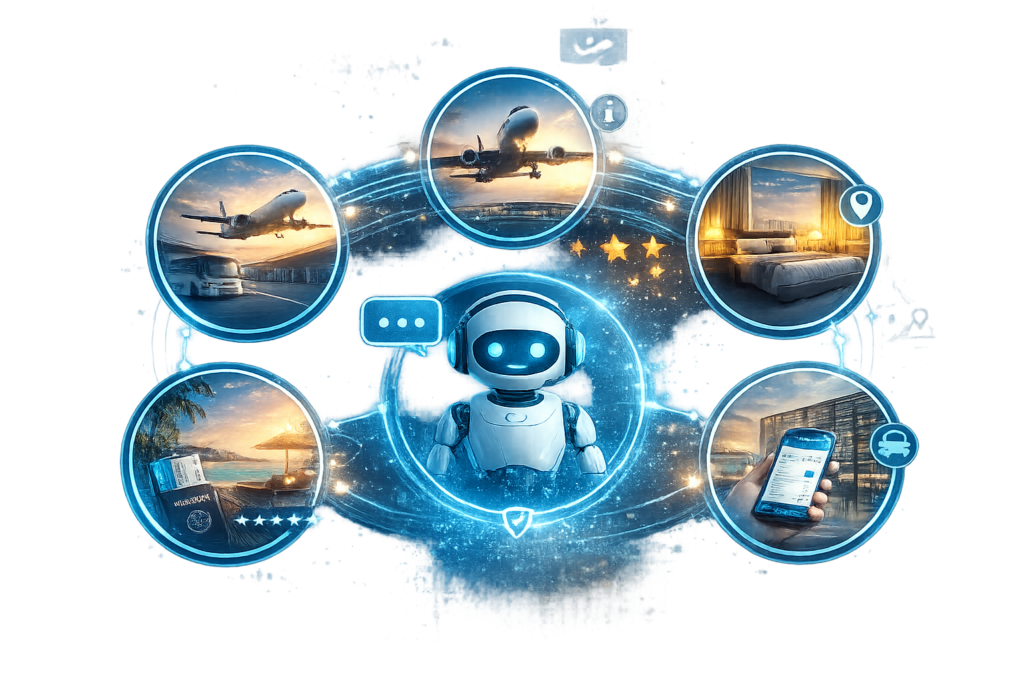
The travel and tourism industry includes airlines, hotels, travel agencies, cruise operators, tour companies, transportation providers, and destination management organizations. Each of these sectors faces unique customer service challenges, yet all can benefit from intelligent chatbot technology. A well-designed Travel Chatbot adapts to different business models while providing personalized assistance throughout the customer journey.
Travel agencies use chatbots to recommend destinations, compare travel packages, generate quotations, answer visa-related questions, schedule appointments, and assist with bookings. Airlines use AI chatbots for online check-in assistance, baggage policy explanations, flight status updates, ticket modifications, refund requests, loyalty program support, and boarding reminders. Hotels rely on chatbots to automate room reservations, answer questions about amenities, process special requests, provide local recommendations, and improve guest communication before, during, and after their stay.
Tour operators and activity providers benefit by allowing customers to discover excursions, reserve tours, compare adventure packages, receive weather updates, and access digital itineraries instantly. Cruise companies use chatbots to explain cabin options, onboard facilities, dining packages, entertainment schedules, and travel documentation requirements. Tourism boards can deploy AI assistants that recommend attractions, restaurants, museums, transportation routes, seasonal events, and cultural experiences based on visitor preferences. Because chatbots are available around the clock, every segment of the travel industry can deliver consistent customer support regardless of time zone or business hours.
Personalized Trip Planning with AI-Powered Travel Chatbots
One of the most valuable capabilities of a Travel Chatbot is personalized trip planning. Every traveller has different expectations, budgets, interests, travel styles, and schedules. Some customers prioritize luxury accommodations, while others focus on adventure, family experiences, cultural exploration, or affordable travel. AI-powered chatbots gather this information naturally through conversation and transform it into customized travel recommendations that feel relevant rather than generic.
Instead of asking users to complete lengthy forms, the chatbot asks simple conversational questions about destinations, travel dates, preferred activities, accommodation types, transportation preferences, dietary requirements, and budget limits. Using artificial intelligence, it analyzes these responses alongside historical customer behavior and available travel inventory to build personalized itineraries. Recommendations may include flights, hotels, restaurants, sightseeing opportunities, transportation options, travel insurance, and local attractions that align with the traveller’s preferences.
Personalization also improves customer satisfaction by reducing decision fatigue. Rather than browsing hundreds of hotel listings or comparing dozens of travel packages, users receive a carefully selected shortlist based on their individual needs. AI can even recommend nearby attractions, weather-appropriate activities, seasonal festivals, and hidden local experiences that customers may not have discovered independently. This personalized approach increases booking confidence while encouraging customers to spend more time engaging with the travel brand, ultimately improving conversion rates and long-term customer loyalty.
Automating Travel Bookings for Faster Customer Experiences
Booking travel often involves multiple steps, including selecting destinations, comparing prices, confirming availability, entering passenger information, choosing additional services, and completing secure payments. These processes can become complicated, especially when customers need to coordinate flights, hotels, transportation, travel insurance, and activities simultaneously. A Travel Chatbot simplifies this journey by guiding customers through every step using an intuitive conversational interface.
The chatbot begins by identifying customer requirements such as travel dates, preferred destinations, passenger numbers, accommodation preferences, and budget. It then searches integrated booking systems to display relevant options in real time. Customers can compare flights, hotel rooms, tour packages, rental vehicles, or vacation bundles without navigating multiple websites. Once selections are finalized, the chatbot assists with reservation details, payment processing, booking confirmation, and digital receipt generation.
Automation significantly reduces booking abandonment because customers receive immediate assistance whenever questions arise. If a traveller hesitates because of baggage rules, cancellation policies, or room availability, the chatbot provides instant clarification that helps maintain booking momentum. Businesses also benefit from reduced operational workloads, fewer manual processing errors, and higher conversion rates. Integration with payment gateways, booking engines, customer relationship management (CRM) platforms, and reservation systems ensures a seamless experience from initial inquiry through final confirmation, making travel planning faster, more convenient, and more reliable for customers worldwide.
Delivering 24/7 Customer Support for Global Travellers
Travel never stops, and customer support should not either. Travellers frequently encounter questions outside traditional business hours due to international time zones, unexpected travel disruptions, or last-minute booking decisions. A Travel Chatbot provides continuous assistance every hour of every day, ensuring customers always have access to reliable information whenever they need it. This constant availability improves both customer confidence and overall service quality.
During the planning stage, travellers may ask about destinations, hotel availability, visa requirements, passport validity, transportation options, or travel insurance late at night. While travelling, they might need immediate assistance with delayed flights, booking confirmations, itinerary updates, emergency contact information, or local recommendations. After returning home, customers often seek invoices, refund updates, loyalty rewards, or future travel suggestions. AI-powered chatbots handle these requests instantly without requiring customers to wait for office hours or available support agents.
Continuous support also strengthens business operations. Customer service teams receive fewer repetitive inquiries, allowing human travel consultants to focus on complex cases requiring empathy, negotiation, or expert advice. AI chatbots maintain consistent service quality regardless of seasonal demand or customer volume, helping businesses manage peak travel periods more efficiently. They can also proactively notify customers about gate changes, schedule adjustments, weather disruptions, check-in reminders, or documentation requirements before problems occur. This proactive communication builds trust, improves customer satisfaction, and reinforces a travel company’s reputation for dependable service.
Improving Customer Engagement and Building Long-Term Loyalty with Travel Chatbots
Customer engagement extends far beyond answering questions or completing bookings. Modern travellers expect ongoing communication before, during, and after every journey. A well-designed Travel Chatbot helps businesses build meaningful relationships by providing personalized interactions that encourage trust, repeat bookings, and long-term loyalty. Instead of treating each conversation as a separate transaction, AI-powered chatbots create continuous customer journeys that evolve based on previous interactions and individual preferences.
Personalization is one of the strongest drivers of customer loyalty. A travel chatbot can remember preferred destinations, seating preferences, accommodation styles, travel budgets, loyalty memberships, and previous bookings. Using this information, it can recommend relevant holiday packages, seasonal promotions, exclusive discounts, and personalized travel experiences that align with the customer’s interests. For example, a traveller who regularly books beach vacations may receive recommendations for newly available coastal resorts, while adventure travellers might be notified about hiking expeditions, wildlife tours, or outdoor activities. These tailored recommendations improve customer satisfaction while increasing the likelihood of repeat bookings.
Travel chatbots also maintain engagement through proactive communication. Instead of waiting for customers to ask questions, they can automatically send booking confirmations, payment reminders, check-in notifications, passport validity reminders, weather forecasts, travel advisories, and destination-specific tips. After a trip concludes, the chatbot can request customer feedback, encourage reviews, suggest future travel opportunities, and inform travellers about loyalty rewards or exclusive offers. These ongoing interactions create a positive customer experience that extends beyond a single booking and strengthens long-term brand loyalty.
Integrating Travel Chatbots with CRM, Booking Systems, and Business Applications
A Travel Chatbot becomes significantly more valuable when connected with existing business systems. Rather than functioning as an isolated communication tool, modern chatbots integrate with customer relationship management (CRM) platforms, booking engines, payment gateways, marketing automation software, inventory management systems, airline reservation systems, hotel property management software, and analytics platforms. These integrations enable seamless customer experiences while improving operational efficiency across the organization.
CRM integration allows the chatbot to access customer history, previous bookings, travel preferences, support tickets, loyalty status, and communication records. This information enables highly personalized conversations because the chatbot understands the customer’s relationship with the business before responding. Instead of asking customers to repeat information during every interaction, the chatbot provides relevant recommendations and personalized assistance based on existing customer data.
Booking system integration allows real-time access to flight availability, hotel inventory, tour packages, transportation schedules, pricing updates, and reservation management. Customers can search availability, compare options, complete bookings, modify reservations, or request cancellations directly within the chatbot conversation. Payment gateway integration further streamlines the experience by enabling secure online transactions without leaving the chat interface. Marketing automation platforms can also use chatbot interactions to deliver personalized campaigns, abandoned booking reminders, promotional offers, and post-trip follow-up communications. Together, these integrations create a connected digital ecosystem that supports efficient business operations while delivering outstanding customer experiences.
Data Security, Privacy, and Trust in AI Travel Chatbots
Travel businesses process significant amounts of sensitive customer information, including names, passport details, payment information, travel itineraries, addresses, contact details, and booking histories. Because of this, security and privacy are essential considerations when implementing a Travel Chatbot. Customers are far more likely to engage with AI-powered services when they trust that their personal information is collected, stored, and processed responsibly.
A secure chatbot should use encrypted communication channels, secure authentication methods, access controls, and regular security monitoring to protect customer data from unauthorized access. Businesses should also establish clear privacy policies that explain what information is collected, why it is needed, how long it will be stored, and how customers can request updates or deletion of their personal information. Transparency builds confidence and demonstrates a commitment to responsible data management.
Travel companies should also perform regular security assessments, software updates, vulnerability testing, and access reviews to maintain a secure environment. Compliance with applicable privacy regulations helps organizations reduce legal risks while strengthening customer trust. Artificial intelligence should also be monitored continuously to ensure accurate responses, minimize bias, and prevent misinformation. By combining strong cybersecurity practices with responsible AI governance, travel businesses create trustworthy digital experiences that protect both customers and organizational reputation.
Measuring the Success of a Travel Chatbot
Implementing a Travel Chatbot is only the beginning. Businesses should continuously measure performance to ensure the chatbot delivers meaningful value to both customers and the organization. Monitoring key performance indicators (KPIs) helps identify strengths, reveal improvement opportunities, and guide future optimization efforts.
One of the most important metrics is response time. Customers expect immediate answers, and AI chatbots should consistently provide responses within seconds. Businesses should also monitor conversation completion rates, customer satisfaction scores, first-contact resolution rates, booking conversion rates, abandoned conversation rates, and human agent escalation frequency. These metrics indicate how effectively the chatbot addresses customer needs without requiring additional support.
Revenue-related metrics are equally valuable. Businesses should measure chatbot-assisted bookings, average booking value, upselling success, repeat customer rates, and overall return on investment (ROI). Customer feedback collected through surveys and post-conversation ratings provides valuable insights into user experience and identifies areas where conversations can become more natural or informative. Continuous monitoring, testing, and optimization ensure that the chatbot evolves alongside changing customer expectations and emerging travel industry trends.
Future Trends Shaping the Evolution of Travel Chatbots
Artificial intelligence continues to advance rapidly, and Travel Chatbots will become increasingly intelligent, proactive, and personalized. Future chatbot solutions will rely on advanced generative AI models capable of maintaining more natural conversations, understanding complex travel requests, and generating customized itineraries that closely match individual preferences. Instead of simply responding to customer questions, future chatbots will anticipate traveller needs before they are expressed.
Voice-enabled conversational assistants will become more common as travellers increasingly use smartphones, smart speakers, and wearable devices. Customers may simply speak their travel requests, receive spoken recommendations, complete reservations through voice interactions, and receive real-time travel alerts while on the move. Multimodal AI will combine text, voice, images, maps, and videos to create richer and more engaging travel experiences.
Predictive analytics will also play a larger role in future travel planning. AI systems will analyze historical travel behavior, seasonal demand, weather forecasts, pricing trends, and customer preferences to recommend the best booking times, identify cost-saving opportunities, and suggest personalized travel experiences before customers begin searching. As responsible AI practices continue to mature, businesses that combine innovation with transparency, privacy, and customer trust will be well positioned to deliver exceptional digital travel experiences while maintaining long-term competitive advantages.
Common Mistakes When Implementing a Travel Chatbot
Implementing a Travel Chatbot can significantly improve customer experience and operational efficiency, but many organizations fail to achieve the expected results because of avoidable mistakes. A chatbot should enhance the customer journey rather than create additional frustration. Careful planning, continuous improvement, and customer-focused design are essential for long-term success.
One of the most common mistakes is relying entirely on scripted conversations. Modern travellers ask questions in many different ways, and a chatbot limited to predefined responses quickly becomes frustrating. Businesses should use AI-powered conversational technology capable of understanding natural language, recognizing user intent, and maintaining context throughout the conversation. Continuous training using real customer interactions also improves chatbot accuracy over time.
Another mistake is failing to integrate the chatbot with existing business systems. Without access to booking engines, customer relationship management (CRM) platforms, payment systems, and travel databases, the chatbot can only provide limited assistance. Customers expect to search availability, complete bookings, modify reservations, and receive real-time updates within a single conversation. Poor integration often forces users to leave the chat and complete tasks elsewhere, reducing convenience and increasing abandonment rates.
Many organizations also underestimate the importance of human support. While AI can automate repetitive conversations, complex travel situations such as emergency itinerary changes, special accessibility requests, international travel disruptions, or unique customer concerns still require experienced travel consultants. A successful chatbot should seamlessly transfer conversations to human agents whenever necessary.
Additional implementation mistakes include:
- Launching the chatbot without sufficient testing.
- Ignoring customer feedback after deployment.
- Providing outdated travel information.
- Failing to monitor chatbot performance regularly.
- Overcomplicating conversation flows.
- Neglecting multilingual support for international travellers.
- Weak data privacy and security practices.
- Not updating AI models as customer expectations evolve.
Avoiding these common mistakes helps businesses deliver reliable, efficient, and customer-friendly conversational experiences that build trust and encourage repeat bookings.
Best Practices Summary
Successful Travel Chatbot implementation requires much more than installing AI software. Organizations should develop a long-term conversational strategy focused on customer experience, operational efficiency, personalization, and continuous improvement. Following proven best practices helps maximize return on investment while delivering meaningful value to travellers.
Begin by clearly defining chatbot objectives. Some organizations focus on customer support, while others prioritize booking automation, itinerary management, lead generation, or travel recommendations. Establishing measurable goals allows businesses to evaluate chatbot performance accurately and identify future improvement opportunities.
Design conversations around real customer needs rather than internal business processes. The chatbot should communicate naturally, provide concise answers, ask relevant follow-up questions, and guide travellers through complex tasks step by step. Every interaction should reduce customer effort rather than increase it.
Maintain accurate travel information by integrating trusted booking systems and regularly updating destination content, travel regulations, pricing information, weather data, and transportation schedules. Real-time information improves customer confidence while reducing support requests.
Security should remain a top priority throughout implementation. Protect customer information using encryption, secure authentication, role-based access controls, and continuous security monitoring. Transparent privacy policies further strengthen customer trust.
Organizations should also monitor chatbot analytics continuously. Key performance indicators such as customer satisfaction, response time, booking conversions, escalation rates, and conversation completion rates help identify opportunities for optimization. AI models should be retrained regularly using real customer interactions to improve conversational quality and recommendation accuracy.
Finally, remember that AI complements human expertise rather than replacing it entirely. The most successful travel businesses combine intelligent automation with experienced travel consultants who can assist customers whenever personalized guidance or complex decision-making is required.
Frequently Asked Questions
1. What is a Travel Chatbot?
A Travel Chatbot is an AI-powered virtual assistant that helps travellers search destinations, compare travel options, book flights and hotels, manage reservations, answer travel questions, and receive personalized recommendations through natural conversations.
2. Can a Travel Chatbot operate 24/7?
Yes. One of the biggest advantages of AI-powered travel chatbots is their ability to provide instant customer support twenty-four hours a day, seven days a week, regardless of business hours or customer location.
3. Can a chatbot handle travel bookings?
Modern travel chatbots can integrate with booking systems to search availability, compare travel options, complete reservations, process secure payments, modify bookings, and provide confirmation details.
4. Are Travel Chatbots suitable for small travel agencies?
Absolutely. Small and medium-sized travel businesses can use chatbots to automate repetitive customer inquiries, improve response times, reduce operational costs, and compete more effectively with larger organizations.
5. Can a Travel Chatbot support multiple languages?
Yes. Many AI-powered chatbot platforms provide multilingual capabilities that allow businesses to communicate with international travellers in their preferred language, improving accessibility and customer satisfaction.
6. How secure are AI Travel Chatbots?
Security depends on proper implementation. Businesses should use encrypted communication, secure authentication, responsible data management, and regular security updates to protect sensitive customer information.
7. Will AI replace human travel consultants?
No. AI automates repetitive tasks and improves efficiency, but experienced travel professionals remain essential for handling complex itineraries, personalized travel planning, emergency situations, and unique customer requirements.
8. How can businesses measure chatbot success?
Organizations should monitor customer satisfaction, response times, booking conversion rates, conversation completion rates, return on investment, repeat bookings, customer retention, and human escalation rates to evaluate chatbot performance effectively.
Conclusion
Artificial intelligence is transforming how travellers discover destinations, plan journeys, complete bookings, and receive ongoing support. A well-designed Travel Chatbot improves customer satisfaction by providing instant assistance, personalized recommendations, automated booking experiences, and continuous communication throughout every stage of the travel journey. At the same time, businesses benefit from improved operational efficiency, reduced support costs, stronger customer engagement, and increased booking conversions.
At EngagerBot, we believe conversational AI should enhance every travel experience through intelligent automation, personalized communication, and reliable customer support. By combining advanced AI capabilities with thoughtful implementation, travel organizations can deliver exceptional digital experiences while building stronger customer relationships and long-term business growth.
Want to Implement This Easily?
Prompt
You are an expert consultant. Based on the blog post titled “Travel Chatbot”, provide a step-by-step, practical implementation guide. Include tools, best practices, common mistakes to avoid, and advanced tips. Assume the reader wants to implement everything discussed in this article effectively.
Call to Action
Want our help implementing this? Just reach out to us via our website contact form: https://www.engagerbot.com/contact-us/