
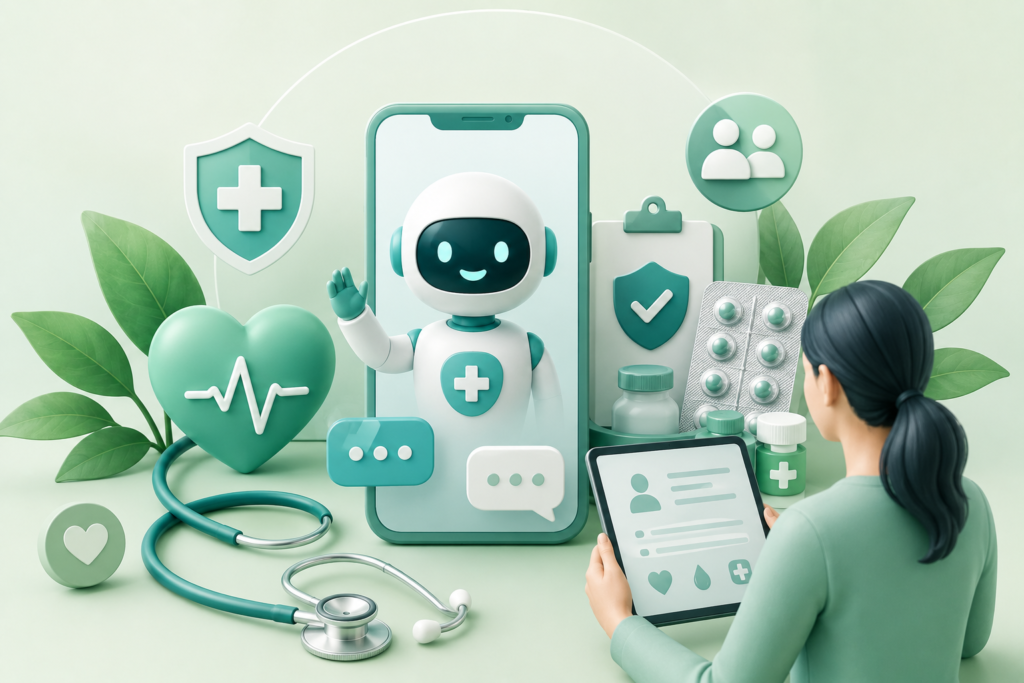
Discover how a Healthcare Chatbot can improve patient engagement, appointment support, healthcare communication, lead generation, accessibility, and administrative efficiency while maintaining privacy, safety, transparency, and trust.
Introduction
Healthcare communication is becoming increasingly digital. Patients expect convenient ways to find information, understand available care options, request appointments, receive reminders, and communicate with healthcare organizations without always having to wait for office hours. At the same time, healthcare providers must manage growing administrative workloads while protecting sensitive information and maintaining a high standard of patient trust. A Healthcare Chatbot can help bridge this gap by providing structured, conversational assistance across websites, patient portals, messaging platforms, and other digital touchpoints.
For Engagerbot, the opportunity is not simply about putting a chat window on a healthcare website. A useful healthcare chatbot should be designed around real patient needs, operational workflows, safety boundaries, accessibility, and responsible information handling. It can help answer routine questions, guide visitors toward appropriate resources, support appointment requests, collect basic non-sensitive information, explain administrative procedures, and connect users with human staff when a conversation requires professional judgment. The objective should always be to make digital communication easier without pretending that automated software can replace qualified healthcare professionals.
Healthcare is also a high-trust environment. People may interact with a chatbot while they are worried, confused, uncomfortable, or looking for urgent assistance. That means chatbot content must be especially clear about its limitations. It should distinguish general educational information from medical advice, avoid unsupported diagnoses, provide appropriate escalation pathways, and make it easy for users to reach a qualified professional or emergency resource when necessary. These principles also contribute to stronger user trust and more responsible digital experiences.
From an SEO perspective, healthcare content deserves the same emphasis on helpfulness, reliability, and people-first value that Google recommends for websites generally. Google warns against creating large volumes of unoriginal content primarily to manipulate rankings, making originality and genuine usefulness essential. Google Search Central This guide therefore focuses on practical implementation rather than keyword repetition. It explores how healthcare chatbots work, where they can create value, what risks organizations should consider, and how to build a trustworthy experience around them.
What Is a Healthcare Chatbot?
A Healthcare Chatbot is a conversational software system designed to communicate with patients, prospective patients, caregivers, visitors, or healthcare staff through natural-language interactions. Depending on its configuration, it may answer frequently asked questions, provide administrative information, help users navigate healthcare resources, support appointment requests, explain preparation instructions, collect basic details, deliver reminders, or route conversations to an appropriate human team. Modern chatbot systems may use predefined conversation flows, natural-language processing, retrieval from approved knowledge sources, artificial intelligence, or a combination of these technologies.
The most important distinction is between administrative assistance and clinical decision-making. A healthcare chatbot can be extremely useful for questions such as “What are your clinic hours?”, “How can I request an appointment?”, “What documents should I bring?”, or “Where can I find the billing department?” These are structured tasks where the organization can define accurate responses. By contrast, questions requiring diagnosis, individualized treatment decisions, interpretation of complex symptoms, or professional clinical judgment require carefully designed escalation rather than confident automated answers. A responsible chatbot should know when it does not have enough information and should make that limitation visible.
The best healthcare chatbot implementations are therefore not designed around the idea of replacing healthcare workers. They are designed to reduce friction around communication. When routine questions are answered automatically, staff can spend more time on cases that genuinely require human attention. Patients can receive basic information without waiting for a phone call. Website visitors can find the right department more quickly. Appointment-related workflows can become more organized. The chatbot becomes a digital front door rather than an artificial doctor.
This distinction is particularly important for trust. Healthcare users should understand what the chatbot can do, what it cannot do, what information it uses, and when they should contact a qualified professional. Clear boundaries are not a weakness; they are part of a trustworthy digital healthcare experience. When organizations build these boundaries into the conversation design from the beginning, automation can become a practical support layer rather than a source of confusion or unnecessary risk.
Why Healthcare Organizations Are Adopting Chatbot Technology
Healthcare organizations handle a large volume of repetitive communication every day. Patients ask about operating hours, locations, appointment procedures, accepted insurance, departments, preparation instructions, billing processes, referral requirements, and many other routine matters. Staff members may answer the same questions repeatedly through telephone calls, email, contact forms, and social messaging. A chatbot can provide a consistent first point of contact for these predictable interactions, allowing human employees to focus on conversations that require empathy, judgment, or specialized knowledge.
Another major advantage is availability. Traditional healthcare communication often follows business or clinic hours, while patients may search for information at any time. A chatbot can remain available outside normal office hours and provide approved information whenever someone needs it. This does not mean the organization must provide 24-hour clinical care. Instead, the chatbot can explain operating hours, direct users to appropriate channels, provide general educational resources, and identify situations where immediate human or emergency assistance may be required. This distinction allows organizations to improve accessibility without making unrealistic promises.
Chatbots can also improve the patient journey by reducing the number of steps required to reach a destination. Instead of asking visitors to navigate several pages to locate an appointment request form, a conversational interface can guide them toward the appropriate action. For example, a visitor might select a department, identify whether they are looking for a new or existing appointment, and then receive the correct next step. The chatbot can also help people find contact information, directions, preparation guidance, or relevant website resources.
However, adoption should not be driven by technology alone. Healthcare organizations should first identify communication problems and then determine whether a chatbot is the appropriate solution. If an organization has outdated information, unclear workflows, poor escalation processes, or inconsistent policies, automation can amplify those problems. The chatbot should therefore be treated as part of a broader digital patient experience strategy. Its success depends on accurate content, clear ownership, regular review, accessible design, appropriate security controls, and a reliable human fallback.
Key Use Cases for a Healthcare Chatbot
One of the strongest applications for a healthcare chatbot is appointment assistance. A chatbot can help visitors understand how appointments work, identify the relevant department, explain whether a referral may be required according to the organization’s published policy, and direct users toward an appropriate scheduling process. Where integrations are available and properly secured, it may also support appointment requests or confirmations. The goal is to remove administrative friction rather than make unsupported clinical decisions.
Another valuable use case is patient information and frequently asked questions. Healthcare organizations can create approved knowledge libraries covering topics such as clinic locations, opening hours, department information, general preparation instructions, payment processes, insurance administration, visitor policies, and contact details. The chatbot can retrieve or present this information conversationally, helping users find answers faster. Organizations should establish a content ownership process so that changes to hours, policies, contact details, or procedures are reflected promptly across the chatbot and website.
Healthcare chatbots can also support patient education and navigation when information is carefully reviewed and appropriately framed. For example, a chatbot might direct a user to an organization’s educational page about a condition, explain where official information can be found, or help a visitor locate a relevant department. Rather than generating unrestricted medical explanations, organizations can prioritize controlled content from trusted sources and clearly distinguish educational material from personalized medical advice. This approach can reduce the risk of users interpreting automated responses as professional diagnosis or treatment instructions.
Other use cases include lead qualification, feedback collection, referral navigation, reminders, administrative triage, and internal staff support. A chatbot can ask a prospective patient what type of appointment they are seeking and route the inquiry to the appropriate team. It can collect feedback after an interaction. It can remind users about administrative tasks when the underlying system supports such functionality. It can also help employees locate internal procedures or frequently used resources.
The strongest implementations typically begin with a limited set of high-volume, low-risk use cases. Organizations can then measure completion rates, escalation frequency, unanswered questions, user satisfaction, and operational impact before expanding the chatbot’s responsibilities.
Designing a Patient-Centered Healthcare Chatbot Experience
A successful healthcare chatbot should be designed around the patient journey, not around a list of technical features. Before building conversation flows, organizations should identify the questions and obstacles patients commonly encounter. These may include difficulty finding the right department, uncertainty about appointment procedures, confusion about administrative requirements, or frustration when information is spread across multiple website pages. Mapping these journeys allows the chatbot to solve genuine problems rather than simply adding automation for its own sake.
Language is equally important. Healthcare users may have different levels of health literacy, technical confidence, age, accessibility needs, and familiarity with medical terminology. A chatbot should use plain, direct language wherever possible. Long blocks of complicated terminology can make an already stressful interaction harder to understand. When a technical term is necessary, the chatbot can provide a short explanation or direct the user to a trusted educational resource. Clear buttons and predictable options can also reduce cognitive load, particularly on mobile devices.
The conversation should provide a clear sense of control. Users should be able to restart a conversation, go back to an earlier step, request human assistance, or leave the chatbot without feeling trapped. If the chatbot does not understand a question, it should not repeatedly produce irrelevant responses. A useful fallback might explain what topics it can help with and provide contact options for situations outside its scope. In healthcare, graceful failure is especially important because an incorrect or confusing interaction can have consequences beyond ordinary customer-service frustration.
Trust should also be established early. The chatbot can identify itself as an automated assistant, explain its purpose, and communicate important limitations where appropriate. If users are asked to provide information, the organization should make it clear why that information is needed and how the interaction is handled according to the organization’s applicable policies. These design decisions help create a patient experience that feels supportive rather than deceptive.
A patient-centered approach ultimately asks a simple question at every stage: Does this interaction make it easier for the person to accomplish what they need safely and clearly? If the answer is no, the workflow should be redesigned before it is automated.
Healthcare Chatbot Privacy, Security, and Trust
Privacy and security should be considered from the earliest planning stage of a healthcare chatbot. Healthcare conversations can involve sensitive information, and organizations should avoid collecting personal or health information simply because a chatbot technically can. Every requested data field should have a defined purpose. If a visitor only needs clinic hours, there is no reason to request their medical history, date of birth, or other unnecessary information.
Organizations should establish clear rules for data minimization, access control, retention, authentication, logging, and vendor management according to the laws and regulatory requirements applicable to their location and operations. The technical architecture should also separate public informational conversations from authenticated workflows where sensitive information is legitimately required. Encryption, secure integrations, controlled administrative access, monitoring, and appropriate incident-response procedures should be part of the overall security design.
Healthcare organizations should also pay attention to the chatbot’s knowledge sources. An AI system should not be allowed to invent policies, medication instructions, clinical recommendations, or organizational information. Approved content should come from authoritative internal sources and, where appropriate, reputable external medical authorities. Content should have clear ownership and review schedules. When information becomes outdated, the chatbot should not continue presenting it simply because it was once included in its knowledge base.
Security is also closely connected to trust. Patients need confidence that an organization takes their information seriously. A chatbot that asks for excessive information, provides unclear privacy explanations, or unexpectedly exposes sensitive details can damage that confidence quickly. Conversely, transparent communication about limitations and data handling can strengthen the overall digital experience.
For organizations evaluating cybersecurity practices, authoritative resources such as Google Search Central are useful for website guidance, while dedicated security frameworks and healthcare-specific requirements should be considered separately according to the organization’s jurisdiction and risk profile. SEO compliance should never be treated as a substitute for privacy or security compliance. A healthcare chatbot needs both a strong digital experience and responsible information governance.
Connecting a Healthcare Chatbot With Existing Systems
A chatbot becomes significantly more useful when it can work alongside the systems an organization already uses. Depending on the implementation, these may include appointment scheduling platforms, customer relationship management systems, contact-management tools, patient portals, knowledge bases, analytics platforms, email systems, or internal ticketing applications. The purpose of integration should be to reduce repetitive work and create a smoother journey for users rather than simply increase the number of connected technologies.
For example, a public website chatbot may answer general questions and then direct a user to an appointment system. In a more advanced implementation, an authenticated user may be able to complete an approved workflow through an integrated scheduling platform. A contact inquiry could potentially be routed to the appropriate administrative team. A frequently asked question that the chatbot cannot answer could be converted into a support request for human follow-up. Each integration should have defined permissions and a clear understanding of which information the chatbot is allowed to access.
Integration design should also account for failure scenarios. What happens if the appointment system is unavailable? What if an API times out? What if the chatbot receives incomplete information? What if the user changes their mind halfway through a process? A robust implementation should have fallback behavior for these situations. The chatbot should never claim that an action was completed if the underlying system did not confirm completion.
Organizations should also avoid building an unnecessarily complicated architecture at the beginning. A staged approach is often safer and easier to maintain. The first release might connect the chatbot to an approved FAQ knowledge base and contact workflow. Once the organization has reviewed performance and user behavior, additional integrations can be introduced. This approach creates opportunities to identify weaknesses before they affect more complex workflows.
The key principle is controlled integration. Every connection should have a defined business purpose, appropriate security controls, clear ownership, and measurable outcomes. A healthcare chatbot should operate as part of an organization’s digital ecosystem while maintaining strong boundaries around sensitive information and high-risk actions.
Making Healthcare Chatbot Responses Accurate and Reliable

Accuracy is one of the most important characteristics of a healthcare chatbot. A beautifully designed interface is not useful if the information it provides is outdated, misleading, incomplete, or presented with unjustified confidence. Healthcare organizations should therefore treat chatbot knowledge as a managed information system rather than a one-time content upload. Every important response should have a source, an owner, and an appropriate review process.
A reliable content workflow begins by identifying authoritative source material. This might include approved organizational policies, department information, appointment procedures, public-facing instructions, patient education resources, and other reviewed materials. Each source should have a defined update process. If a clinic changes its opening hours or appointment procedure, the responsible team should know exactly where that information appears in the chatbot and how to update it.
AI-generated responses require additional safeguards. Large language models can produce fluent answers even when the underlying information is incomplete or incorrect. Healthcare organizations should therefore avoid treating fluency as evidence of accuracy. Retrieval from controlled sources, response constraints, human review, escalation rules, and testing against realistic questions can reduce risk. High-risk topics should have stricter controls than low-risk administrative questions.
The chatbot should also communicate uncertainty appropriately. If it cannot determine the answer from an approved source, it should say so rather than inventing an answer. If a question requires professional assessment, it should guide the user toward an appropriate human or clinical resource. If a situation may be urgent, the chatbot should follow the organization’s predefined escalation policy rather than attempting to manage the situation independently.
Accuracy should be tested continuously. Organizations can review unanswered questions, incorrect responses, user feedback, escalation patterns, and content changes. This creates a feedback loop where the chatbot becomes more useful without becoming less controlled. The objective is not to make the chatbot answer everything. The objective is to make it dependable within its defined scope.
Human Handoff and Clinical Escalation Strategies
A healthcare chatbot should never be designed as a dead end. There will always be conversations that require a human being, particularly when users have complex questions, complaints, accessibility needs, sensitive concerns, or situations outside the chatbot’s approved scope. A strong human handoff strategy therefore needs to be designed before launch rather than added after problems occur.
Handoff can take several forms. The chatbot may provide a phone number, contact form, email address, live-chat option, appointment request process, or instructions for contacting the appropriate department. In an integrated environment, it may transfer relevant conversation context to an authorized staff member, subject to applicable privacy and security requirements. The handoff experience should explain what happens next rather than simply saying “contact support.” Users should understand who they need to contact, when they can expect assistance, and what information they may need to provide.
Clinical escalation requires particular care. A chatbot should not attempt to determine that a user is safe simply because their wording does not match a predefined emergency phrase. Conversely, it should not create unnecessary alarm through vague or excessive warnings. Organizations should define escalation scenarios with qualified professionals and appropriate risk stakeholders. The chatbot can then follow those approved rules consistently.
Clear escalation language is also part of user trust. If someone asks a question that requires a healthcare professional, the chatbot should be straightforward about that limitation. It should not imitate a clinician or use authoritative language to hide uncertainty. A statement such as “This question requires professional assessment, so the safest next step is to contact your healthcare provider” is more responsible than a confident but unsupported answer.
Human handoff should also be measured. Organizations can track how often users request assistance, which topics cause escalation, whether handoffs are completed, and where users abandon the process. These insights can reveal gaps in chatbot content as well as weaknesses in human support workflows. Over time, the organization can improve both sides of the experience.
The ideal healthcare chatbot is therefore not one that eliminates human interaction. It is one that knows when automation is appropriate and when human expertise should take over.
Healthcare Chatbot for Appointment Booking and Patient Scheduling
Appointment management is one of the most practical areas where a Healthcare Chatbot can reduce friction for both patients and administrative teams. Patients frequently need help determining which department to contact, what type of appointment they require, whether they are new or returning patients, and what steps are involved in scheduling. A chatbot can guide users through these administrative questions in a structured way and then direct them to the organization’s approved booking process. This can make the digital patient journey more straightforward while reducing repetitive inquiries handled manually by reception teams. Importantly, the chatbot should not independently determine a patient’s medical need or select a clinical treatment pathway unless the organization has specifically designed and validated an appropriate system for that purpose. For most healthcare websites, the safer and more useful role is administrative navigation.
A well-designed scheduling workflow can begin with simple choices. The chatbot might ask whether the visitor is looking for a new appointment, wants to modify an existing booking, needs information about a department, or is seeking general contact information. From there, it can present only the relevant options. If an external scheduling platform is used, the chatbot can direct the visitor to it rather than collecting unnecessary information. Where secure integration is available, the system may support approved scheduling actions, but every completed action should be confirmed by the underlying booking system. The chatbot should never tell a patient that an appointment has been booked, cancelled, or changed unless the connected system has actually confirmed the transaction.
Appointment reminders and preparation information can also improve the overall experience. Depending on the organization’s workflow, a chatbot may explain general preparation instructions, direct users to approved appointment information, or remind them where to find relevant documents. Any preparation guidance that could materially affect a patient’s health should come from an approved and regularly reviewed source. The chatbot should avoid improvising instructions. When organizations combine appointment automation, clear escalation paths, accurate information, and reliable system integration, they can create a more efficient scheduling experience while keeping professional decision-making where it belongs.
Personalization Without Compromising Patient Trust
Personalization can make a healthcare chatbot feel more relevant, but healthcare organizations need to approach it carefully. In ordinary e-commerce or customer-service environments, personalization may involve product recommendations or behavioral targeting. Healthcare is different because conversations may involve sensitive personal circumstances. The goal should therefore be useful personalization with appropriate boundaries, not aggressive data collection. A chatbot can often personalize a conversation using information that a user voluntarily provides for a clear purpose, such as selecting a department or choosing whether they are looking for appointment information. Organizations should avoid asking for sensitive information when it is unnecessary for the task.
One useful approach is contextual personalization. If a visitor selects “cardiology,” the chatbot can present cardiology-related administrative information instead of displaying unrelated departments. If someone indicates that they are trying to contact an existing care team, the chatbot can guide them toward the appropriate approved communication channel. This kind of personalization reduces navigation effort without requiring the system to create an extensive personal profile. It also makes the experience easier to understand because users can see why a particular option is being presented.
Transparency is essential when personalization becomes more sophisticated. Users should not be left wondering why a chatbot knows particular information about them. Where authentication, account information, or stored preferences are involved, organizations should explain the purpose of the interaction and provide appropriate privacy information. The technical system should also enforce access controls so that information available to one user cannot accidentally become visible to another. Personalization should never weaken security simply because a smoother conversation is desirable.
Trust is ultimately more valuable than personalization for its own sake. A patient should feel that the chatbot is helping them accomplish a task rather than monitoring them unnecessarily. Healthcare organizations can build this confidence by minimizing data collection, clearly communicating limitations, providing human support, and allowing users to move to a traditional communication channel when they prefer one. Responsible personalization means using the minimum appropriate information to improve the user’s current journey while maintaining privacy, transparency, and control.
Accessibility and Inclusive Healthcare Chatbot Design
Accessibility should be treated as a core requirement of healthcare chatbot design rather than a final-stage enhancement. Healthcare websites serve people with different abilities, devices, languages, literacy levels, ages, and technology experience. A chatbot that works perfectly for one group may be difficult or impossible for another to use. Accessible design therefore contributes directly to the usefulness and fairness of the digital patient experience. Organizations should evaluate keyboard navigation, screen-reader compatibility, text clarity, contrast, focus states, button sizing, mobile responsiveness, and other relevant accessibility considerations during development and testing.
The conversation itself should also be accessible. A chatbot that uses unnecessarily complicated medical terminology can create barriers for users who are unfamiliar with healthcare language. Short sentences, clear headings, descriptive buttons, and predictable navigation can make interactions easier. Where medical terminology is unavoidable, the chatbot can provide plain-language explanations. It should also avoid relying exclusively on color, icons, or visual indicators to communicate important information. Users should be able to understand what is happening from the text and interaction structure.
Mobile accessibility is particularly important because many people access healthcare websites through smartphones. Chatbot controls should be large enough to use comfortably, messages should remain readable on smaller screens, and forms should avoid unnecessary complexity. If a user needs to provide information, the system should request only what is necessary. Long multi-step forms can be frustrating on mobile devices, especially when users are already dealing with a stressful healthcare-related task.
Organizations should test accessibility with real users where possible and use established accessibility guidance during development. The objective is not simply to achieve a technical checklist; it is to make the chatbot genuinely usable. An inclusive patient communication chatbot should provide alternatives when automated interaction is unsuitable, including human contact methods and accessible information formats where appropriate. Accessibility is ultimately part of quality, because a digital healthcare tool cannot be considered successful if the people who need it most cannot use it effectively.
Measuring Healthcare Chatbot Performance and ROI
A healthcare chatbot should be evaluated using meaningful outcomes rather than vanity metrics. The number of conversations alone does not demonstrate success. A chatbot could receive thousands of interactions because users are confused and repeatedly asking the same question. Better measurement focuses on whether users accomplish their intended tasks efficiently and whether the chatbot produces measurable operational improvements. Useful metrics may include conversation completion rate, appointment-request completion, successful information retrieval, human escalation rate, fallback frequency, user satisfaction, response accuracy, abandonment rate, and time saved by administrative teams.
Organizations should establish a baseline before launching the chatbot whenever possible. For example, if staff currently receive a large volume of routine appointment-related calls, the organization can measure the existing workload and compare it with performance after implementation. If the chatbot is intended to help users find department information, the organization can monitor whether fewer users abandon the website after searching for that information. These comparisons provide a more useful picture of value than simply counting chatbot sessions.
Quality monitoring is equally important. Teams should regularly review conversations for inaccurate answers, misunderstood questions, unnecessary escalation, confusing wording, and content gaps. Sensitive or high-risk topics deserve particularly strict review. Organizations should establish a process for correcting inaccurate responses quickly and documenting major changes to the knowledge base. Analytics should support improvement without encouraging staff to optimize for engagement at the expense of user safety or privacy.
Return on investment can come from several areas. Administrative employees may spend less time answering repetitive questions. Patients may find information more quickly. Appointment workflows may become more efficient. Website visitors may be more likely to complete intended actions. Support teams may gain better visibility into common questions and operational problems. However, organizations should calculate these benefits against implementation, maintenance, integration, security, content-review, and governance costs.
A strong measurement framework therefore asks four questions: Is the chatbot accurate? Is it useful? Is it safe? Is it creating measurable operational value? If any of these areas performs poorly, the organization should improve the underlying system rather than simply increasing chatbot usage.
Common Mistakes When Implementing a Healthcare Chatbot
One of the most serious mistakes is trying to make a chatbot answer every healthcare question. Broad capability may sound impressive, but unrestricted responses can create unnecessary risk. Healthcare organizations should establish clear boundaries around clinical advice, diagnosis, treatment recommendations, medication-related questions, emergencies, and other high-risk areas. A chatbot that confidently generates an answer outside its validated scope can create a false sense of authority. A better approach is to define specific use cases, use approved sources, and establish clear escalation procedures for questions that require professional expertise.
Another common mistake is launching the chatbot with outdated or poorly maintained information. A chatbot may initially provide accurate opening hours, department details, appointment procedures, and contact information, but these details can change. If the knowledge base is not connected to a content governance process, users may receive information that is no longer valid. Organizations should assign content ownership and establish review intervals. When important information changes, updates should be reflected promptly. The chatbot should be treated as part of the organization’s information ecosystem, not as a separate piece of software that can be forgotten after launch.
Excessive data collection is another avoidable problem. Organizations sometimes ask for names, phone numbers, dates of birth, health details, or other information before determining whether that information is actually required. This creates unnecessary privacy exposure and can make users uncomfortable. The better principle is collect only what is necessary for the specific task and provide a clear reason when information is requested.
Poor human handoff is also a major weakness. If the chatbot cannot help and simply tells users to “contact support,” the organization has not solved the underlying communication problem. Users should receive a clear next step, appropriate contact method, and useful context. Another mistake is failing to test real-world conversations. Teams may test ideal questions but overlook misspellings, incomplete requests, unexpected wording, accessibility needs, repeated questions, and emotionally distressed users.
Finally, organizations should avoid judging success purely by automation. Reducing human involvement is not automatically a positive outcome in healthcare. The better objective is to automate appropriate tasks while improving access to qualified human support when it is needed.
Best Practices Summary for Long-Term Healthcare Chatbot Success
The strongest healthcare chatbot strategies begin with a clearly defined purpose. Organizations should identify specific communication problems and select use cases where automation can provide genuine value. Appointment navigation, administrative FAQs, department information, contact routing, general educational-resource navigation, and other controlled workflows are often more suitable starting points than unrestricted clinical conversations. Each workflow should have a documented scope, an owner, an escalation path, and measurable success criteria.
Content quality should remain a continuous responsibility. The chatbot should use reliable, reviewed information and avoid presenting unsupported claims as facts. Organizations should maintain a content governance process that identifies who is responsible for updates, how changes are approved, and how outdated information is removed. Regular conversation reviews can identify new questions that should be added to the knowledge base while also revealing areas where the chatbot should not attempt to answer.
Security, privacy, and accessibility should be built into the system from the beginning. Organizations should apply appropriate access controls, minimize unnecessary data collection, secure integrations, monitor system behavior, and maintain an incident-response process appropriate to their environment. Accessibility testing should cover different devices and interaction methods. Users should always have an understandable path toward human assistance when automation is unsuitable.
Healthcare organizations should also create a structured testing program. Before launch, teams can test common questions, ambiguous requests, incorrect inputs, unexpected phrasing, escalation scenarios, integration failures, and accessibility conditions. After launch, monitoring should continue. New content, system changes, regulatory requirements, and user feedback can all affect chatbot performance.
The long-term objective is not to create the most sophisticated chatbot possible. It is to create a dependable digital healthcare assistant that performs clearly defined tasks well. Organizations that prioritize accuracy, safety, transparency, accessibility, privacy, human oversight, and continuous improvement are more likely to create lasting value.
Future Trends in Healthcare Chatbots
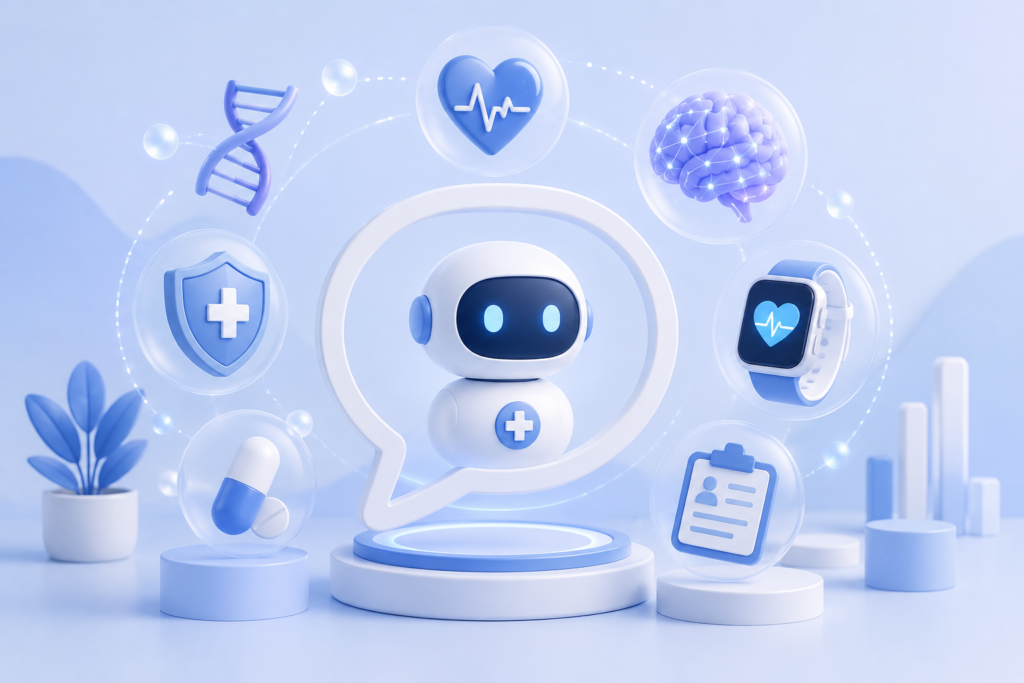
The next generation of healthcare chatbots is likely to become more deeply integrated with digital healthcare ecosystems. Instead of functioning as isolated website widgets, conversational systems may increasingly connect with knowledge platforms, scheduling tools, patient portals, contact centers, and other approved systems. This could create more seamless patient journeys, where users can move from information discovery to an appropriate administrative action without navigating multiple disconnected interfaces. However, deeper integration will also increase the importance of authentication, authorization, monitoring, and careful governance.
Generative AI is another major development. Modern language models can understand more natural phrasing and generate conversational responses rather than relying entirely on rigid decision trees. This can make interactions feel more intuitive, but it also introduces additional reliability considerations. In healthcare, natural language fluency should never be confused with clinical accuracy. Organizations will need stronger retrieval controls, source grounding, evaluation frameworks, human oversight, and clear limitations as conversational systems become more capable.
Another important trend is multichannel healthcare communication. Patients may expect consistent support across websites, portals, mobile applications, and messaging environments. Organizations can benefit from maintaining a consistent knowledge source so that information does not become contradictory across channels. The challenge will be ensuring that each channel has appropriate security and functionality rather than simply duplicating the same chatbot everywhere.
Voice-based interaction may also become more relevant, particularly for users who find typing difficult. Accessibility-focused conversational interfaces could help people navigate administrative information using speech. However, voice systems introduce additional considerations around recognition accuracy, privacy, environmental noise, and confirmation of important actions.
Finally, healthcare organizations are likely to place greater emphasis on responsible AI governance. As automated systems become more capable, organizations will need clear policies covering acceptable use, data handling, model evaluation, monitoring, human oversight, and incident response. The future of healthcare chatbots will therefore not be defined solely by better AI. It will be defined by the ability to combine advanced technology with professional responsibility and patient-centered design.
FAQs
1. What is a Healthcare Chatbot used for?
A Healthcare Chatbot can support many administrative and informational tasks, including answering frequently asked questions, helping visitors find departments, explaining appointment procedures, directing users to approved resources, supporting scheduling workflows, and providing contact information. Its exact capabilities depend on the organization’s technology and governance model.
A healthcare chatbot should not automatically be treated as a replacement for a doctor, nurse, therapist, pharmacist, or other qualified professional. High-risk questions should be handled through appropriate escalation processes.
2. Can a Healthcare Chatbot diagnose patients?
A general website chatbot should not be presented as a diagnostic authority. Diagnosis involves professional assessment and may require clinical history, examination, testing, and other information that a basic conversational system cannot reliably provide.
If an organization develops a specialized clinical AI application, it needs a much more rigorous approach involving appropriate clinical validation, regulatory considerations, safety testing, professional oversight, and risk management. A public-facing administrative chatbot should maintain clear boundaries.
3. Can a Healthcare Chatbot help patients book appointments?
Yes. Appointment assistance is one of the most practical applications. A chatbot can explain appointment procedures, direct users to the correct department, provide scheduling instructions, and, where appropriately integrated, support approved scheduling workflows.
The system should confirm successful actions through the underlying scheduling platform rather than assuming that a request was completed.
4. How does a Healthcare Chatbot improve patient engagement?
A chatbot can make information easier to access by providing conversational navigation and immediate responses to routine questions. Patients may be able to find department information, appointment instructions, contact details, and approved educational resources without waiting for a staff member.
Better engagement comes from usefulness rather than constant interaction. The chatbot should help users accomplish their goals efficiently instead of encouraging unnecessary conversations.
5. Is a Healthcare Chatbot secure?
Security depends on how the chatbot is designed, hosted, integrated, configured, and maintained. Organizations should consider access control, authentication, encryption, data minimization, secure APIs, logging, monitoring, vendor risk, retention policies, and incident response.
Healthcare organizations should also determine which legal and regulatory requirements apply to their specific jurisdiction and operations before handling sensitive information through a chatbot.
6. Should a Healthcare Chatbot collect patient information?
Only when there is a legitimate and clearly defined reason to do so. Organizations should avoid collecting sensitive information simply because the chatbot has a field available.
A useful principle is to collect the minimum information necessary for the task and clearly communicate why it is required.
7. How much does a Healthcare Chatbot cost?
There is no single price because costs vary according to complexity. A basic FAQ chatbot may require substantially less investment than a system involving secure authentication, appointment integration, analytics, multiple channels, custom knowledge retrieval, advanced governance, or other specialized capabilities.
Organizations should evaluate total cost of ownership, including development, integrations, security, maintenance, content management, monitoring, and ongoing optimization.
8. How can healthcare organizations measure chatbot success?
Useful metrics include successful task completion, appointment-related conversions, information retrieval success, escalation rate, abandonment rate, user satisfaction, response accuracy, staff time saved, and recurring content gaps.
The most valuable measurement framework combines user outcomes, operational efficiency, safety, and accuracy rather than focusing only on the number of conversations.
Conclusion
A Healthcare Chatbot can become a valuable part of modern digital patient communication when it is designed around real user needs and responsible operational boundaries. It can help organizations manage routine questions, improve appointment navigation, make information easier to access, support administrative workflows, and reduce repetitive communication workloads. The greatest value comes from removing unnecessary friction while preserving human expertise for situations that require professional judgment.
The most important lesson is that healthcare chatbot implementation is not simply a technology project. It is a trust, content, security, accessibility, workflow, and patient-experience project. Organizations need accurate knowledge sources, clear governance, appropriate privacy controls, reliable integrations, strong human handoff processes, and continuous testing. They also need to communicate honestly about what automation can and cannot do.
For organizations ready to modernize healthcare communication, Engagerbot can be considered as part of a broader strategy for creating useful conversational experiences. The objective should not be to automate every interaction. It should be to create a dependable digital pathway that helps people find the right information and the right next step with less confusion.
When healthcare organizations combine thoughtful automation with professional oversight, transparent communication, strong security practices, and continuous improvement, conversational technology can support a more accessible and efficient digital patient experience without compromising the trust that healthcare depends upon.
Want to Implement This Easily?
AI Implementation Prompt
You are an expert consultant. Based on the blog post titled “(Healthcare Chatbot)”, provide a step-by-step, practical implementation guide. Include tools, best practices, common mistakes to avoid, and advanced tips. Assume the reader wants to implement everything discussed in this article effectively.
Call to Action: Want our help implementing this? Just reach out to us via our website contact form: contact form